
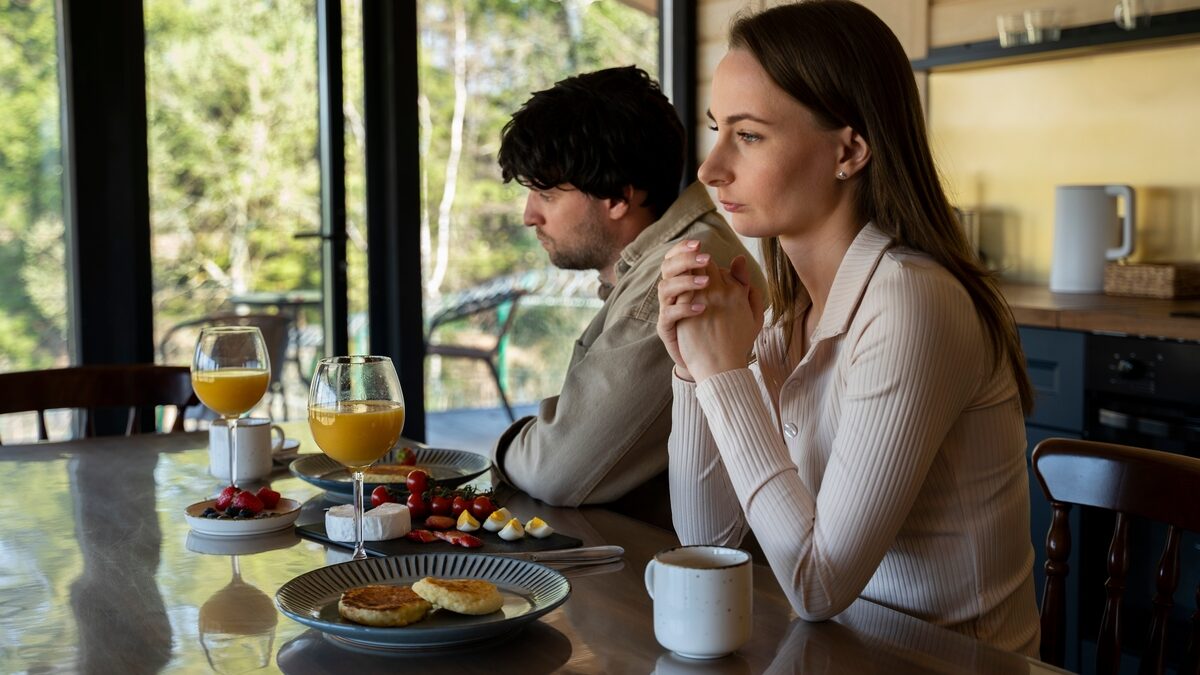
You want pasta. Your partner dreams of soup instead. And you have decided to succumb to your desires… separately. Except that this habit has taken hold. And since then, a question has been running through your head: when everyone eats what they want, is the meal still a moment of sharing? Or does this separation of plates risk (also) alienating you? Jeanne Siaud-Facchin, clinical psychologist and psychotherapist, enlightens you.
What if the problem isn’t what’s on the plate?
On paper, “food divorce” (i.e. having a “separate plate”, according to the New York Post) may seem unfriendly. Except that in reality, it responds above all to a very concrete need: to let everyone eat what they want (you swear by your sprouted seeds, and your husband by his minced steak). This is how some couples – tired of making multiple compromises – have chosen to make their lives easier.
“I never eat like my husband”confided therapist Alexandra Muller to her Instagram subscribers. And if the desire to each enjoy their own meal was imposed by different needs (sport, menstruation), “there is also, quite simply, (the fact) that we don’t like the same things”,
she continues.
Meals taken in “distinct pieces”
would even know “rapid growth“, according to the New York Post.
So would eating separately really be the solution to all our problems? Or yet another proof of egocentrism within the couple? Our psychologist sees no problem with it.
“I think above all that it is a question of moments. If everyone wants to please themselves, there is no point in imposing their dish on the other. The important thing is to maintain the good mood and share this moment together. Besides, when we go to a restaurant, we do not necessarily eat the same thing, but again, the main thing remains the pleasure of sharing a meal”, explains Jeanne Siaud-Facchin.
In other words, eating differently would ultimately be less important than what happens around the table: two separate plates do not prevent us from discussing and enjoying this precious time together.
“Sharing a moment together, yes it is important, on the other hand, what is on the plate is secondary. Besides, if food is not the object of the conflict, there is no particular reason for it to become a subject of discord”, continues the practitioner.
When does eating differently become a problem for the couple?
If the contents of the plate are secondary, it happens that the preparation and tasting of these two meals become sources of tension.
“If the atmosphere becomes confrontational, with phrases like “we all just have to eat in our own corner”, then, yes, it can become problematic,” specifies the specialist.
The risk appears especially when the two meals become two ways of distancing oneself. Because what matters is not having the same plate, but continuing to share a moment together.
The real subject: who takes care of the meals?
Behind the question of the menu there is often another reality: the entire organization of the meal. Thinking about the menu, checking what’s left in the fridge, shopping, cooking… This succession of small tasks can end up weighing heavily.
“The mental load represented by organizing meals for three or four people can, in fact, become heavy. In a family, on a daily basis, having to deal with the tastes and desires of each person can end up being a source of conflict and frustration,” warns Jeanne Siaud-Facchin.
For some couples and families, cooking separately makes life easier. Everyone manages their meal, according to their desires and schedules, without having to think about the needs of others. But that doesn’t mean that you also have to sit at a separate table: these moments of meeting are one of the little pleasures of life that it would be a shame to deprive yourself of…