
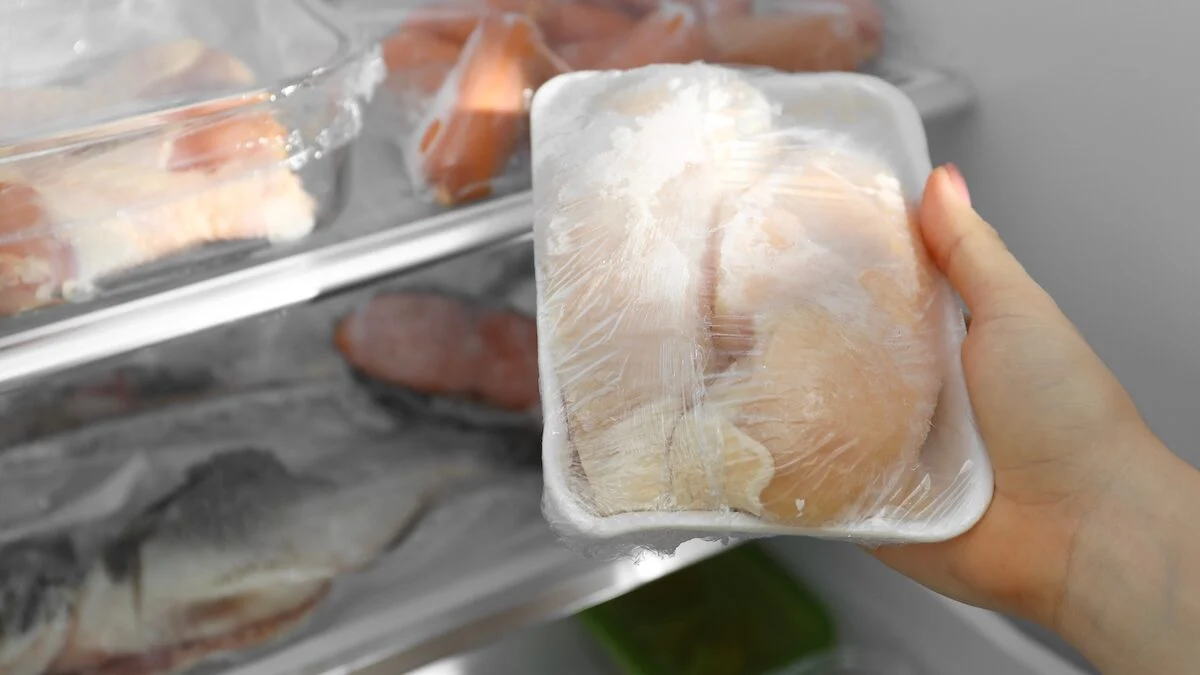
In front of the promotions aisle, many fill their baskets with steaks, prepared meals or “short-dated” yogurts, with a DLC that drops the next day or the same day. Once home, the same question comes up: to avoid waste, can we
freeze before expiry without danger, sometimes at the very last minute?
On Instagram, French virologist Dr Océane Sorel, known under the pseudonym @thefrenchvirologist, responded in a video taken up by Marmiton on September 17, 2025. For her, freezing food on the day of its expiration date remains possible, but “I don’t want to be a jerk, but it’s not ideal.”
Authorities such as the DGCCRF and ANSES encourage much earlier freezing.
Freeze just before the shelf life: the opinion of virologist Océane Sorel
In her video, Dr Océane Sorel summarizes the situation with a very telling image:
“Freezing is a bit like pressing the pause button on the remote control.” “It’s the same thing with food. As soon as you defrost it, the bacteria will multiply again”she explains.
In other words, freezing does not sterilize the food. Cold blocks or greatly slows down the multiplication of microorganisms, but most survive freezing. When defrosting, they can therefore start to multiply again.
This is why the time at which you freeze your food matters. The more time a product has spent in the refrigerator, the more time any bacteria that may be present have had time to grow.
Freezing it at the last moment therefore does not reset the counter.
The Ministry of Agriculture also gives a telling example: when a bacteria reproduces every 20 minutes, multiplication can lead to a population 1,024 times higher after a few hours under favorable conditions.
DLC: why the authorities recommend not waiting
Here we must distinguish two notions that are easily confused: the DLCfor “use by date”, and the DDMfor “minimum durability date”.
The DLC corresponds to the words “consume until”. It particularly concerns very perishable foods such as certain meats, fish, cold meats and fresh produce. This date constitutes a limit to be respected when the storage conditions indicated on the packaging have been respected.
The DDM corresponds to the words “preferably consumed before”. It concerns in particular dry products, certain canned goods or foodstuffs whose quality may decrease over time. An exceeded MAD therefore does not automatically mean that the food is dangerous, provided in particular that the packaging is intact and that the product has been correctly stored.
And for freezing, the official instructions are clear:
you have to anticipate it. The DGCCRF indicates that you should never freeze a product whose shelf life is close to, reached or exceeded. The administration recommends freezing foods immediately upon purchase or preparation rather than waiting until the end of their shelf life.
Anti-waste: can you freeze meat on its expiry date? (
This is where the nuance is important.
If you bought chops or a roast with a same-day shelf life, the temptation is to immediately place them in the freezer rather than throwing them away. This is precisely the situation mentioned by Océane Sorel, who believes that this can be done, while specifying that it is not the best practice from a health point of view.
But this position does not correspond to the current official recommendation. The Ministry of Agriculture specifies that
most microorganisms survive freezing and therefore recommends freezing food in advance, and not at the end of the shelf life.
In practice, it is therefore better to take the following reflex:
if you know that you will not eat fresh meat or fish quickly, freeze it as soon as you return from shoppingrather than waiting until the last day. This limits the time bacteria can multiply in the refrigerator.
What if the food has already been in the refrigerator for several days?
This is precisely the situation in which we must avoid considering the freezer as a “go back in time” machine.
A food which reaches the end of its shelf life is not returned to its initial state by freezing. Cold slows down microbial multiplication, but does not destroy the majority of microorganisms. When the food is thawed, those that survived can resume their development.
And beware of a preconceived idea: the smell or appearance does not always detect the presence of dangerous bacteria. Contaminated food may not show any obvious changes. You should therefore not rely solely on your senses to decide whether to freeze or consume an expiry date product.
How to freeze food correctly?
To limit the risks, a few reflexes are essential.
- Freeze as soon as possible. If a fresh product is not intended to be consumed quickly, it is better to place it in the freezer immediately upon purchase, while of course respecting the cold chain.
- Use a real freezer. The Ministry of Agriculture recommends a temperature of -18°C for storing frozen foods. However, not all compartments are capable of freezing food: a freezer does not have the same performance as a four-star freezer, which allows the core temperature to be quickly lowered.
- Protect and date foods. Place them in freezer-safe packaging and write down the date so you know how long they have been stored.
- Do not defrost on the counter. Defrosting must be done in the refrigerator or, when provided, directly by cooking. At room temperature, bacteria can multiply more quickly.
- Never refreeze a product that has already been thawed. Further freezing does not destroy bacteria that may have multiplied during defrosting. On the contrary, the different transitions between cold and higher temperatures can encourage their proliferation.
A simple rule to avoid unpleasant surprises
Did you buy meat on Monday and you know you won’t eat it for several days? Don’t wait until Thursday evening to think about the freezer. The best reflex is to freeze it quickly, respecting the cold chain.
If, on the other hand, the product has already reached its expiry date or is very close to it, the official recommendations advise not to freeze it. And once the shelf life has passed, you should not rely on freezing to prolong your food safety: a shelf life is a consumption limit, not a simple indication of quality.
The freezer therefore remains a formidable ally against waste… provided you use it beforehand, and not as a “pause” button pressed at the very last moment.