
The six French soldiers who were hit by a drone strike in the Erbil region of Iraqi Kurdistan were urgently repatriated this Saturday, March 14. But while their transfer has already been organized, what is really awaiting these patients? A former military doctor explains the process to us of this express repatriation.
Three soldiers were seriously injured
According to TF1-LCI, these soldiers were injured while they were inside “camp Black Tiger”, a base located southwest of Erbil, the capital of Iraqi Kurdistan. A lightning and devastating attack, which killed chief warrant officer Arnaud Frion and seriously injured three soldiers, according to France Télévisions. The others seem to have been more lightly affected. But all were evacuated to France. In detail, the soldiers were transported to Villacoublay airport (Yvelines) aboard a specially equipped A400M plane, making it possible to provide first aid during the flight.
“The injured person, as soon as he enters the plane, is as well secured as if he were in a mainland structure. There are personnel, if they are seriously injured, who are placed in an artificial coma under anesthesia. But there are also what we call lightly injured. For them, psychological care takes place at that time”specifies Dr Patrick Clervoy, military doctor and author of Man at War (Ed. Odile Jacob).
A strategy confirmed by Dr Xavier Ballongue, former doctor colonel.
Repatriation of French soldiers: the process explained step by step
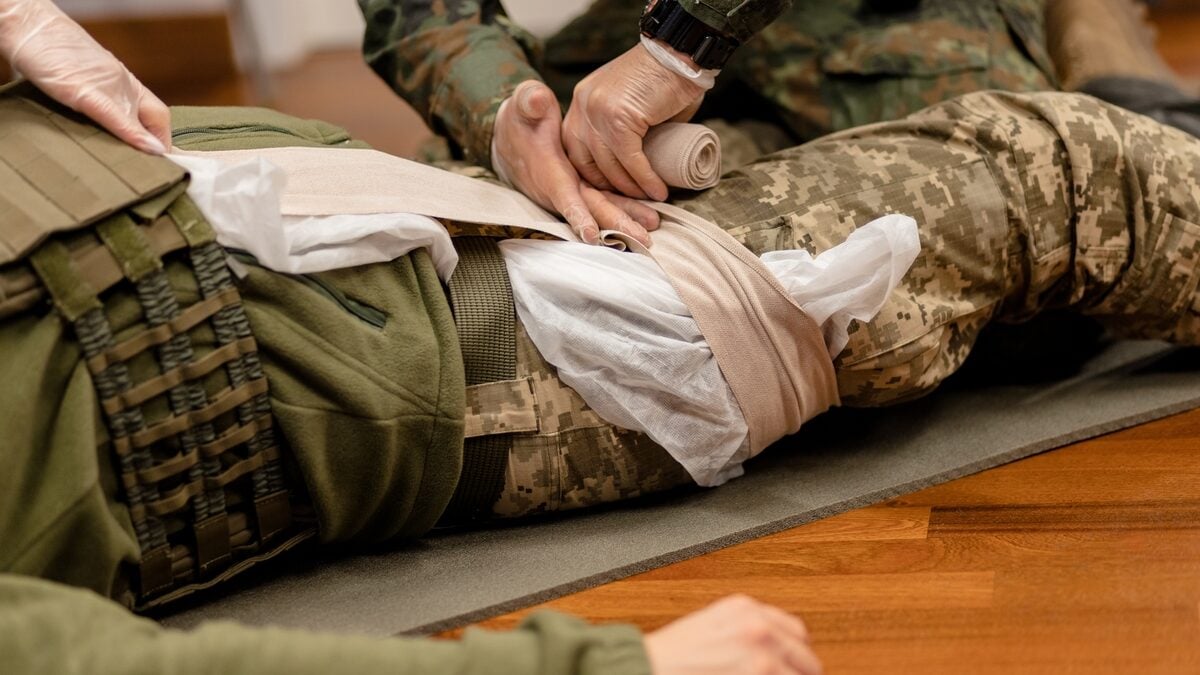
“The French army’s strategy is to be as close as possible to the soldiers and to treat them as quickly as possible. When soldiers go on a mission, there is always a nurse or medical assistant close to them, capable of carrying out the first aid actions: dressings, morphine injections, application of tourniquets, sometimes thrombolysis… This saves quite a few lives. And often, behind, the medical team arrives to continue the treatment. This organization dates back to Dominique Larrey, pioneer of military emergency medicine“, recognizes the doctor colonel, who
has participated several field missions in sensitive areas (Side
ivory, Guyana, Kosovo…).
The injured are then repatriated by medical teams, by helicopter or by medical VAB (a reinforced vehicle, protected against gunfire) to an aid station or a surgical unit. Then the doctor takes over and the injured person is finally transferred to a hospital.
“The soldier is sometimes operated on on site. But he is always repatriated by the air force to military hospitals in France, often in Marseille or Paris: Percy, Val-de-Grâce, Laveran, Sainte-Anne…”, explains Dr Xavier Ballongue.
In the case of the six injured French soldiers, all were treated at the Percy military hospital, near Paris.
“The Percy military hospital, in Clamart, is indeed very renowned: there is even a “trauma center”, dedicated to traumatized patients, victims of serious accidents. All emergencies – whether neurological, visceral, orthopedic, etc. – can be taken care of there. The teams on site can recover and treat almost any injured person”,
underlines the former military doctor.
A system which therefore seems to have proven itself… and which offers effective care to our injured soldiers.
“This care makes all the difference, because in the United States teams often take the injured person directly to the hospital without treating them on site. An approach that raises questions, because it can waste precious time,” concludes Dr Xavier Ballongue.
Note that in the Mediterranean, near Cyprus, a huge French hospital ship also welcomes our wounded soldiers. Visceral and orthopedic surgery teams are present there and operate directly on board. A new demonstration of the medical know-how of the French armies.