
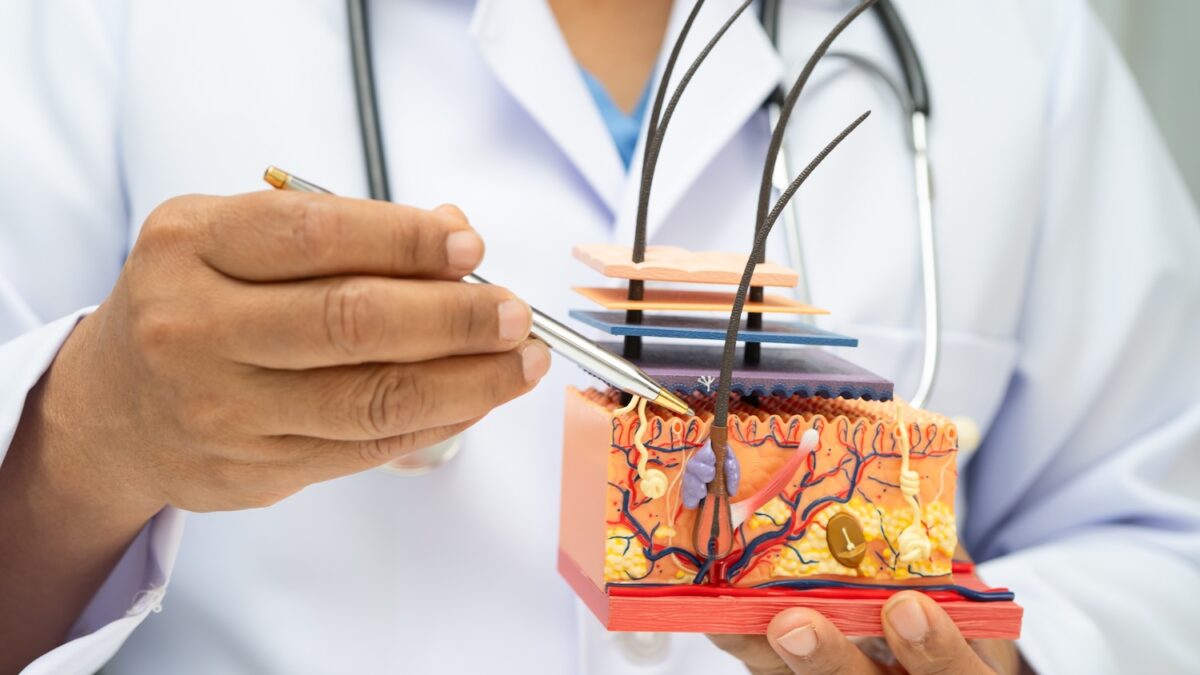
Behind this technological feat, a very concrete hope: to limit the surgical interventions, pain and long hospitalizations faced by people suffering from extensive burns. But before transforming patient care, this skin will still have to go through several decisive stages.
For serious burn victims, one less operation could change a lot of things
A serious burn is more than just an injury to the skin. When the lesions are deep and extensive, they disrupt the essential functions of this organ: protecting the body against external attacks, preventing water loss and providing a barrier against infections. For patients, the care journey is often particularly trying. Surgical interventions follow one another, the pain accumulates and hospitalization can last for several weeks or even longer.
Today, when skin tissue is deeply destroyed, doctors resort to autografts. The principle consists of taking healthy skin from part of the patient’s body to cover the burned areas. A technique which remains a reference in many situations, but which has a significant limitation: it requires creating a second wound, also painful and which must heal.
In people who have a large part of their body burned, the difficulty is even greater. Reserves of healthy skin may be insufficient to immediately cover all lesions. The medical teams must then organize the samples and transplants in several stages.
It is precisely this difficulty that the GENESIS project wishes to address. His ambition: manufacture living artificial skin in advance, available when the surgeon needs it, without having to take skin from the patient.
A prospect which, if confirmed, could considerably lighten the care pathway for certain burn victims.
Skin made in a laboratory, but which remains alive after freezing
On November 20, 2026, the URGO group announced that it had reached a major milestone after five years of research. With its partners, the company claims to have succeeded in producing living artificial skin, designed to be grafted onto a patient. This innovation is based on three complementary technological advances.
The first concerns cells. URGO indicates that it now has its own bank of pharmaceutical grade cells, intended to provide the biological elements necessary for the manufacture of this skin. The company thus claims the possibility of producing living cells in large quantities, without depending on skin samples taken directly from each patient.
The second feat concerns the organization of these cells. It’s not just a matter of depositing cells on a wound. Researchers are seeking to reconstruct a true three-dimensional skin architecture, by assembling cells in a precise order. The goal is to obtain tissue that is sufficiently organized and strong to be able to be handled by a surgeon and grafted.
Finally, third advance, this skin could be preserved by cryopreservation. Concretely, it would be manufactured in advance, frozen at very low temperature, then stored until use. According to information provided by URGO, the envisaged temperature could reach -150°C.
The product could then be transported to a hospital facility, thawed before the procedure and used while retaining living and functional cells.
This is an essential point. Today, the manufacture of living tissues intended for transplantation also poses a problem of conservation and availability. Being able to have skin produced in advance and ready for use would therefore represent a significant logistical change for hospital teams.
GENESIS: five years of French research behind this first announcement
This advance is the result of collective work bringing together public research and private industry. Launched in 2021, the GENESIS program brings together several partners around URGO: the Center for the Study of Stem Cells (CECS), the French Blood Establishment (EFS), the CNRS, the University of Lyon 1 and Dassault Systèmes.
Each brings particular expertise, from the control of living cells to tissue repair, including production processes and digital modeling.
The project also benefited from public financial support of 22.8 million euros during its launch, as part of the Future Investment Program, operated by Bpifrance.
For Guirec Le Lous, president of the URGO group, this achievement marks the culmination of a scientific challenge begun five years earlier.
“Five years ago, we set ourselves a crazy challenge: to recreate the skin. Today, our teams and partners have achieved this world first. Tomorrow, there is hope for patients with severe wounds of less burdensome care and faster healing. This project perfectly illustrates our URGO mission to patients and caregivers.”he declares in the company press release of November 20, 2026.
The expression “world first” must, however, be placed in context. Skin substitutes already exist, particularly for certain serious burns. In the United States, the FDA authorized StrataGraft in 2021, a living cell product intended for certain partial deep thermal burns in adults. In France, the High Authority for Health has also evaluated dermal substitutes such as INTEGRA.
The particularity claimed by GENESIS lies in the combination of several characteristics: a living skin organized in three dimensions, produced in advance and preserved by freezing before use.
It now remains to be verified that this technical feat will translate into real benefit for patients.
First patients in 2030: why we will still have to wait
This is undoubtedly the most important point for those affected and their loved ones: this artificial skin is not yet a treatment available in hospital. At this stage, the information made public by URGO concerns a technological achievement in the laboratory. No human clinical trial results are communicated for this product: neither number of patients, nor success rate, nor duration of follow-up, nor data on the quality of healing.
However, between the production of living tissue and its successful transplant into a patient, several questions still need to be answered.
Researchers will have to verify in particular that the skin retains its properties after freezing and thawing, that it is correctly tolerated by the body and that it allows lasting healing. It will also be necessary to assess the risks of infection, the quality of the scars and, above all, determine to what extent it could really reduce the use of autografts.
The question of biological compatibility will also be decisive. The fact that the cells are presented as usable to produce skin intended for different patients is not sufficient, in itself, to demonstrate the absence of rejection or immune reaction.
URGO announces a first clinical study with patients from 2030. The company plans to commercialize it by 2040, subject to the results of the trials and the necessary authorizations. The timetable therefore remains ambitious. And we should not confuse an announced scientific advance with a treatment whose effectiveness and safety have already been demonstrated.
For burn victims and their families, GENESIS nevertheless represents a particularly encouraging avenue of research. Because behind artificial skin, there is a promise that goes beyond mere technological prowess: that of being able, tomorrow, to repair serious injuries by imposing fewer additional ordeals on already deeply bruised bodies.