
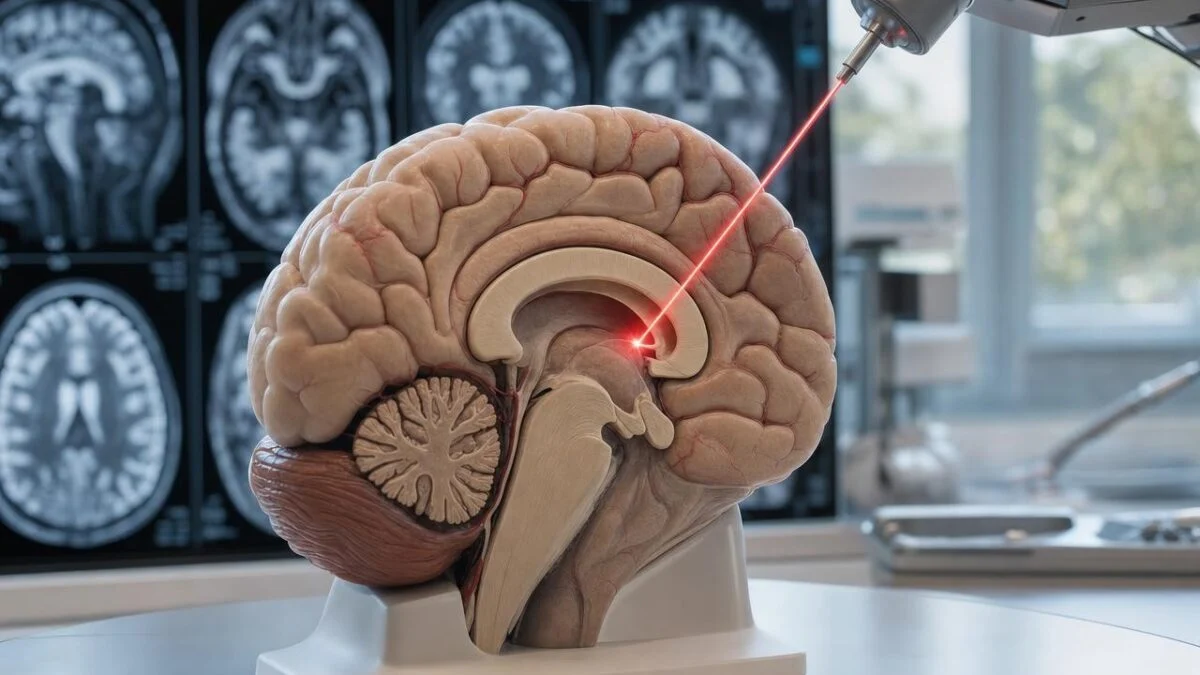
Rather than opening the skull widely, this technique makes it possible to reach certain tumors using a fine laser probe guided by MRI. The results provide new insights into which patients are likely to benefit.
When a glioblastoma is announced, the question is also that of time. Time saved from illness, but also time spent with loved ones and the possibility of preserving daily life as much as possible.
For several years, a minimally invasive technique has been attempting to push back this frontier: Laser Interstitial Thermal Therapy (LITT)or interstitial laser therapy. An analysis of 787 patients now provides valuable information on its effectiveness and use.
An intervention that avoids widely opening the skull
The principle is as impressive as it is precise. The neurosurgeon performs a tiny hole in the skullthen introduces a laser probe to the tumor. Its progression is monitored in real time using MRI, in order to limit damage to healthy tissue as much as possible. Once positioned, the probe delivers heat which destroys tumor cells around its tip. The NeuroBlate system used in the registry was authorized by the U.S. Food and Drug Administration in 2009.
The interest for patients is particularly linked to recovery. In the LAANTERN register, conducted in 25 American centersthe median length of hospitalization was
32.4 hours. Next to 62.6% of patients did not need resuscitation. The rate of adverse events linked to the intervention reached 12.8%while operative mortality was
0.25%. The majority of complications were transient. Researchers also report an overall stable quality of life for up to three years.
The challenge is therefore not only to live longer. It is also to preserve, as much as possible, life during this extra time.
Glioblastoma: the more the tumor is destroyed, the greater survival seems
One of the most striking findings concerns patients with newly diagnosed glioblastoma. When the procedure made it possible to destroy at least 91% of tumor volumemedian survival reached 2.1 years from diagnosis. In patients whose ablation was below this threshold, it was only 0.36 yearsor approximately four months.
These figures obviously do not mean that LITT guarantees two-year survival or that it can cure glioblastoma. They show an association between extent of ablation and survival.
The median survival usually reported with standard open surgery is around one and a half years in this setting. These data could therefore contribute to considering LITT earlier in certain carefully selected patients.
“Our goal is to both extend the survival of our patients with brain tumors and improve their quality of life. This analysis identifies the factors that lead to the best results. This essential new information will help us identify opportunities for patients to get the most benefit from this therapy.”explains Eric C. Leuthardt, neurosurgeon at Washington University School of Medicine and lead author of the study.
Brain metastases: intervene before the tumor grows
The study also provides important elements concerning the
brain metastasesthese cancers originating from another organ which have spread to the brain. After initial radiation therapy, doctors can sometimes monitor a small lesion and wait to confirm its progression before intervening. The LAANTERN data invites us to reconsider this strategy in certain situations.
The researchers observed that LITT seemed particularly interesting when the metastases were still small in size. For lesions less than 7.9 cm³or approximately 2.5 cm depending on their shape, patients whose tumor had been completely destroyed had a median survival of 2.8 yearsagainst 1.3 years when the ablation was not complete.
The message is potentially important: in certain brain metastases, intervening while the lesion is still small could be preferable to waiting until it grows. But this does not mean that every metastasis must be treated with laser. Its location, its volume, the general condition of the patient, the original cancer and the treatments already received remain determining factors.
A promising advance, but not yet a miracle treatment
Enthusiasm must be measured. The LAANTERN study is an observational registry: it analyzes the results of patients treated with LITT, without direct randomized comparison with open surgery. Another limitation: The study was funded by Monteris Medical, which develops the NeuroBlate system used for the procedure. Several researchers also declare ties to industry.
These elements do not cancel the results, but invite them to be interpreted with caution. LITT appears above all as a technique allowing better selection of patients and clarification when to intervene and how much to treatrather than as a replacement for traditional surgery.
Eric Leuthardt summarizes the issue as follows:
“We are in the process of completely changing the framework of our management of brain tumors. When patients learn they have only months to live, having the opportunity to benefit from a low-risk procedure that allows them to return home to their families in little more than a day is profoundly important.”
For people facing glioblastoma or brain metastasis, the benefit of treatment is never measured solely in additional months. It is also measured in preserved autonomy and moments shared with loved ones. LITT does not yet change the prognosis of all brain cancers and does not constitute a cure. But this analysis of 787 patients provides a solid lead: For some patients, treating earlier and destroying more of the tumor could make a real difference.