
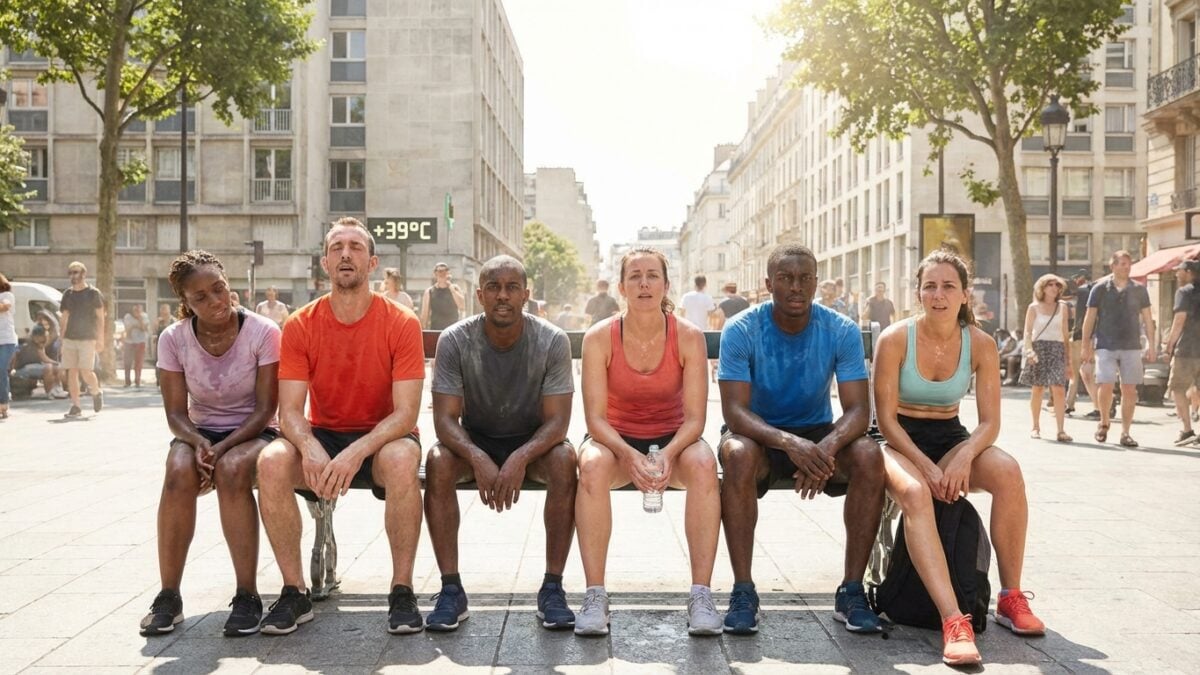
Going out for a run on a summer evening could become a real obstacle course as the thermometer rises. A new international study shows that global warming not only increases heat waves: it also risks making physical exercise significantly more difficult in many countries.
The researchers modeled the evolution ofphysical inactivity in 156 countries between 2000 and 2022, by linking it to monthly average temperatures. Their verdict is clear: from a certain heat threshold, sedentary lifestyle increases, which could, by 2050, result in hundreds of thousands of additional premature deaths. A horizon that calls out.
Global warming: a global study warns of a more sedentary future
Published in the journal The Lancet Global Healththe analysis conducted by Christian García-Witulski crosses health data and annual temperatures in 156 countries between 2000 and 2022. Each additional month with an average temperature above 27.8°C increases inactivity by around 1.5 percentage points worldwide, and by 1.85 points in low- and middle-income countries.
However, physical inactivity already represents a heavy burden: around a third of adults do not respect the recommendations of the World Health Organization in terms of weekly physical activity, and it is responsible for around 5% of deaths in adults. The authors estimate that, under the effect of climate change, this burden could increase by 470,000 to 700,000 premature deaths per year by 2050, for 2.40 to 3.68 billion dollars (2.18 to 3.35 billion euros) in productivity losses.
When the heat makes each effort more taxing on the body
The team describes a mechanism well known to doctors: under high heat, “heat increases skin blood flow and sweating, increasing cardiovascular load, risk of dehydration and perception of effort“, which makes brisk walking or running much more strenuous. This drop in activity then increases the risk of cardiovascular disease, type 2 diabetes, certain cancers and mental health disorders.
Projections show the largest increases in inactivity in Central America, the Caribbean, eastern sub-Saharan Africa and equatorial Southeast Asia, with more than 4 points added per month above 27.8°C. “It’s not just a story of climate, it’s also a story of inequalities. Places expected to see the largest increases in climate-related inactivity are often those with fewer resources to adapt“, explains Christian García-Witulski, quoted by The Guardian.
An observation highlighted in Science Media Center by Anna Cabré, climate physicist, oceanographer and research consultant at the University of Pennsylvania: “These results introduce a new dimension to climate justice, as populations least able to adapt are likely to disproportionately suffer the indirect consequences of heat. At the same time, the study opens up an essential avenue of research and action: how to design cities and urban environments that allow residents to remain physically active even in high heat, thanks to solutions such as shaded spaces, green infrastructure, adapted schedules and urban developments reducing thermal exposure?
Cooler cities and adapted activity to avoid these 500,000 additional deaths
To limit these approximately 500,000 additional deaths projected each year, researchers are calling for cooler cities: more trees and shade networks, reflective surfaces, fountains, but also financially accessible air-conditioned sports equipment. They also call for explicitly integrating the heat risk into prevention messages on physical activity.
However, the researchers point out that these forecasts are based on models, using self-reported activity surveys, and focus only on temperature fluctuations. Therefore, there remains significant uncertainty regarding the precise actual effects.