
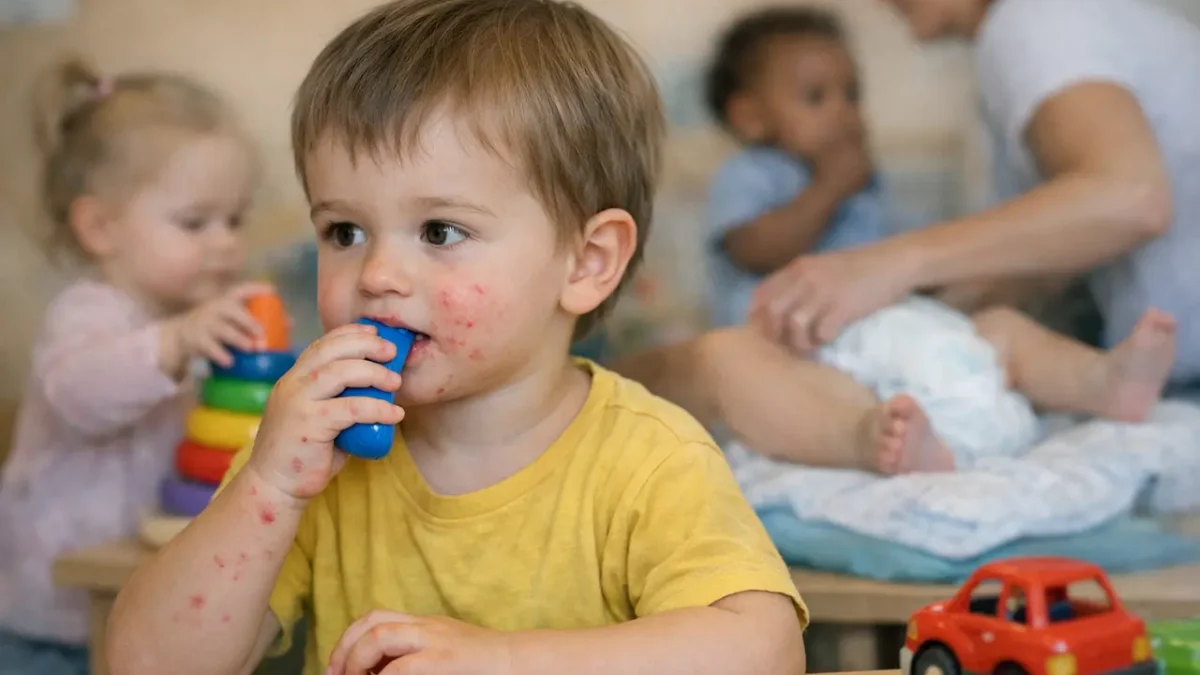
On Instagram, Dr Sermed Mezher, British general practitioner and influencer, reminds us that hand, foot and mouth syndrome is not just a story of visible pimples. In daycare, it can spread very quickly because the child is sometimes contagious before the rash, through contact with hands, toys, secretions and everyday surfaces.
Why the nursery is a transmission accelerator
Hand, foot and mouth disease is a common viral infection in young children. It is caused by enteroviruses, including certain Coxsackie viruses. The doctor emphasizes a useful point for understanding contagion: despite its name, the infection does not only affect the hands, feet and mouth. The child may also be feverish, tired, “woozy”, before the typical lesions really attract attention.
In the community, this infection finds an ideal environment. Toddlers share the same spaces, handle the same toys, often put their hands or objects in their mouth and need help with meals, blowing their noses or changing clothes. However, the virus can circulate via saliva, respiratory secretions, stools, soiled hands and surfaces.
Concretely, a child can touch a contaminated toy, then put his fingers to his mouth, nose or eyes. An adult can also carry the virus from one child to another through the hands if hygiene is insufficient after changing or before a meal. It is therefore not a single “bad gesture” that explains the spread, but the accumulation of close, repeated contacts, in an environment where children are still learning hygiene.
This is also why talking about a disease that “explodes” in daycare must be understood with caution: the available sources above all confirm a facilitated community transmissionnot a quantified current outbreak. To find out more about the symptoms and progress, our file on hand-foot-mouth syndrome in children details the most common signs.
Why pimples often arrive too late to warn
The main trap is temporal: contagion can begin before the spots are visible. Health Insurance indicates that a child can be contagious two days before the rash, then be particularly contagious during the first week of illness. The virus can also remain present in the stools for several weeks, which explains the importance of precautions when changing diapers.
Dr. Mezher also makes a very concrete observation: in real life, the child may first have a fever and feel unwell for a few days, then have a rash that lasts about seven to ten days. This chronology matches French medical descriptions: before the lesions in the mouth, on the hands or feet, the child may simply seem feverish, less in shape, have a sore throat, eat less or have rhinitis.
In other words, waiting for pimples to suspect the disease is not always enough to slow down circulation. This does not mean that we must systematically exclude all children at the slightest symptom: the Health Insurance guide for communities does not recommend systematic exclusion for this disease. Return or reception decisions depend on the instructions of the structure and the general condition of the child.
The most useful measures in daycare remain simple, but they must be repeated rigorously:
- Wash your hands after each change, before meals and after blowing your nose;
- Clean toys, tables, handles and surfaces regularly affected by children;
- Limit the sharing of objects put in the mouth when a case is identified;
- Remain attentive to a child who is very embarrassed, feverish or at risk, without replacing the advice of a health professional.
In the majority of cases, the illness is mild in children, although it can be uncomfortable. The challenge in daycare is therefore less to dramatize than to understand what makes it so contagious: symptoms that are sometimes discreet at first, early transmission and an environment of constant contact. If in doubt about a rash, our article on infectious pimples in children can help to better identify the signs to look out for.