

Difficulties in obtaining an appointment, high out-of-pocket costs, drug shortages: the survey paints a picture of a system under pressure, where the most vulnerable pay the highest price.
Better informed, but still lost: these rights which remain theoretical
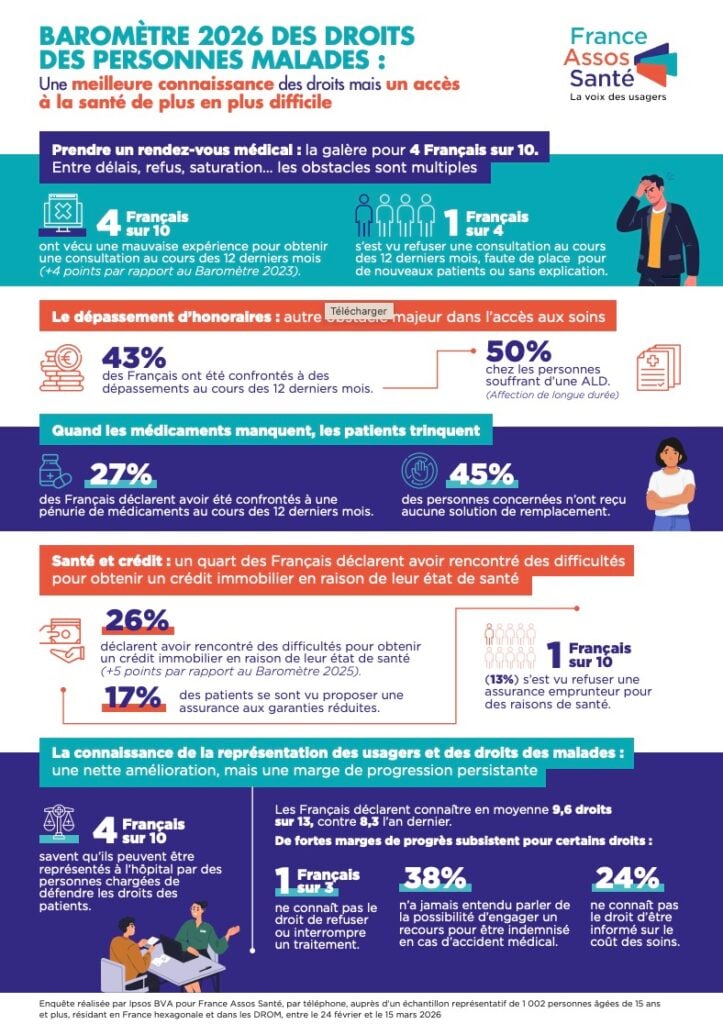
On paper, patient rights are progressing. The French say they know on average 9.6 out of the 13 tested, compared to 8.3 the previous year. The right to respect, to the free choice of one’s doctor, to access to care or even to the designation of a trusted person are now part of a widely identified base.
But this progression masks persistent gray areas.
- A third of respondents are still unaware that it is possible to refuse or interrupt treatment. Even more worrying, 38% have never heard of the right to recourse in the event of a medical accident. As for information on the cost of care, almost a quarter of French people say they do not know it — or do not know it well;
- Another blind spot: user representation. If 39% of French people now know that they can be accompanied by representatives in health establishments, 61% remain unaware of their existence.
Thus, despite better dissemination of rights, their appropriation remains incomplete. As if knowledge were not enough to make these rights truly effective. The transition to reality on the ground is brutal.
4 out of 10 French people struggle to get a medical appointment
Because once confronted with the healthcare system, patients encounter a much harsher reality.
Certainly, 91% of them say they are satisfied with their relationship with healthcare professionals. But you still have to manage to consult them. And that’s where the problem lies: 4 out of 10 French people say they have had difficulty obtaining a medical appointment in the last twelve months.
The obstacles pile up. Nearly a third (30%) mention waiting times that are too long. A quarter (25%) report refusals of consultation, sometimes due to lack of space for new patients. Added to this, for some, is the impossibility of even finding a doctor or specialist practicing in sector 1.
What was once isolated situations becomes a shared experience. A form of insidious renunciation sets in, fueled by the fatigue of the procedures, repeated refusals, and the feeling of being left behind from care.
And when access is finally possible, another reality arises: that of cost.
When treating yourself becomes a trade-off
THE fee overruns now affect 43% of French people. A proportion which says a lot about the evolution of the system. If the wealthiest households use it more, the poorest are forced to give up — sometimes without even trying.
In patients with long-term illness (ALD), the situation is even more marked: one in two is faced with these excesses.
And the consequences are concrete. In 47% of cases, they lead to budgetary decisions: spacing out consultations, delaying care, or even giving it up completely. Health then becomes an adjustment variable.
Added to these financial difficulties is another source of anxiety: drug shortages. More than a quarter of French people (27%) have been confronted with it over the past year. Among ALD patients, this figure rises to 43%. And in almost one in two cases (45%), no therapeutic alternative was offered.
Anticancer drugs, cardiovascular treatments, antibiotics, psychotropic drugs… supply tensions concern essential medicines.
Finally, the repercussions of the state of health now extend beyond the medical field. Obtain a home loan
also becomes a journey strewn with pitfalls: 26% of French people say they have encountered difficulties due to their state of health, a proportion which reaches 38% among ALD patients.
A widening health divide
Throughout the pages of the barometer, a constant emerges: it is always the same people who find themselves on the front line. Patients with long-term illnesses, people with modest incomes, the most vulnerable populations or those far from the healthcare system. For them, the obstacles do not just add up — they accumulate, reinforce each other, and end up creating a real health divide.
In this context, patients’ rights appear to be a promise that is still unfulfilled. Known, sometimes recognized, but too often inaccessible.
A simple but essential question then remains: what is a right worth if it cannot be exercised?
The response involves much more than the health system. It questions our collective capacity to guarantee, in concrete terms, equality in the face of illness.
 © France Assos Santé