
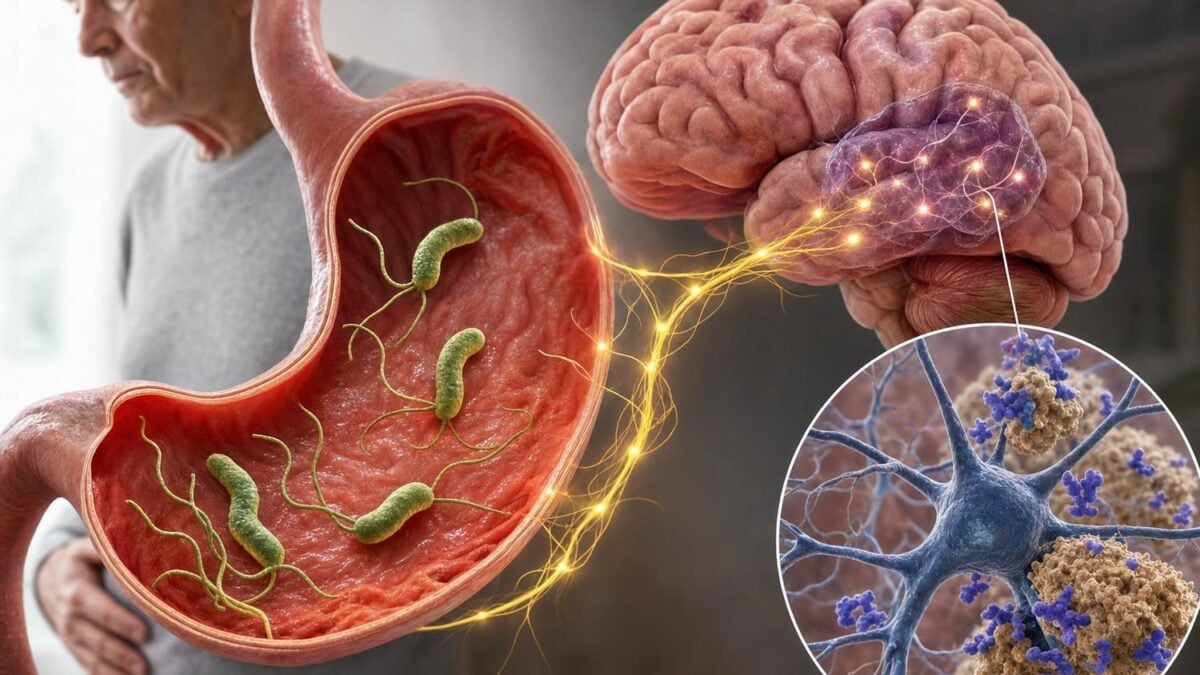
Worldwide, one person develops dementia every three seconds, and the Alzheimer’s disease represents 60 to 70% of these cases. Recent treatments mainly target
amyloid plaques which are deposited in the brain, with limited benefit and serious side effects.
However, a series of laboratory experiments has shaken up this picture by pointing to a stomach bacteria, although infamous, as a possible source of protection.
This bacteria, Helicobacter pyloriinfects approximately half of the world’s population and remains known to cause gastric ulcers and cancers. Researchers were interested in one of its weapons, the CagA proteinand more precisely to a fragment located at its N end, called
CagAN. By incubating this fragment with amyloid-β and the protein tauthey observed in the laboratory a virtual disappearance of toxic clusters, even at very low doses. Enough to open up a completely unexpected field of research.
Helicobacter pylori Alzheimer’s: a CagA protein that blocks toxic clusters
In Alzheimer’s, amyloid-β forms plaques on the outside of neurons while tau accumulates in tangles inside cells, eventually leading to their death.
This “amyloid hypothesis” has for years guided the development of monoclonal antibodies that eliminate amyloid-β, but only at early stages and without acting on tau. The need for broader targets therefore remains immense.
The fragment CagAN arrives here like a surprising puzzle piece. The researchers show that it prevents amyloid-β and tau proteins from sticking to each other, including the formation of the small initial clumps, which are the most toxic to neurons. Techniques such as nuclear magnetic resonance and computer modeling confirm this direct blockage.
CagAN also reduces bacterial amyloids and Escherichia coli and Pseudomonas biofilms, indicating that it attacks a very general aggregation mechanism.
Between increased risk and molecular protection: the Helicobacter pylori Alzheimer paradox
This possible “protective” side does not erase the other side. A large cohort of more than four million Britons aged over 50, analyzed by McGill University, indicates that clinical infection with Helicobacter pylori
increases the risk of developing Alzheimer’s by approximately 11%.
Other work links the bacteria to a higher risk of dementia. Chronic inflammation of the stomach, vitamin B12 or folate deficiencies and imbalance of intestinal microbiota are among the avenues explaining this excess risk.
The paradox therefore emerges: prolonged infection appears deleterious, while an isolated piece of CagA could inspire future drugs.
In the laboratory, CagAN also blocks the aggregation of IAPP, involved in type 2 diabetesand thealpha-synucleinat the heart of the Parkinson’s disease. These very different pathologies in fact share the same common thread, the accumulation of amyloid aggregates, which this bacterial fragment seems capable of disrupting on a broad spectrum.
Towards treatments inspired by the microbiota, not Helicobacter pylori infection
All these experiments remain confined to test tubes. No data yet exists in animals or humans, and the authors plan to test CagAN in animal models before considering the next step.
There is therefore absolutely no question of keeping an infection
Helicobacter pylori to “protect” your brain: this bacteria clearly remains to be treated when a doctor diagnoses it, given its digestive and possibly neurological risks.
The real interest lies elsewhere, in the idea of designing molecules inspired by CagAN which would retain its anti-amyloid effect without the harmful effects of the bacteria. This change of outlook joins a broader trend: see the
intestinal microbiota as a library of compounds to exploit. To better understand Alzheimer’s, Parkinson’s or diabetes, science is now looking as much towards the brain as towards the billions of microbes that live in our digestive tract.