
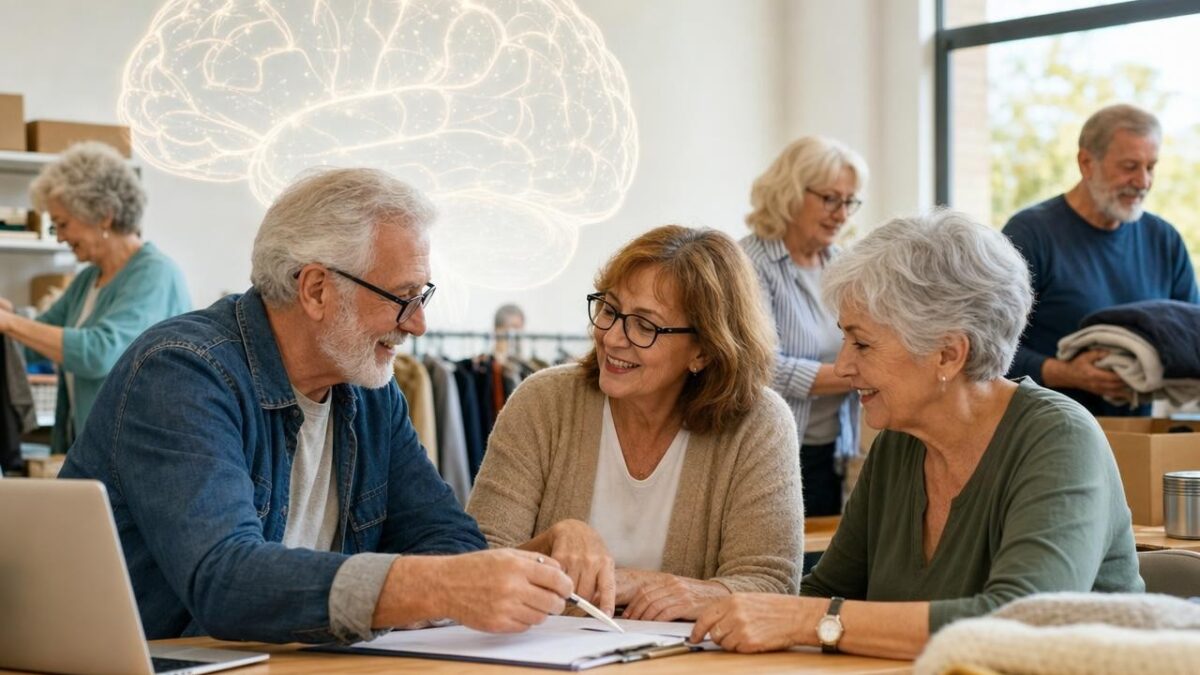
Large population surveys have long shown that strong social ties go hand in hand with better health and longer lives. Most work, however, mainly looks at what we receive: support, help, presence… A team of American researchers wondered whether the opposite effect, the fact of regularly helping those around you, was seen directly in the brains of middle-aged or advanced adults.
MIDUS study: helping others and a younger brain
To test this link, the researchers used data from the American project MIDUSwhich tracks the health of middle-aged and older adults. Participants indicated the number of hours spent on instrumental support (concrete, material or financial help) and emotional support. “While previous research has primarily focused on the benefits of receiving social support, the neuroprotective potential of providing social support to others remains largely unexplored.“, write Minwoo Lee and his colleagues.
The team then calculated, for each participant, a score
BrainAGEthe difference between brain age estimated from images ofStructural MRI and real age. “BrainAGE was estimated with a machine learning algorithm trained to predict chronological age from structural magnetic resonance imaging scans“, describe the authors. The lower or negative the BrainAGE, the younger the brain appears for a given age.
Helping more hours, lower BrainAGE score
The researchers then used statistical methods to study the relationship between BrainAGE values and participants’ level of helping others. They then observed that a greater number of hours spent helping predicted a lower BrainAGE. “This association persisted even after accounting for a full set of covariates, including demographic characteristics, health status, lifestyle factors, and broader psychosocial context, including received social support“, they write.
Another key point, “hourly measure of support provided explained additional variance in BrainAGE beyond indices based on social roles, such as caregiver or grandparent status“, note the authors. Additional analyzes suggest that the emotional support is more linked to low BrainAGE than practical/concrete help.
The researchers point out, however, that their study remains observational and cannot prove on its own that helping slows brain aging.
Prosocial behaviors and possible neuroprotection
For the authors, “Our findings highlight daily prosocial behavior as a potential neuroprotective pathway in middle- and older-aged individuals, with implications for interventions and policies for healthy aging“. Future studies will have to verify whether encouraging these gestures of mutual assistance can really modify the estimated brain age.
If these conclusions are validated by other studies, these results could potentially inspire the development of new policies encouraging prosocial behavior among adults, or the implementation of specific activities for seniors focused on mutual aid.