
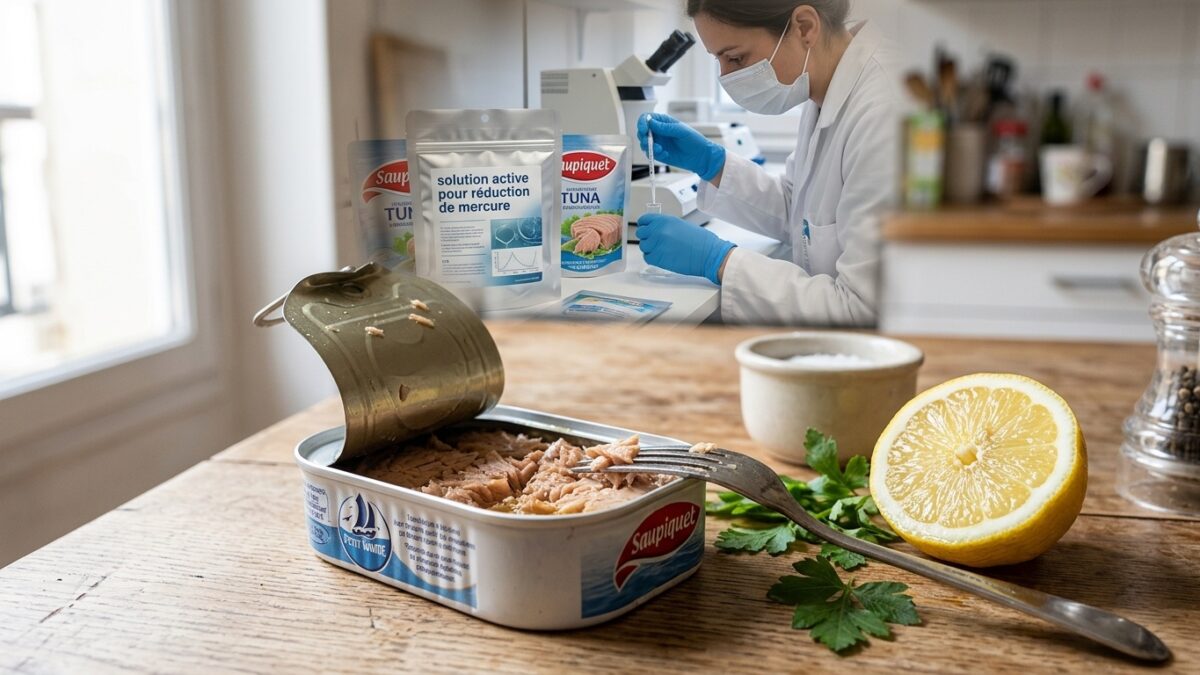
Open a can of tuna, squeeze a little lemon into it and convince yourself that you are “eliminating” some of the mercury: the reflex is widespread in France. However, this is not enough to rule it out.
In Europe, the regulatory limit for tuna is set at 1 mg of mercury per kilo. But NGOs like Bloom and Foodwatch are calling for it to be lowered to 0.3 mg/kg, after detecting mercury in 148 cans tested, with some showing levels up to four times higher than fresh tuna. Faced with this observation, a Swedish team is exploring an unexpected avenue: taking action on the packaging of this little fish.
Mercury in tuna: what the new study reveals
Mercury is classified by the World Health Organization as one of the substances of greatest concern for the nervous system, particularly in the fetus and young children. At the same time, fish remains a valuable source of protein and omega-3. The challenge here is therefore to reduce the risk of contamination without losing the benefits of this little fish.
Researchers from the Swedish University of Agricultural Sciences and Chalmers University of Technology tested an innovative approach. In a study published in the journal Global Challengesthey immersed canned tuna in a solution containing a single compound. Result: a reduction in mercury of 25 to 35% in the laboratory.
The effect is greatest when the tuna is chopped and remains in contact with the liquid for about two weeks. Good news: neither the smell nor the appearance of the product is altered. Enough to consider “active” packaging capable of reducing contamination during storage.
Cysteine, a sulfur-containing amino acid that binds to mercury
Lemon juice or a simple water rinse has little effect. For what ? Because mercury is bound to the heart of fish proteins.
The researchers focused on cysteine, a sulfur-containing amino acid that binds strongly to mercury. “We thought this would extract some of the mercury, which would then bind to the solution to be removed“, explains chemist Przemysław Strachowski, from Chalmers University of Technology. The process is slow: the mercury gradually migrates from the flesh into the preservation liquid.
The tested solution contains approximately 1.2% cysteine, operates at typical canned pH, and does not require additional additives. “The advantage of this type of packaging is that it remains active as long as the product is on the shelf.“, specifies the researcher. In other words, no need to modify the production stages.
Active packaging: what impact for the consumer?
Everything is not settled yet. “Further research is needed to manage the extracted mercury“, recognizes Przemysław Strachowski, the liquid becoming more loaded with contaminants.
Food specialist Mehdi Abdollahi sums up the issue: “Our study shows that there are other approaches than simply limiting consumption.“Objective: improve food safety while promoting products currently subject to restrictions.
Even with 25 to 35% less mercury, tuna will not become “mercury-free.” ANSES’s recommendations will therefore remain valid. But this additional margin of safety could weigh on the European debate on a possible lowering of the thresholds – without making canned tuna disappear from the shelves.