
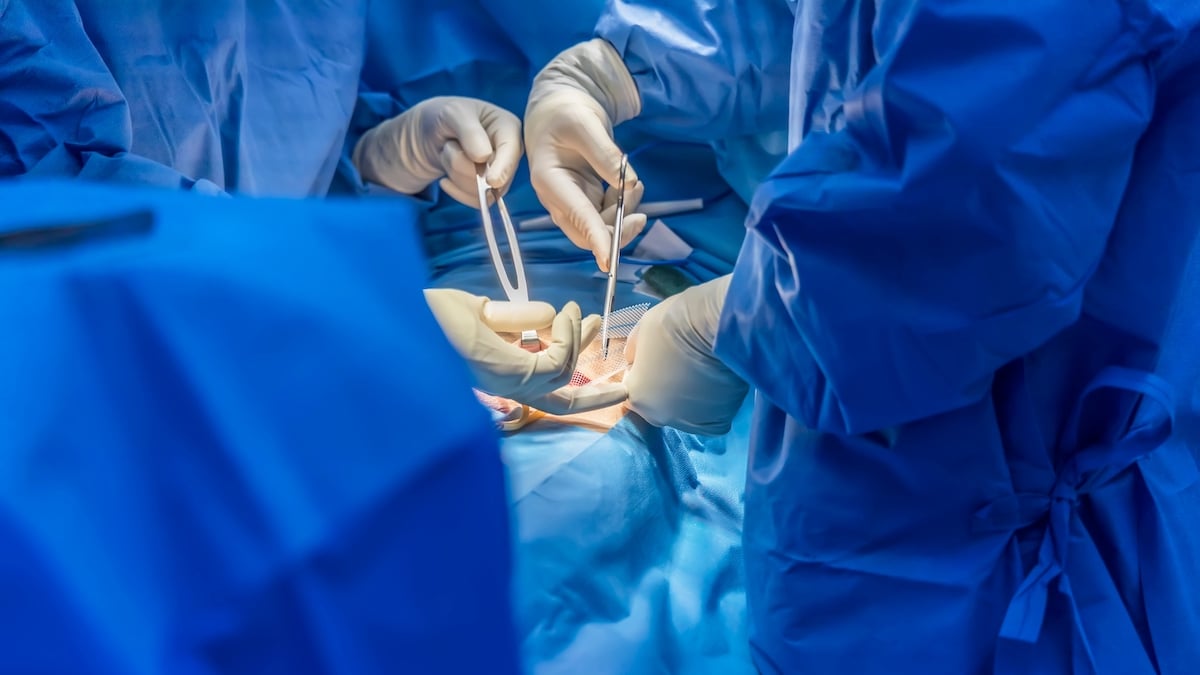
At the age of 42, actor and director Arnaud Denis announced that he had taken steps to resort to euthanasia in Belgium in 2026. A difficult decision, which he directly links to the persistent suffering he has endured since an operation that was considered routine: the installation of an implant for an inguinal hernia, carried out in July 2023. Since this intervention, his life has apparently turned upside down. “I no longer have a social life, I no longer have a life at all. I live like a terminal cancer patient”he confides today.
A banal operation… with dramatic consequences
Abdominal hernia is a common pathology, generally benign, which mainly affects the groin region. It manifests itself by an exit of part of the intestine through the abdominal wall.
To treat this pathology, surgeons resort, in the majority of cases, to the installation of a synthetic prosthesis. This is often made of polypropylene, in order to reinforce the weakened wall. The procedure is most often done by laparoscopy and is considered very safe. In France, around 500 operations of this type are carried out every day.
Rare but recognized chronic pain
Although the vast majority of patients recover without difficulty, a minority develops persistent pain. Since 2017, these implants have been classified as “high risk” devices. According to available data, 10 to 12% of patients still experience pain three to six months after the procedure.
But in the case of Arnaud Denis, complications appeared almost immediately after the operation: blackened testicle, blood in urine and stools, tinnitus, hearing loss, visual disturbances, severe insomnia… His condition deteriorated rapidly. In October 2023, he was hospitalized and had to interrupt his rehearsals. He then lost 17 kilos.
For Dr Aissat, visceral surgeon at the Turin Clinic and Pitié-Salpêtrière, previously consulted, this pain can have several origins:
“This disabling pain can be linked to the type of prosthesis, the location of the hernia, the surgical method chosen, the type of attachment used: glue, staples, wires… What must nevertheless be remembered is that it is a very safe intervention, these cases of chronic pain, beyond the post-operative period of two months, are at the margin“.
A patient without a solution?
The surgeon also emphasizes the importance of an accurate assessment. “First of all, it is essential to know if the pain described is linked to the surgical procedure and if it is not something else, hip pain caused by osteoarthritis for example. And if surgery is the cause of the pain, it is important to listen to the patient and try to relieve them with medication.”.
Due to a lack of a solution in France, Arnaud Denis went to the United States to have the incriminated prosthesis removed. The operation cost him 40,000 euros, with no significant improvement in his condition. Removing implants is indeed particularly delicate.
“This is difficult to do, because their installation generates fibrosis to close the hernia. This scar tissue, composed of collagen, is very strong”admits Dr. Aissat.
A controversial diagnosis
A diagnosis ends up being mentioned: myalgic encephalomyelitis relating to ASIA syndrome, a rare inflammatory disease which could be triggered by certain adjuvants contained in the implants. Among the symptoms described in the literature: diffuse pain, cognitive disorders and muscle weakness.
This hypothesis is however contested by the French Society of Parietal Surgery – Club Hernie, which asserts that it “There is, to date, no demonstration of the existence of an intolerance syndrome to prosthetic material involving the immune system in the medical literature.”
The manufacturer of the prosthesis, Medtronic, also maintains that the benefit-risk ratio of these devices remains positive and that compliance standards have been respected.
But patients who organize themselves
Faced with what they consider to be a lack of recognition of their suffering, several patients have banded together on social networks, notably within the collective “French victims of hernia prostheses”, initiated by Arnaud Denis himself.
The National Medicines Safety Agency (ANSM) announced last February the implementation of a “market surveillance action” on these implants, recognizing a probable under-reporting of adverse effects.
For his part, the actor announced his intention to file a complaint against X for “unintentional injuries”.
An assumed decision
Despite this, the suffering being too intense, the actor wants to put an end to it. Weakened, but determined, Arnaud Denis will travel to Belgium at the end of January for a preliminary interview as part of his request for euthanasia.
“I don’t want to end up in the hospital with tubes everywhere, with a stomach tube to feed me. A man knows deep down when he is doomed”he says.
End of life: a debate back on the table
This announcement illustrates the resumption of debates on the end of life in France. On pause due to political instability, it resumes this Wednesday, January 7 in committee in the Senate.
The executive wants the law to be adopted before the end of the second presidential five-year term, in 2027. “We will complete the legislative work on the question of the end of life with dignity, a subject on which I committed to you in 2022,” declared the head of state.
The text will be examined in the Senate from January 20, with a formal vote scheduled for January 28. The National Assembly should then resume debates in February.