
Around 1.4 billion adults live with
high blood pressureand the number of cases has jumped 115% since 1990. This high pressure on the arteries promotes heart attacks, strokes and kidney disease. A vast international synthesis shows that adding certain plant foods to your plate could reduce this risk.
Soy and legumes: allies against hypertension
Published in the newspaper BMJ Nutrition, Prevention & Healththe review led by English researchers brings together 12 cohort studies, or 309,853 adults followed over several years. She concludes that high consumption of
legumes (beans, lentils, chickpeas, peas) andsoy foods (tofu, edamame, miso, tempeh, soy milk) is associated with a 16% and 19% lower risk of hypertension between the extreme groups.
The researchers then calculated, for each 100 g consumed per day, the variation in risk. Each additional 100g daily serving of legumes is linked to an approximately 12% reduction in the risk of hypertension, and 100g of soy is linked to an approximately 24% reduction. By applying the criteria of the World Cancer Research Fund, the authors of the study judge these data “supporting a likely causal relationship between legume and soy consumption and reduced risk of hypertension“.
How to integrate them into everyday meals
For legumes, the observed relationship is almost linear, with an approximately 30% reduction in risk at 170 g per day. For soy, the majority of the benefit appears between 60 and 80 g daily, then the curve stabilizes. A simple guideline: 100g is about a cup or 5 to 6 tablespoons of cooked beans, chickpeas or lentils, or a palm-sized slab of tofu.
The study authors write:
“Current consumption of legumes in Europe and the UK remains below dietary recommendations, with average intakes of only 8 to 15 g/day, well below the 65 to 100 g/day recommended for overall cardiovascular health.“.
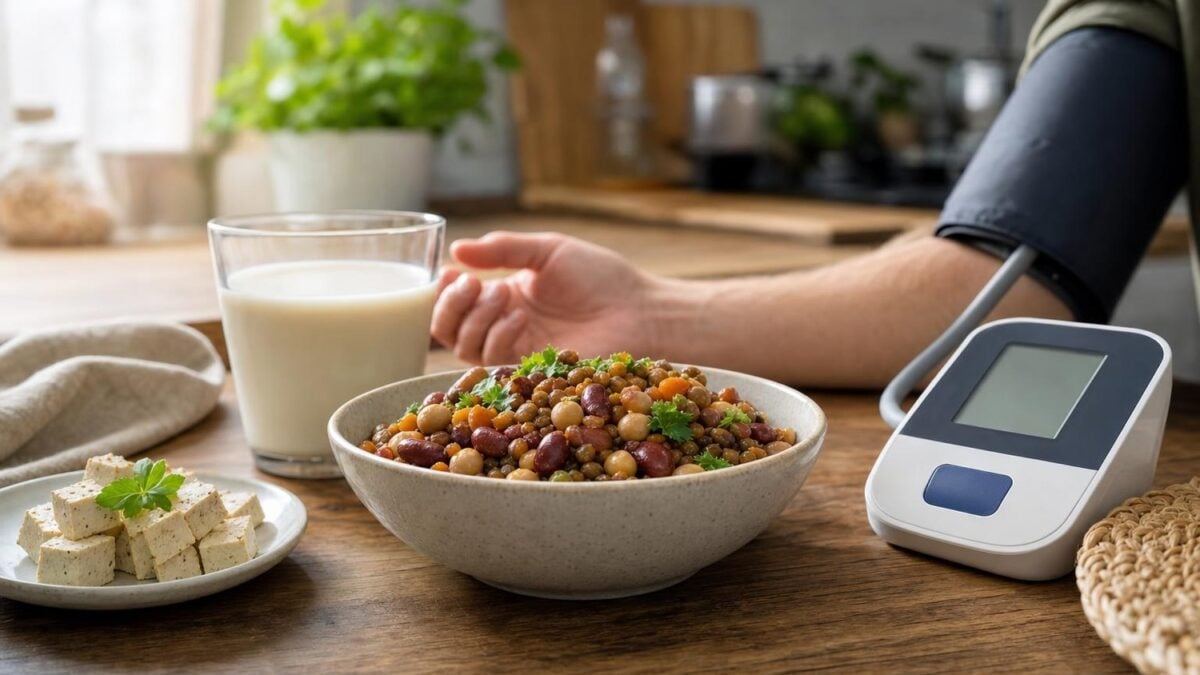
Achieving these quantities remains feasible on a daily basis: 170 g is, for example, a large portion of lentil salad or bean chili, and 60 to 80 g of soy corresponds to a small grilled tofu steak or a bowl of soy milk.
Promising results, but not magical
These foods provide potassium, magnesium and fiber, three elements associated with lower blood pressure. The fermentation of their fibers also produces short-chain fatty acids which promote vessel dilation, and soy isoflavones appear to have a direct effect on the arterial wall.
The authors summarize: “Despite these limitations, the results of this meta-analysis have major implications for public health, given the alarming increase in the prevalence of hypertension worldwide. Current consumption of legumes in Europe and the United Kingdom remains below nutritional recommendations, with average intakes of only 8 to 15 g/day, well below the recommendations of 65 to 100 g/day recommended for good cardiovascular health.” they emphasize.
Be careful, however, not to believe that eating more legumes and soy can replace the prescribed treatment, or the other key levers for blood pressure: physical activity, salt reduction, limiting alcohol and stopping smoking.