
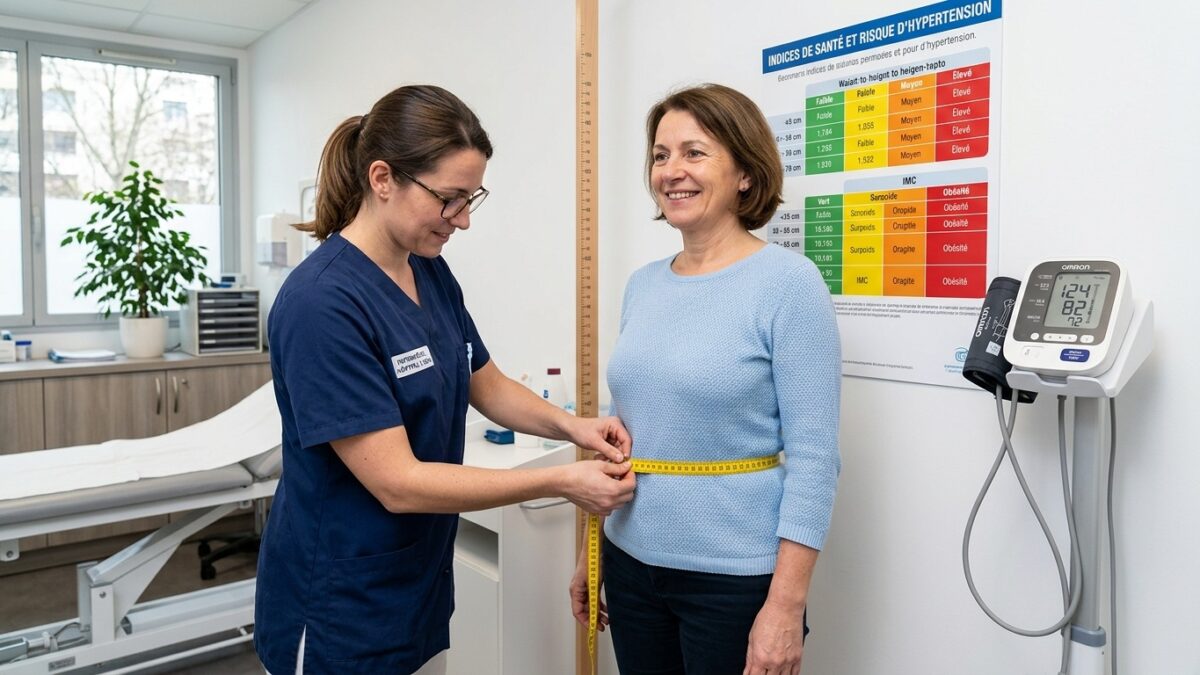
What if a simple seamstress meter said more than your scale about your blood pressure? For years, the body mass index (BMI) has been used to classify overweight and obesity. It relates weight to height, but does not know where fat is located in the body.
A team from the University of Eastern Finland and Robert Wood Johnson Medical School studied the waist/height ratio. In an analysis of data from 2015 to 2023 on 19,124 Americans aged 12 and over, this ratio would better predict the risk ofhypertension
than BMI.
Why waist-to-height ratio beats BMI for hypertension
Obesity corresponds to a lasting excess of fat. The body mass index remains the routine tool, but it does not separate fat mass and muscle mass. For Mahidere Ali, doctoral student at the University of Eastern Finland and lead author of the study, “BMI failed to detect the independent effect of adiposity, probably because it does not isolate the confounding influence of muscle mass, which may amplify its association with blood pressure at early stages while masking its relationship with established hypertension..
THE size/height ratio divide the waist measurement in centimeters by the height in centimeters. It reflects abdominal fat, which is very involved in cardiovascular diseases. The British organization NICE already recommends a threshold of 0.5. The authors used “normal fat” (0.40-<0.50), “high fat” (0.50-<0.53) and “excess fat” (≥0.53) thresholds, recently validated in certain countries to help prevent diabetes or fatty liver disease.
An online calculator is available online at: https://urfit-child.com/waist-height-calculator/
Large NHANES study links waist circumference, height and tension
To test these categories, the team used representative NHANES 2015-2023 data, i.e. 19,124 participants aged 12 and over. “High” blood pressure was defined as ≥120/70 mm Hg andhypertension by ≥140/90 mm Hg. In the 2021-2023 cycle, 7,243 people (mean age 44.8 years) had 63.5% high blood pressure and 14.4% hypertension, with analyzes taking into account the main risk factors.
Among adults, compared to the “normal fat” group, those in the “high fat” group had a 50% greater risk of high blood pressure and an 82% greater risk of hypertension. In the case of “excess fat”, these risks increased by 91% and 161%. The effect of adiposity on blood pressure peaked between ages 25 and 65. In those under 25, a high or excessive waist-to-height ratio increased the likelihood of high blood pressure by 66% and 98%, with hypertension remaining rare.
Decline in BMI and rise in waist/height ratio in screening
The researchers conducted the same analysis with the categories ofBMI. Overweight and obesity were well linked to high blood pressure, but not clearly to hypertension. Mahidere Ali concludes: “Having demonstrated consistent correlations regardless of ethnicity, age, and survey cycle, it can be safely concluded that body fat estimates based on waist-to-hip ratio are a more accurate and clinically relevant indicator of hypertension risk. Waist-to-hip ratio is a simple and adaptable tool that can strengthen early screening and improve detection of adiposity-related cardiovascular risk“.
Easy to measure, accessible to all and more precise in many cases, the size/height ratio could well emerge as a new ally in early detection. Without completely replacing the BMI, it above all reminds us of one essential thing: the location of the fat matters as much as its volume. And in this area, a simple seamstress’s tape measure could make all the difference.