
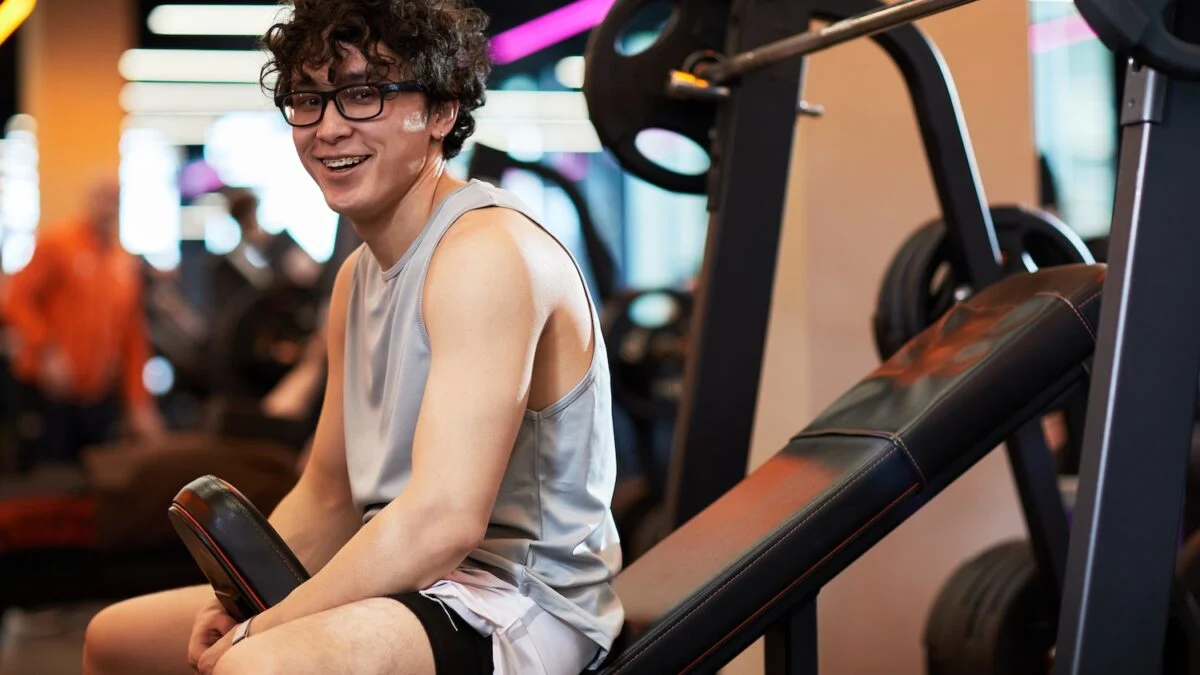
Long associated with adults, bodybuilding now appeals to college students. If physical activity is beneficial at all ages, the search for a sculpted physique, fueled by social networks and constant comparison, can lead some young people to adopt practices that are unsuitable for an organism that is still in full development.
“I want my friends to see me crazy“: when social networks reshape the ambitions of college students
Whatever the weather, in this Parisian street workout area, teenagers do pull-ups alongside adults. Like many, they train every weekend and even continue their exercises at home, sometimes morning and evening. Their goal is simple, almost naive: to become stronger, more muscular, more impressive.
“I want my friends to see me as a mess. Bodybuilding, we can always improve”confides Vadim, aged 13, to
Parisian. He feeds this passion by watching videos from specialized content creators and workouts broadcast on TikTok by athletes he admires.
More and more boys, but also girls, are replicating programs seen online: daily sets of push-ups, repeated pull-ups, challenges with friends or CrossFit sessions upon entering middle school. What begins as a desire to surpass oneself sometimes becomes a permanent quest for a body deemed more efficient, more aesthetic or more rewarding.
Because behind the screens, the models follow one another without respite. During adolescence, a period when self-image is particularly fragile, comparison becomes almost daily.
A body still under construction… but already subject to the demands of adults
Seeing a teenager playing sports is obviously nothing to worry about. Doctors even point out that physical activity is essential for the proper development of young people. What alerts them, on the other hand, is the intensity of certain training sessions and especially the early use of heavy loads.
Doctor Jean-Jacques Menuet, specialist in sports medicine, issues a blunt warning in The Parisian :
“As doctors, we are worried. It is common for parents who are a little lost to come to see us without their teenager, to ask for advice. What we tell them is clear: as long as the adult body shape is not reached, i.e. from the age of 18, we do not lift weights. Strength training too early can slow growth and disrupt the bones, muscles, tendons and joints that are still forming. It could be a disaster! Not to mention the psychological impact: this search for the mirror is not always healthy”.
The danger is not always spectacular. It can start with persistent pain, joint discomfort or unusual fatigue, before becoming lasting if training becomes too intensive.
And girls are not spared. In some CrossFit classes aimed at younger people, teenage girls as young as 14 are already handling 20 kg bars under the supervision of coaches, exposing themselves to sporting accidents.
When the quest for muscle also invades the plate… and the mirror
As the body becomes a project, food changes too. Some teenagers are already talking about “cutting down”, limiting sugar or fats to make their abs appear. Others consider creatine even before they reach the age of majority, convinced that it will allow them to progress more quickly.
For Guillaume Vallet, professor of economics and author of The Muscle Factorythis development reflects a deeper need than a simple sporting passion.
“Sport remains a healthy preoccupation, but it must not lead to withdrawal. At 14, you’re looking for yourself and your body seems to be the only thing you have control over.”he explains in The Parisian.
This permanent search for the “best physique” can gradually shift the pleasure of sport towards a logic of control, where each session, each meal and each look in the mirror become indicators of success. Experts also point out that social networks encourage constant comparisons and expose adolescents to body models that are often unrealistic, which can weaken their relationship with their image.
Worse, more dangerous products to “build muscle” are used such as anabolic steroids and certain doping supplements containing hidden substances. As Dr. Gérald Kierzek, emergency physician and medical director of True Medical, points out, “they can cause hypertension, heart attack, stroke, rhythm disorders, liver damage, infertility, mood disorders and dependence, sometimes with deaths reported in young athletes“.
And added: “In practice, any non-prescribed bodybuilding product, purchased outside the medical circuit, which promises very rapid muscle gains, “hormonal effects” or which contains (or may contain) steroids, pro-hormones or powerful stimulants must be considered high risk.“.
Encourage movement… without skipping steps
Should we therefore ban all forms of muscle strengthening among adolescents? The specialists don’t say that. They rather invite us to distinguish physical activity adapted to age – body weight exercises, supervised progression, sufficient recovery – from real bodybuilding inspired by adults, with significant loads and rapid search for muscle volume.
The signals that should alert you are known: daily training without rest, rapid increase in loads, obsession with the mirror or increasingly restrictive diet.
For parents, it is not always easy to find the right balance between encouraging a sporting passion and protecting a body that is still growing. But faced with this new fascination with muscles, fueled every day by social networks, doctors remind us that during adolescence, the priority remains less to show off abs than to build lasting health.