
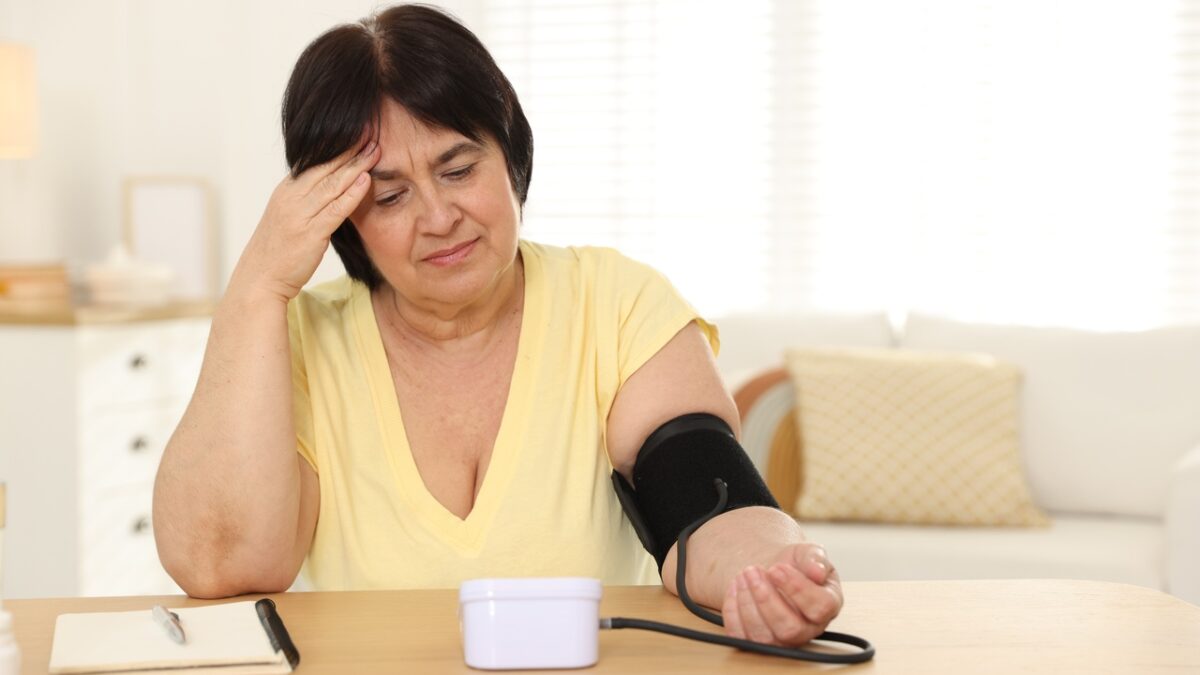
Just taking out his blood pressure monitor is enough to make him anxious. Laurence, an Internet user on the True Medical forum, expresses her concern about the figures that appear on the device.
She dreads taking her blood pressure as much as not controlling it. And when the first measurement displays
15/9difficult for her to reassure herself, even if the following values are lower.
In a message published on May 6, 2026, this user explains having had heart exams in 2024 and not following any treatment on that date. She notices that his measurements vary and wonders about his state of health. A phenomenon that Health Insurance recommendations allow us to better understand, without remotely determining the origin of its results.
Laurence fears her blood pressure, even when she doesn’t measure it
“If I don’t take it, it stresses me out and just saying that I control it, that stresses me out too“, confides Laurence on the True Medical forum. A worry that accompanies him even before pressing the button on his blood pressure monitor.
What particularly concerns her are the discrepancies between several successive checks. “I take it several times the first is always higher 15/9 for example and then I also have lower numbers however my pulses are good”she continues.
She explains that previously, it was mainly the second number that seemed too high to her, while the first now also increases on certain occasions. Despite the cardiac examinations carried out in 2024, she continues to wonder and seeks to find out if other people are experiencing a comparable situation.
Why can a first measurement show a higher voltage than the following ones? According to Health Insurance, blood pressure is not constant. It fluctuates throughout the day, depending on physical activity, emotions and stress level. The apprehension linked to the measurement can therefore temporarily influence the result.
This mechanism recalls thewhite coat effectwhich designates a temporary increase in blood pressure in the presence of a healthcare professional. But in the case of Laurence, it is impossible to conclude about this phenomenon based solely on his testimony.
Is a blood pressure of 15/9 during the first check necessarily worrying?
On a blood pressure monitor, a value of 15/9 corresponds to 150/90 mmHg. The first number represents the systolic pressure, when the heart contracts. The second measures diastolic pressure, when the heart relaxes.
According to Health Insurance, the values considered normal are less than 140/90 mmHg in the doctor’s office and 135/85 mmHg when self-measured at home. A measurement at 15/9 therefore exceeds these thresholds, but an isolated figure does not confirm that a person suffers from high blood pressure.
The High Authority for Health recommends confirming hypertension by measurements taken outside the medical office, either at home or using an ambulatory blood pressure measuring device, called
MAPA. This automatically records blood pressure at different times of the day and night.
Another important point in Laurence’s testimony: she explains that her pulses are good. Yet, a normal heart rate is not enough to rule out hypertension. Pulse and blood pressure correspond to two different parameters.
The World Health Organization also recalls that hypertension can progress without any particular symptoms. In 2024, it concerned approximately 1.4 billion adults aged 30 to 79 worldwide, according to estimates published by the organization in September 2025.
Stress and blood pressure, the method recommended by Ameli to obtain reliable measurements
When the values change from one take to another, the measurement conditions are as important as the numbers displayed. Health Insurance recommends a precise protocol to limit variations linked to poor position, recent activity or agitation.
To carry out a self-measurement in good conditions, here are the main recommendations:
- Use a validated electronic blood pressure monitorpreferably with a cuff adapted to the arm;
- Avoid physical exertion, tobacco and caffeine during
30 minutes preceding the measurement; - Sit quietly for 3 to 5 minutesback supported, feet flat on the ground and arm placed at heart level;
- Perform three measurements spaced one to two minutes apart in the morningthen three others in the evening, for three consecutive days, when this protocol is requested;
- Record all results to transmit them to the doctor, who can interpret them as a whole.
This protocol, called rule of threeallows you to collect 18 measurements over three days. It avoids drawing conclusions from a single value, whether it is higher or lower than the others. Multiplying checks beyond what has been recommended does not necessarily provide more useful information.
For a person who, like Laurence, feels strong anxiety when measuring their blood pressure, it is useful to talk to your doctor about it. This person will be able to adapt the monitoring method and consider an ABPM if necessary. The objective is to have usable measurements without maintaining permanent verifications.
Very high blood pressure accompanied by chest pain, difficulty breathing, confusion or visual disturbances requires immediate medical evaluation.
In France, these signs justify calling 15 or 112.
Laurence specifies that she is not taking any treatment and has already carried out cardiac examinations. This information alone does not allow interpretation of current measurements. A healthcare professional will be able to review her recent readings, check the conditions in which she uses her device and determine if additional tests are necessary.