
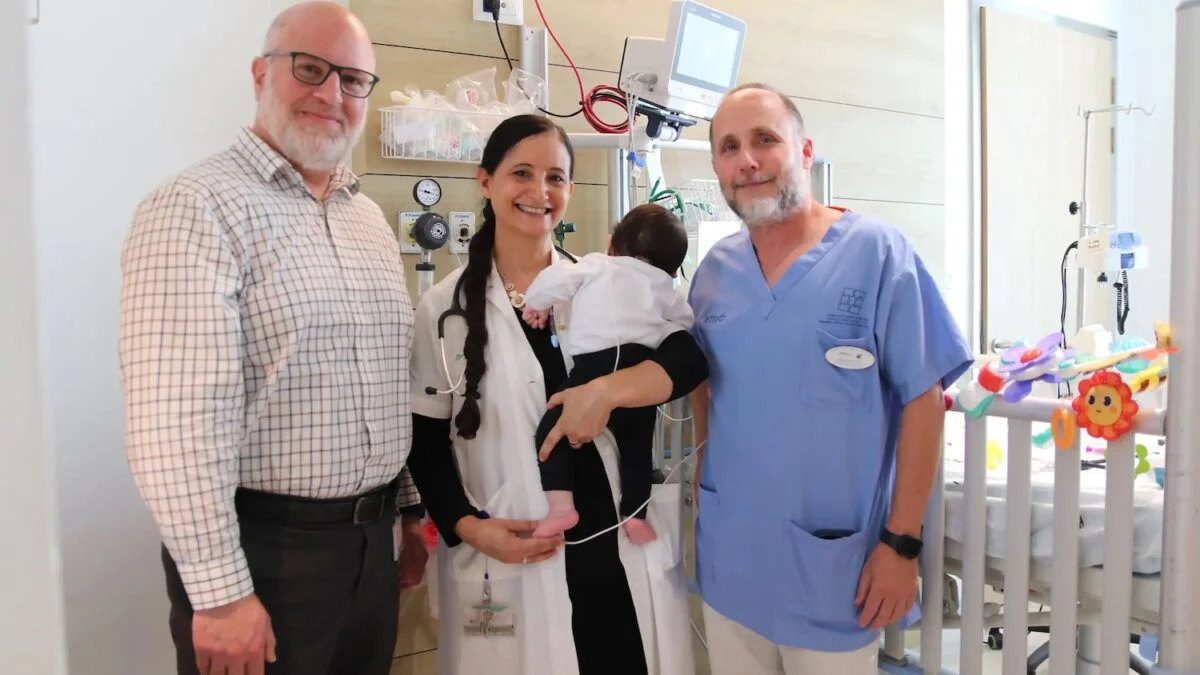
Carried out at the Schneider Children’s Medical Center in Israel, this experimental intervention aims to correct the very cause of the disease, and no longer just its symptoms. Although the results are still very preliminary, this advance marks a turning point in the long quest for treatments for the most severe genetic epilepsies.
When each crisis brings the worst closer: the race against time of a family and their doctors
Initially, there was nothing to suggest the tragedy. At birth, the infant appears in perfect health. Then, at six weeks old, the first convulsions occur. They quickly multiplied. Usual treatments remain ineffective. Even more worrying, the child’s development seems to be going backwards: acquired knowledge disappears instead of progressing.
Doctors then identify the origin of the problem: a gene mutation WWOXresponsible for WOREE syndrome, an extremely rare epileptic encephalopathy. Worldwide, only 60 to 90 cases have been described to date. This disease is among the most severe forms of genetic epilepsy in infants. Affected children have frequent, drug-resistant seizures, major neurodevelopmental delay, and a high risk of early death.
For Dr. Naama Ornstein, a specialist in pediatric neurology at Schneider Children’s Medical Center, the story brings back a painful memory. She had already followed another child suffering from the same disease, who died for lack of a therapeutic solution. This time, she refuses to give up.
For more than ten years, Professor Rami Aqeilan, researcher at the Hebrew University of Jerusalem, has been studying the role of the WWOX gene. His work in animals showed that gene therapy to restore this gene could suppress epileptic seizures and prolong survival. These experimental results will gradually convince researchers, health authorities and manufacturers that an attempt in humans is worth considering.
But there remains a major obstacle: no one has ever administered this treatment to a patient.
Injecting a gene into a baby’s brain: a world first full of hope
After obtaining exceptional authorization within the framework of compassionate use, the medical team decided to take an unprecedented step forward. The principle is as simple to state as it is complex to carry out: providing brain cells with a functional copy of the missing gene. To do this, researchers use a viral vector called AAV9, a biological tool capable of transporting the healthy WWOX gene to neurons.
At the age of eight months, the infant is treated for a particularly delicate neurosurgical procedure. Neurosurgeon Dr. Ido Ben Zvi injects the gene therapy directly into the child’s brain. Each parameter is calculated with extreme precision in order to adapt the dose to the baby’s brain volume. The goal is not simply to reduce symptoms, but to correct the genetic cause of the disease.
For Dr. Naama Ornstein, emotion goes far beyond the medical framework.
“This was much more than a medical procedure. It was a fight to give a child a chance to smile, to develop and to live. Families often ask us: If a child doesn’t have a working gene, why can’t we just give them one? Usually we don’t have an answer. This time, for the first time in the world, we were able to do it.”.
One month after the procedure, doctors reported that the child was clinically stable. The severe seizures did not recur and the infant was able to return home.
These first results remain encouraging but must be interpreted with caution. At this stage, there is no sufficient hindsight to know whether the benefits observed will persist over time.
A nascent medical revolution, still surrounded by many unknowns
Behind this advance lies the culmination of more than a decade of fundamental research. For a long time, the WWOX gene was mainly studied for its involvement in certain cancers. Gradually, researchers discovered that it also plays an essential role in brain development. When both copies of the gene are altered, the brain no longer develops normally. In animal models, this anomaly causes massive epileptic seizures, defects in myelination – this protective sheath that surrounds neurons – and early death.
Experiments carried out by the team of Professor Rami Aqeilan from the Hebrew University of Jerusalem had already shown that a single injection of gene therapy could correct a large part of these abnormalities in mice. For the researcher, the intervention carried out in Israel represents a historic step.
“This moment represents the culmination of many years of fundamental and translational research. What began as an effort to understand the biological function of a gene has become a potential therapeutic strategy for children with one of the most severe forms of genetic epilepsy.“.
However, the questions remain numerous. This infant remains today the only patient in the world to have received this treatment. Doctors still do not know how long the gene will remain active, what impact it will have on future cognitive development or whether adverse effects could appear in the long term.
Therapies using AAV vectors also raise questions already known in other pediatric diseases: immune reactions, optimal dosage or safety over several years. But despite these uncertainties, this world first sends a strong signal to the scientific community.
Until recently, certain genetic epilepsies in infants were considered diseases against which medicine could only support families. Today, the idea of directly replacing a missing gene in a child’s brain no longer belongs to science fiction. For families facing WOREE syndrome, this is proof that another outcome may be possible.