
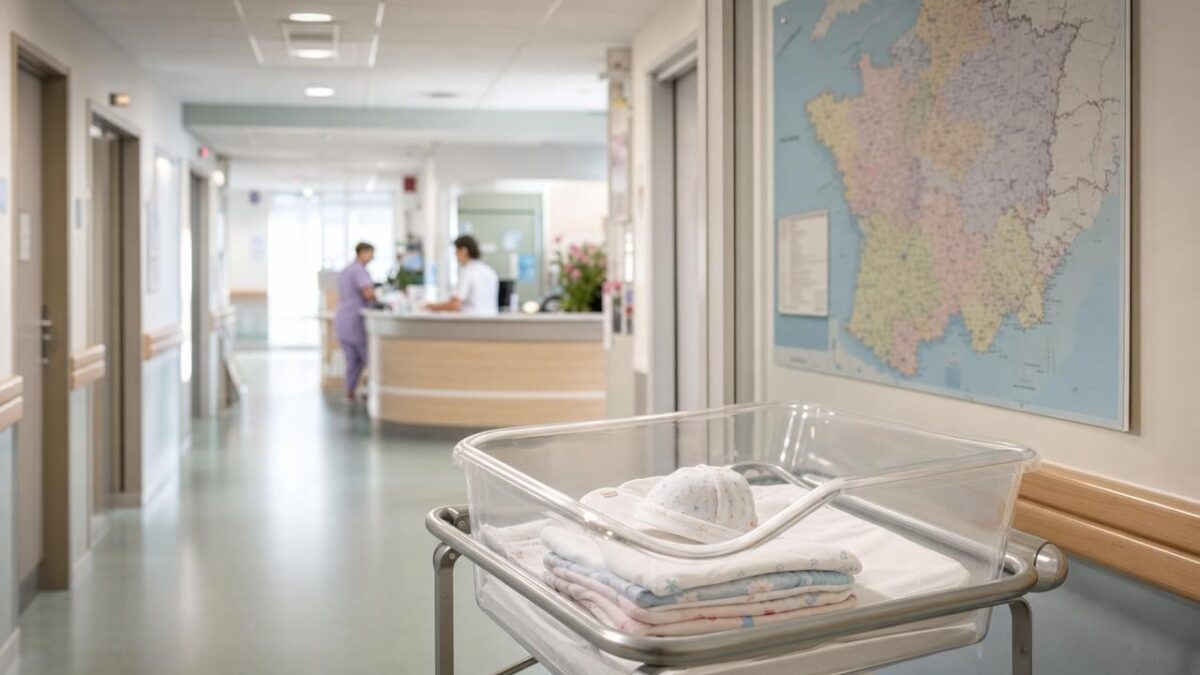
In France, the question of places of birth now goes beyond territorial planning. The ministerial mission on perinatal care recalls that “the infant mortality rate increased from 3.5 deaths per 1000 live births in 2011 to 4.1 per thousand in 2024”, even though the birth rate is declining. Between elected officials worried about medical deserts and caregivers exhausted by endless guard duty, the network of maternity wards is at the center of tensions.
In this context, the report submitted to the Government at the end of September by Marie-Pierre Bonnet, Elsa Kermorvant and Loïc Sentilhes estimates that “maintaining a significant number of low-activity maternity units mobilizes disproportionate human resources to ensure continuous care twenty-four hours a day, seven days a week“, in a “model of permanent care that has become unsustainable“. The authors mainly target sites close to or below the minimum threshold of 300 births per year set by the perinatal decrees of 1998, while admitting that the response will have to remain territorial. Conclusions which deserve to be analyzed…
Low-activity maternity wards: why the mission speaks of an “unsustainable” model
For the mission, these small maternity wards require the simultaneous presence of numerous specialists for sometimes reduced activity. She emphasizes that “this organization simultaneously requires the presence or on-call duty of gynecologists-obstetricians, anesthetists-intensivists, pediatricians and midwives, even though some of these professionals are in insufficient number, and this sometimes for a volume of medical activity that is sometimes low or even very low depending on the structures.“.”This mismatch between needs and available resources leads to massive recourse to medical temporary work“, deplores the report.
However, there is no consensus on this diagnosis, including within the mission. Midwife Eliette Bruneau refused to sign the final document, denouncing a “hospital-centric vision very far removed from the field” and a text “invisibilizing the roles and actions of midwives”. Several midwifery organizations support this position and point out that the reorganization of perinatal care cannot ignore work in the city or the demand for close monitoring of women.
Dr. Gérald Kierzek, emergency physician and medical director of True Medical, agrees with this by denouncing “women giving birth in fire trucks on the sides of the roads. The best place to give birth is obviously a maternity ward, even a small one, that is to say on a human scale.“.
Proximity versus security: a contradiction at the heart of the maternity map
The three signing doctors summarize the situation by writing that “the territorial organization of maternity wards is faced with a contradiction“. On the one hand, “the difficulties of recruiting and maintaining teams make it increasingly difficult for a large number of small structures to operate“. On the other, “the absence of a national restructuring strategy leads to urgently decided closures, with significant negative consequences for the populations“. Lengthening journeys and saturated referral maternity wards: each sudden closure feeds the fear of a
medical desert.
To avoid these case-by-case decisions, the mission proposes a multi-criteria “national framework” with the guiding principle “safety of care”. This framework would take into account the threshold of 300 annual deliveries, but also incidents, the quality of the organization and geographical isolation. In the territories where a closure would be decided, the authors rely on
local perinatal centers to “maintain a secure territorial perinatal care offer”. They would offer consultations, pregnancy and postpartum monitoring, with tele-expertise and medical transport to the reference maternity ward if necessary.
Better management of pregnancies by reducing the number of maternity wards… Really?
Let us remember, however, that these local maternity wards allow women to give birth in a place close to their home, without having to travel an hour and risk giving birth on the road, in this case causing risks systematically ignored by these reports (the previous one dated from 2023) which advocate the closure of maternity wards. In around twenty years, nearly 30% of maternity hospitals have closed without infant mortality rates improving, on the contrary.
Beyond the argument of safety (which is therefore questionable), the other argument of the report is based on the impossibility and/or the cost linked to permanent care in these local maternity wards. By threatening the sustainability of these establishments, we can assume that future health professionals will think twice before committing to them, thereby accentuating the phenomenon of shortage…
“It is obvious that threats of closures are not good recruitment arguments to expand medical teams.” quips Dr. Gérald Kierzek. “Let’s propose regional projects with pooling with larger structures and we will have no problem bringing in young professionals and keeping them competent. The argument of lack of personnel is the argument to justify closures already decided by technocrats.”
Doesn’t focusing on small maternity hospitals avoid looking more generally at the French health system which continues to deteriorate (between medical deserts and the emergency stretcher bed scandal)?