
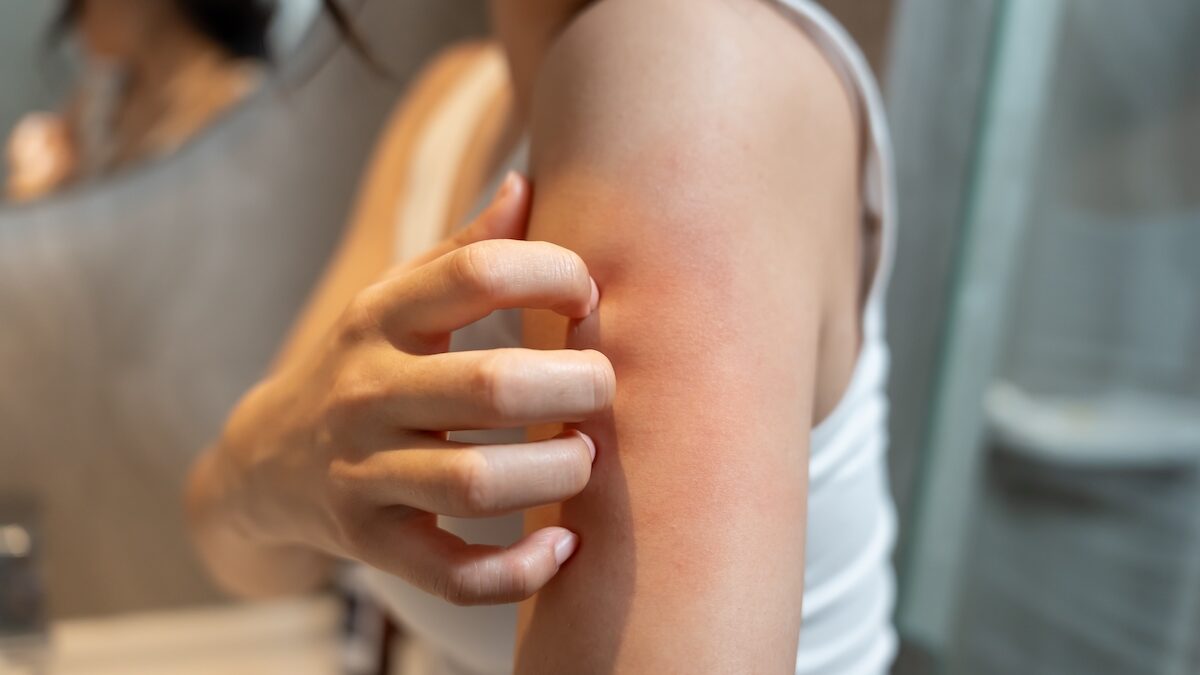
With summer, time spent outside, and windows open, insect bites are back on our arms and legs. And what’s better than a little “scratching” to temporarily relieve irritation? And quite precisely. If this gesture seems almost instinctive as it provides immediate relief, doctors are clear: this pleasure is short-lived and could well make the situation worse.
This idea that itches you is not the right one
For a long time, doctors advised against scratching without knowing precisely why it made symptoms worse. A team led by Dr. Daniel Kaplan, a dermatologist at the University of Pittsburgh, recently shed light on the biological mechanisms involved.
For their work, the researchers caused a skin reaction in mice, then compared those that could scratch to others prevented from doing so by small collars, similar to those used in animals after veterinary intervention.
The results are clear: mice that scratched developed more swelling and inflammation. Conversely, those prevented from scratching had much less severe lesions.
According to Dr. Kaplan, this experience confirms what many see on a daily basis: “If a mosquito bite is ignored, the itch goes away within five to ten minutes for most people. But if you start scratching it, it becomes your companion for a whole week.” Ok. But why?
Why scratching relieves… before making things worse
“Scratching an insect bite sometimes provides relief in the moment, but it maintains the itching, damages the skin and can open the door to secondary infection”warns Dr Gérald Kierzek, emergency doctor and medical director of True Medical.
The cause: a real vicious circle. When an insect bites, the body triggers a local inflammatory reaction. Histamine and other chemical mediators are released, stimulating nerve fibers in the skin and causing that itchy sensation.
The problem ? “Scratching gives a brief feeling of relief, but it also activates reward circuits in the brain, making the urge harder to control.”explains the doctor.
In other words, the more we scratch, the more we maintain the inflammation… and the more the itch persists.
What are the risks of scratching too much?
In addition to the prolonged discomfort mentioned above, excessive scratching is not without consequences.
“The main risk is breaking the skin barrier, which encourages the entry of bacteria and therefore local infection, or even impetiginization,”
emphasizes Dr. Kierzek.
Scratching can also:
- Increase redness and swelling;
- Increase the pain;
- Leave lesions or scars;
- Promote skin infection.
In the case of bee or wasp stings, you must also remain vigilant for possible signs of severe allergy, such as difficulty breathing, discomfort or significant swelling of the face.
How to soothe a sting without scratching?
Fortunately, there are several solutions to soothe the itching without aggravating the situation, and without removing the claws.
Dr. Kierzek first recommends applying cold to the affected area, using a cool compress or a cold pack wrapped in a cloth.
Dermatologists also advise:
- To use hydrocortisone cream or calamine lotion;
- To take an oatmeal bath in case of extensive itching;
- To keep nails short to limit involuntary injuries;
- To clean the skin if it has been damaged.
Another tip mentioned by Dr. Kaplan: creams containing menthol. By providing a feeling of cold, they temporarily “trick” the skin and sometimes help break the itch-scratch cycle.
When should you consult?
In addition, according to Dr. Kierzek, a medical consultation is recommended if the redness spreads quickly, if the area becomes very painful or hot, or if general symptoms appear, such as vomiting, discomfort or difficulty breathing.
Because if scratching is often a natural reflex, the best way to make a sting disappear is ultimately… to resist it.