
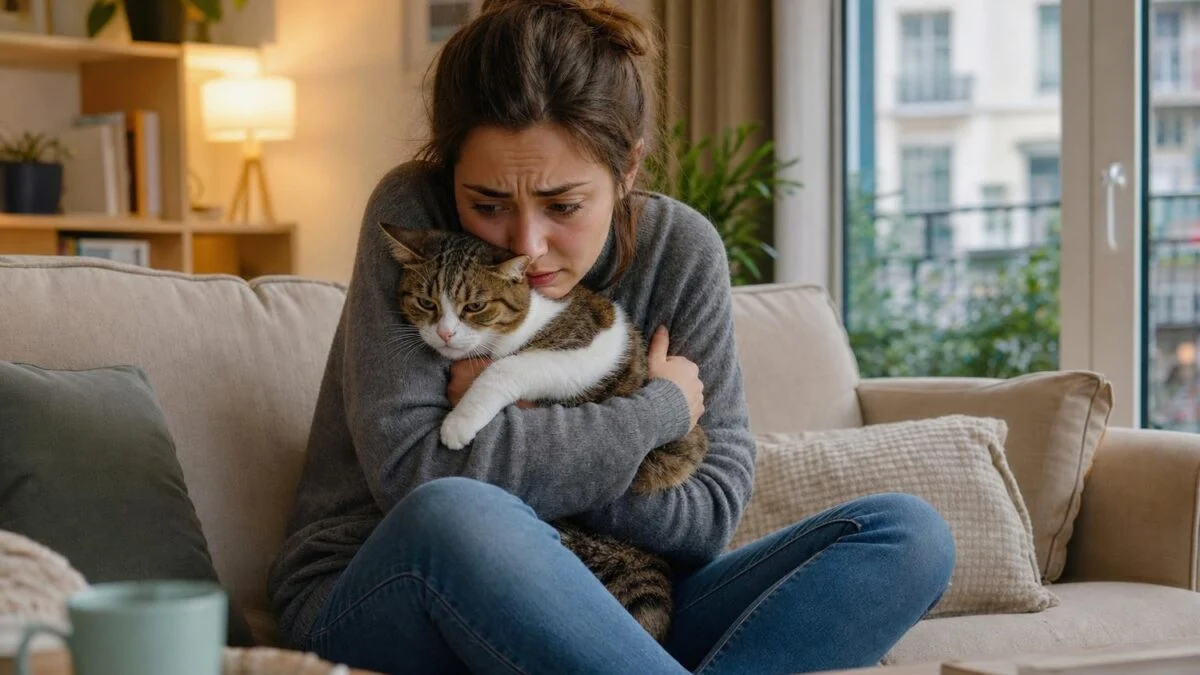
After a tiring day, many owners rely on their pet to relieve the pressure. France has 16.6 million cats and 9.9 million dogs and the idea that these companions protect us from stress has taken hold everywhere. New research carried out by the Open University in the Netherlands, however, complicates this reassuring picture.
Published in 2026 in the journal Frontiers in Psychologythe study shows that cuddle your cat when you’re stressed could make negative emotions worse instead of alleviating them. While confirming that dogs and cats improve mood overall, psychologists describe a much less clear effect on the stress felt in the moment.
Cuddling your stressed cat: what the new Dutch study shows
The researchers followed 188 dog and cat owners using an app that questioned them ten times a day for five days, or nearly 8,000 measurements in real time, details Frontiers. With each notification, participants indicated their stress level, their emotions, what they were doing and whether they interacted with their pet, as well as the intensity of this contact.
On average, interacting with your pet was associated with more positive emotions and fewer negative emotions, whether you lived with a dog or a cat. But the famous “buffering effect” of stress has not been found. “Our results indicate that stress mitigation is not the mechanism that explains momentary emotional well-being when interacting with a pet. Interaction with either species did not act as a buffer against negative emotions“, explains Mayke Janssens, assistant professor of psychology at the Open University and lead author of the study.
Why your cat reacts badly to your cuddles when stressed
It is among cat owners that the most surprising result appears. “In cats, we even observed that a higher level of interaction was associated with a stronger link between stress and negative emotions in owners“, notes Mayke Janssens. In other words, in the moments when the participants declared themselves very stressed, the more intensely they interacted with their cat, the more their negative feelings increased. Remember, however, that the sample included only 36 cat owners compared to 75 dog owners, which limits the statistical solidity of this observation.
To try to explain this paradox, Sanne Peeters, researcher at the Open University, puts forward a suggestion: “One explanation, still speculative, is that interactions with cats are often more passive and less demanding in nature; a higher level of interaction might be more emotionally evocative. This may not correspond to the need for support in times of stress“, she suggests. Ethologists also point out that the cat was domesticated much later than the dog and remains close to the solitary and territorial feline, which makes it less tolerant of imposed cuddles, especially if its human is already tense and misreads its signals of discomfort.
Cats, dogs and stress: how to keep the hug on the good side
The authors are cautious: the association “high stress + intense cuddling with the cat = feeling worse” does not appear in all the analyses, and the small size of the group of cat owners suggests that this result should be seen as preliminary. “I wouldn’t say that one species makes a ‘better’ pet than another. Rather, it is about the personality and preferences of the owner. The main conclusion is that interacting with dogs and cats appears to provide similar emotional benefits.“, summarizes Sanne Peeters.
For everyday life, the message is therefore above all to better adjust one’s expectations. Rather than treating your cat as an immediate anti-stress medication, it can be more helpful to take advantage of its simple presence, letting it come on its own, especially when you feel exhausted. “It may be that interacting with a pet provides a feeling of companionship and that animals help people feel more connected and less alone, which in turn could help improve emotional well-being“, says Mayke Janssens. Clearly, respecting your cat’s consent and banking on the long-term relationship remains the best way to preserve her mood… and your own.