
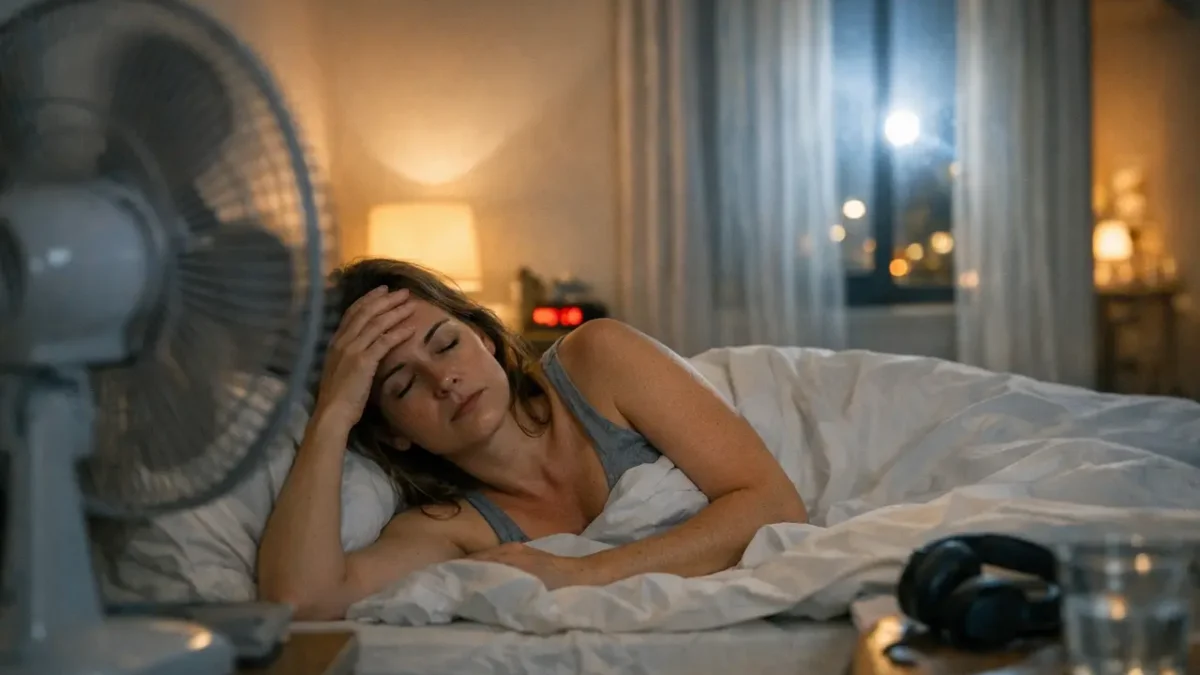
Before blaming coffee or stress, it can be helpful to take a look around your room. Temperature, light, noise: these evening details sometimes seem secondary, but they come to the heart of a study conducted by Penn State. Published in the October issue of Sleep Healthshe followed 372 young adults for two weeks, with a wrist sensor and daily questionnaires. Result to be retained with caution: nights perceived as too hot, bright or noisy are associated with less favorable sleep qualitywithout proving that they alone cause insomnia.
The practical interest is simple: these observations are consistent with already well-established advice. For an environment more favorable to sleep, Health Insurance recommends a bedroom quiet, dark, airy and not overheatedwith a temperature around 18 to 20°C.
Is your bedroom too hot to sleep in?
This is often the first setting to check. In the Penn State study, nights rated as “too hot” by participants were associated with slightly lower sleep maintenance efficiency, that is, a more fragmented or less continuous night. We should not conclude that everyone would systematically lose hours of sleep, nor that one degree less would solve chronic insomnia.
But the advice remains concrete: avoid overheating the room. It is advisable not to exceed 18 to 20°C, to ventilate the room and to avoid, in the evening, raising your body temperature too much. This may involve a hot bath too late, physical activity in the evening or a duvet unsuitable for the season.
On True Medical, this point is already regularly reminded, notably in this article on the fact that turning the heating on too high can encourage waking up at night.
Can light and noise really disrupt the night?
Here again, the study does not directly measure lux or decibels in the rooms: it is based on what the participants said they perceived each evening. This is the main methodological reservation to keep in mind: these are observational associations, not proof of causality. In other words, a room perceived as bright or noisy accompanies poorer sleep in this cohort, but the study does not show that this factor explains everything.
However, useful actions are known. In terms of light, it is recommended to sleep in the dark, with shutters or curtains closed if possible, and to favor warm, subdued lighting in the evening. Screens and notifications also have their role: it is better to limit them before bedtime or turn them off during the night. If you want to track down small forgotten light sources, indicator lights and devices on standby, you can also read our article on invisible light sources in the bedroom.
In terms of noise, the objective is not to transform each room into a recording studio. But if an interior noise comes back every evening – ventilation, electrical appliance, slamming door, notifications – it deserves to be identified. Ameli also mentions, if necessary, the use of noise protection.
What settings to test this evening, without medicalizing everything?
The simplest thing is to proceed piece by piece, or rather sensation by sensation. First the temperature: radiator, ventilation, bedding, pajamas. Then the light: curtains, shutters, night lights, screens, indicator lights. Finally the noise: continuous sources, phone alerts, devices in the room.
These tweaks don’t promise to cure insomnia. They can only help create a more sleep-friendly environment. If difficulties persist, if nighttime awakenings become frequent or if fatigue affects the day, it is best to speak to a health professional. You can also consult our file to understand chronic insomnia.