
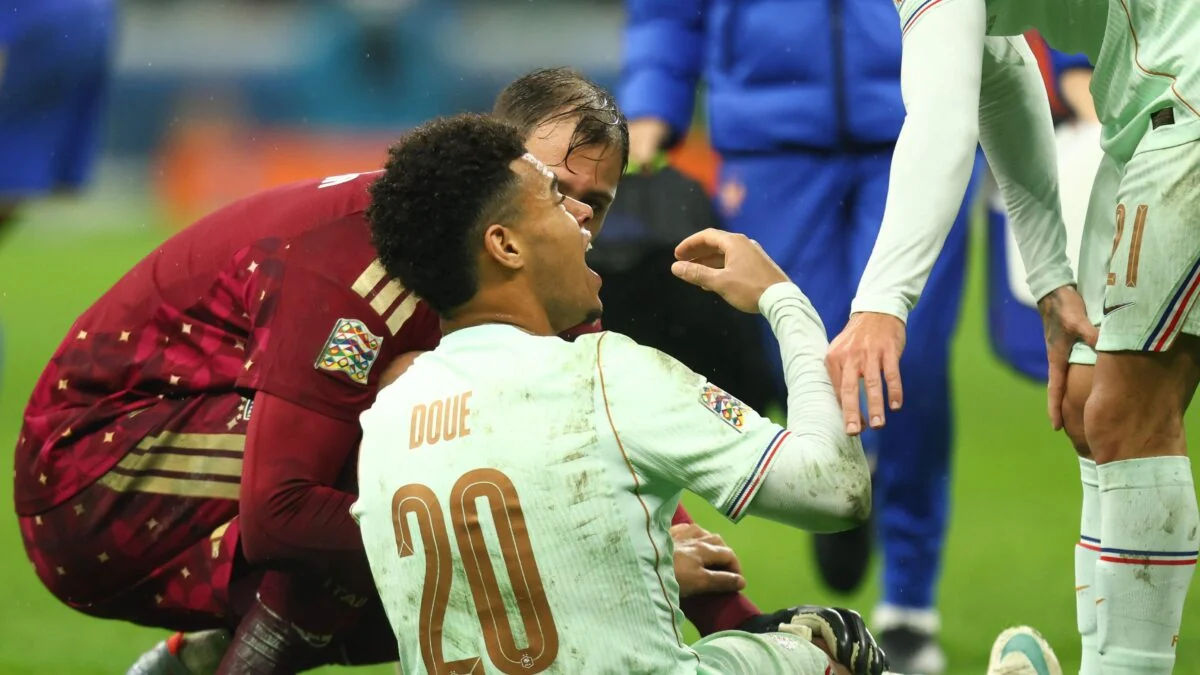
A tooth that moves after an impact is not necessarily “just impressive”. During the Italy-France match on November 12, 2026,
The Parisian reported that after contact with Davide Frattesi, one of Désiré Doué’s incisors appeared to have moved. According to
The Parisiancoach Zinedine Zidane declared at the microphone of TF1: “A tooth has moved I think, from tomorrow we will take care of him”. The article also specifies, in its update, that the tooth would have been stabilized before an appointment with the dentist.
Impossible, of course, to make a diagnosis based on match images. But this sequence reminds us of a rule valid for everyone, athletes or not: a tooth still in place may require urgent treatment. And the first reflex is not always the right one.
Crooked tooth: why shouldn’t you push it back?
After a blow to the mouth, a tooth can remain in its socket even though it has changed position. Health Insurance describes in particular the case of a dislocated tooth: it may appear longer, shorter or offset in relation to neighboring teeth. It can also be painful, mobile, or accompanied by bleeding.
In this case, the action to avoid is to “test” the tooth with the tongue or fingers, or to want to straighten it yourself. If the tooth has moved, leave it in the position where it is and we urgently consult a dentist when a tooth is displaced, fractured, expelled or if there is bleeding. He will be able to examine the tooth, check the tissues around it, decide whether it needs to be repositioned, stabilize it with a retainer and organize follow-up.
The important point is that dental trauma must be treated quickly, even if the tooth has not fallen out. International recommendations in dental traumatology also emphasize the importance of diagnosis, treatment and follow-up after a fracture or dislocation of a permanent tooth.
When should you consult urgently?
According to Health Insurance, you must urgently consult a dental surgeon if a tooth has been expelled, fractured or displaced, or in the event of bleeding in the mouth. In other words, a tooth that “only” seems crooked after an impact should not be trivialized.
While waiting for professional advice, avoid biting on the traumatized side, do not force the tooth and do not multiply the manipulations. The sooner the situation is assessed, the more the dentist can adapt the treatment. : repositioning, restraint, x-ray if necessary, monitoring of the vitality of the tooth, advice on diet and hygiene.
Context also matters. If the shock is accompanied by violent head trauma, loss of consciousness, vomiting or a serious accident, Health Insurance recommends calling medical help, 15 or 112. In this case, the priority goes beyond just the tooth.
In sport, impacts on the mouth are frequent and sometimes minimized when hot, under the effect of adrenaline. Hence the interest in knowing how to prevent dental trauma during sport, particularly with dental appliances, even when there is no obvious fracture.
What if the tooth is completely out?
The situation is different if the tooth is completely knocked out. There, it must be reported immediately by telephone to the dentist or to the service contacted, because storage time and conditions matter. For a permanent tooth, Health Insurance advises grasping it by the crown, that is to say the white part visible in the mouth, and never by the root.
If it is dirty, it can be rinsed very lightly, without rubbing. It should not be stored dry or in ice. If it must not or cannot be repositioned — particularly if it is a baby tooth, if it is not known whether it is a baby tooth or permanent, or if an obstacle prevents it from being put back in place — it must be kept in milk or, failing that, in physiological saline while awaiting the consultation. Health Insurance specifies that the best results are observed when the time between expulsion and reimplantation is less than 20 minutes, even if the prognosis also depends on other factors.
To better distinguish the situations, here is also what to do if a tooth has completely come out after an impact. The pointer to keep in mind: after a blow, a tooth still in the mouth may still have been displaced. Don’t test it, don’t push it away, get it examined quickly.