

In 2025, France recorded 259,400
voluntary terminations of pregnancy, an increase of 2.9% in one year, according to the Directorate of Research, Studies, Evaluation and Statistics (Drees). The recourse rate reached 17.8 abortions per 1,000 women aged 15 to 49after several years already on an upward trend outside the Covid period. The progression affects all age groups, which raises a question: what is really fueling this increase?
According to the Drees, this increase is primarily based on the diffusion ofMedical abortion outside health establishments, which now represents 81% of procedures, and on an organization of care which has changed.
The 2025 figures for abortion: an increase in all generations
The rate of recourse to abortion remains the highest among 20-24 year olds, with 29.7 abortion per 1,000 women, and among 25-29 year olds, with 30.3 per 1,000, according to the Drees. Among minors, it stands at 5.8 per 1,000, remaining the only indicator lower than 1990. The Drees also emphasizes that this figure depends on the methods of anonymity, used by 7.8% of women in 2025.
The temporary abortion index increased from 0.55 in 2018 to 0.61 in 2024 then 0.63 in 2025, again according to the Drees. Which means that with current rates by age, more than six out of ten women would have an abortion during their reproductive life. For the institution, this progression “is a continuation of previous years among women over 25 but marks a break for the youngest, whose appeals were decreasing“.
Medical abortion and in the city: when the provision of care causes the figures to rise
The medicinal method largely dominates: it concerns 81% of abortions in 2025, compared to 68% in 2017 and 31% in 2001, according to the Drees. Nearly half of these medical abortions take place outside a health establishment, in a private practice, in a health center or by teleconsultation. The choice of method can “be also constrained by the available care offer“, observes Drees again.
© Studies and Results N° 1384 Published on 09/22/2026
In 2004, all abortions were performed in establishments; in 2025, only 53% will still be, according to Drees. In the city, 54% of abortions are performed by midwives, who carried out 59,680 procedures in private practices, for an increase of 15% compared to 2024. One in four abortions in total now passes through their hands, ahead of general practitioners and gynecologists.
Territorial disparities in abortion: gaps that question the causes
Geographical differences remain marked: the standardized rate reaches 33 abortions per 1,000 women in the Droms, compared to 17 in mainland France, according to the Drees.
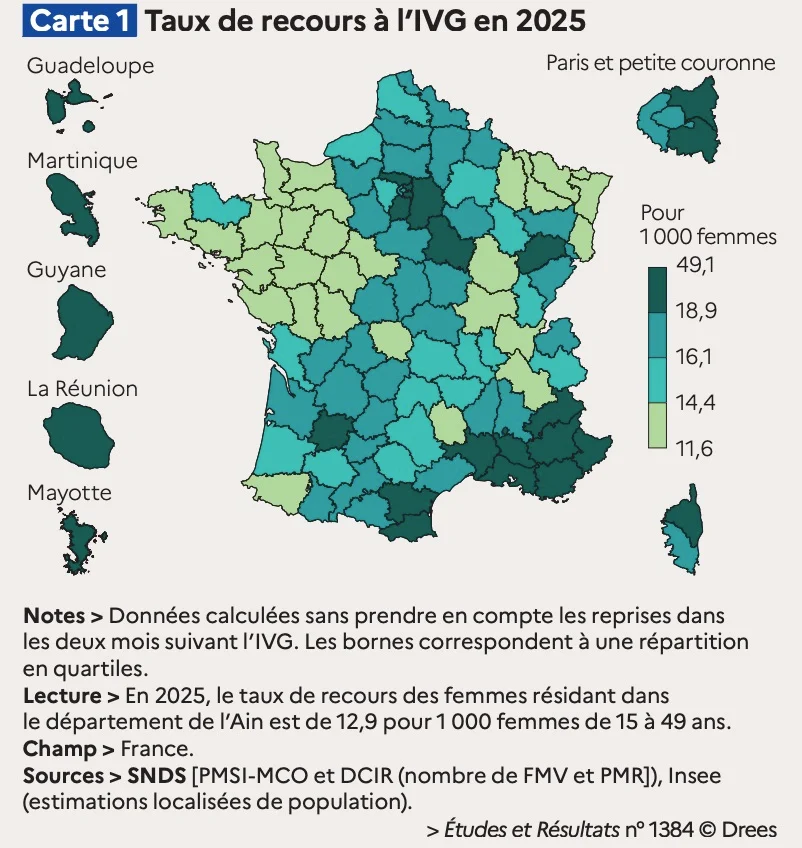 © Studies and Results N° 1384 Published on 09/22/2026
In mainland France, it still varies almost by a factor of two, from 12.6 in Pays de la Loire to 23 in Provence-Alpes-Côte d’Azur, which calls into question the provision of care and access to contraception.
How can we explain this increase in the use of abortion? Easier access to abortion (particularly medical) undoubtedly constitutes part of the answer, but other causes could be put forward: greater economic insecurity, less desire for children linked to an anxiety-provoking climate, less effective prevention of unwanted pregnancies… These figures from the Drees only allow us to attest to the increase and not yet to explain the causes.