
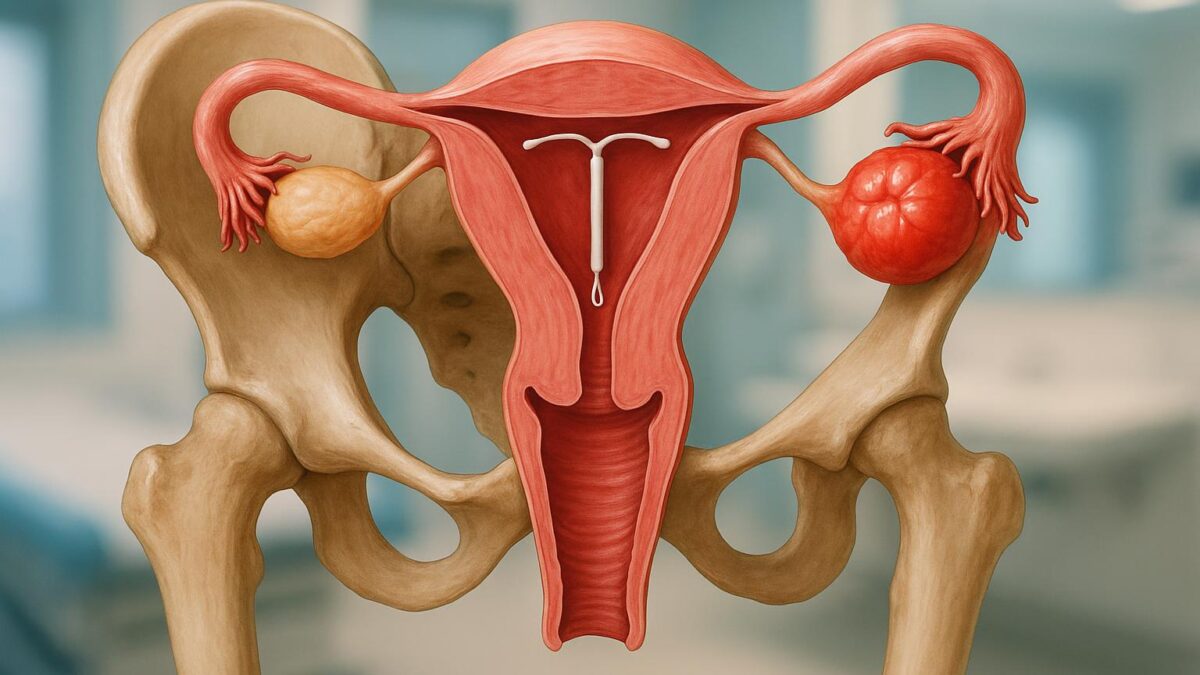
A new French study, published on November 25 in the journal NEJM Evidenceconfirms a signal that worries many IUD users. Data from the National Health Data System show that the Jaydess hormonal IUD, dosed with 13.5 mg of levonorgestrel, carries a higher risk of ectopic pregnancy than other models of IUDs, whether copper or hormonal.
This work, carried out by the EPI PHARE scientific interest group at the request of the National Medicines Safety Agency (ANSM), does not call into question the contraceptive effectiveness of IUDs, which remain among the most reliable methods. The health agency also recalls that the risk of ectopic pregnancy in women wearing Jaydess remains much lower than that observed in women without any contraception. There remains a very concrete question for the approximately 55,000 to 60,000 French women affected by the Jaydess IUD today: what exactly do these figures mean for them.
Ectopic pregnancy and Jaydess IUD: what the EPI PHARE study shows
The study published in NEJM Evidence is based on a large national cohort, using Health Insurance data. Between 2018 and 2022, researchers followed women who had an IUD inserted for the first time, whether it was a copper device or a hormonal levonorgestrel intrauterine device. In total, 45,450 women received a 13.5 mg device (Jaydess), 212,301 a 19.5 mg device (Kyleena), 244,871 a 52 mg device (Mirena and Donasert), and 1,033,505 a copper IUD. The objective was to compare the occurrence of ectopic pregnancies in the year following insertion.
During this one-year period, an ectopic pregnancy was recorded in 71 Jaydess users, representing an incidence of 0.18 cases per 100 person-years. The rate is 0.10 per 100 person-years among users of the 19.5 mg device, 0.04 per 100 person-years with the 52 mg, and 0.07 per 100 person-years for copper IUD wearers. Compared to the copper IUD, the relative risk of ectopic pregnancy is multiplied by 2.57 with levonorgestrel 13.5 mg, by 1.37 with 19.5 mg, while it is reduced with 52 mg (hazard ratio 0.62). The ANSM summarizes these results as follows: “The results show that Jaydess, the lowest dose of the levonorgestrel hormonal IUDs, exposes you to a risk of GEU 2 to 3 times higher than that observed with other IUDs.“, indicates the agency.
Wearing a Jaydess IUD: real risk level, symptoms and ANSM recommendations
An ectopic pregnancy corresponds to the attachment of the fertilized egg outside the uterus, most often in a fallopian tube. The ANSM speaks of a “gynecological emergency”, because the egg can cause distension and then rupture of the tube with significant intra-abdominal bleeding, which can endanger the woman’s life and reduce her future chances of pregnancy. In France, there are estimated to be 2 ectopic pregnancies per 100 births, or around 13,300 cases in 2024. The agency points out, however, that regular and effective contraception, whether it is a copper IUD, a hormonal IUD or another method, reduces the risk of pregnancy, and therefore of ectopic pregnancy, compared to women without contraception.
The context is special for Jaydess. The ANSM estimates the number of women who still wear this device between 55,000 and 60,000, the majority of them women who have never given birth, although the instructions specify that it is not a first-line method for nulliparous women. After safety signals transmitted by the Bayer laboratory and a request from the European Medicines Agency to conduct a post-marketing authorization study, the EPI PHARE study confirms this additional risk. Bayer has ceased all marketing of Jaydess in France since November 2024, even if stocks may still be available in pharmacies until February 2027. For users, the ANSM insists on the fact that Jaydess “remains an effective method of contraception” and does not recommend systematic removal: this is discussed with the doctor or midwife, in the event of a wish to change method or in the event of pregnancy. The agency also invites IUD carriers, whatever it is, to consult very quickly in the presence of a late period with suspicion of pregnancy, pain in the lower abdomen, often on one side only, or vaginal bleeding, due to the risk of rupture of the tube and hemorrhage in the abdomen.