
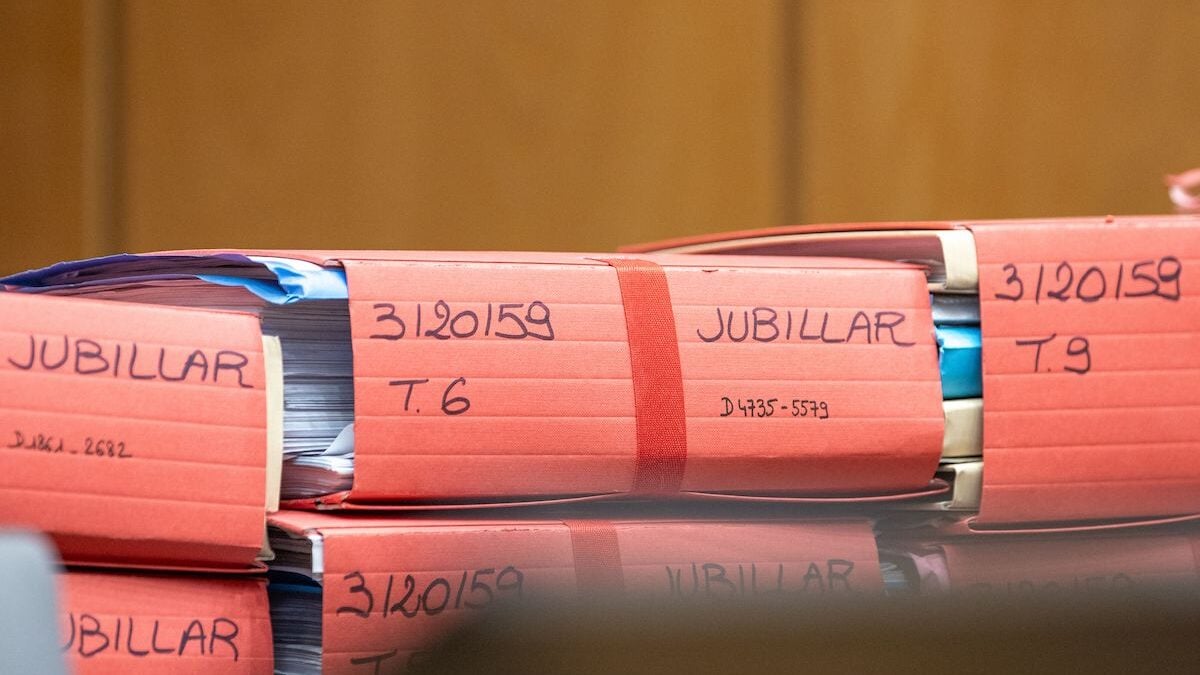
The trial had been expected for several years. This morning, in front of the Tarn Assize Court, Cédric Jubillar entered the accused box for four weeks of trial. He has been suspected, since June 2021, of voluntary homicide by spouse on his wife Delphine. But the case is not judged in advance. Indeed, the young woman’s body has never been found, a point on which the defense of the accused insists.
A likely murder, but without a corpse
Delphine Jubillar, a 33-year-old nurse, disappeared on the night of December 15 to 16, 2020 in Cagnac-les-Mines, in the Tarn, without any personal affairs. From the start, the hypothesis of a voluntary departure from the household was dismissed. On the other hand, that of an argument or a blood stroke, against a backdrop of separation, is widely envisaged. In question: a conflictual situation of the couple (Delphine, separated, wanted to live with her lover), the testimony of neighbors on an argument and cries on the evening of December 15, as well as the behavior of the husband who has intrigued since this sudden disappearance. In addition, two testimonies (of a fellow prisoner and an ex-partner) come to weaken his defense. Despite everything, the young woman’s body has never been found and Cédric Jubillar claims her innocence. The accusation is therefore only based on a bundle of clues, without direct material evidence.
How to mourn when the person has disappeared?
There remain a family and a circle of friends in search of responses and tangible elements to reach a conclusion. Mourning which, for the moment, seems difficult, if not impossible.
“”Can we mourn when there is no body? Difficult, in my opinion! Mourning is always a difficult and complex process. But when, in addition, there is no body, this irrefutable proof is missing: death. Therefore, the absence becomes an enigma. We don’t know. We cannot imagine. The brain turns in a loop: what if it was still alive? What if we were wrong? This is the absolute horror of what a loved one can experience“Underlines Amélie Boukhobza, clinical psychologist.
The supposed murder adds to the horror experienced
Any disappearance without explanation leaves loved ones in doubt and misunderstanding. But the story of Delphine Jubillar is worse, since the possibility of a murder remains the common thread of the case.
“When it comes to a” simple “disappearance, without trace of crime, we keep hope. But when the idea of murder hovers, necessarily pain changes in nature. There is an additional degree“Explains our psychologist.”It becomes an endless pain, nourished by the imagination. We rebuild the scene. We are looking. We fill the holes. We write the story failing to have it. The absence is coupled with unspeakable violence: the certainty that something horrible has happened, without tangible evidence. “
A bad film that has no conclusion. Endless mourning, because it cannot anchor itself in reality. “”No burial. No last gesture. No ritual. Just questions, images, hypotheses.“”
Can we find appeasement anyway?
So, can we mourn a girl, a friend who disappeared, and perhaps under the blows of her husband? “”Yes, but it’s very difficult“Regrets our expert.”We can learn to live with absence, to gradually appease the imagination. But this type of mourning, without body and with supposed crime, leaves deep traces. It’s like a chapter that we have to close without ever reading the last page. “
Will Cédric Jubillar say more about the circumstances of Delphine’s disappearance during the trial? Nothing is less certain. But if he is found guilty of the murder of his wife, he faces life imprisonment.