
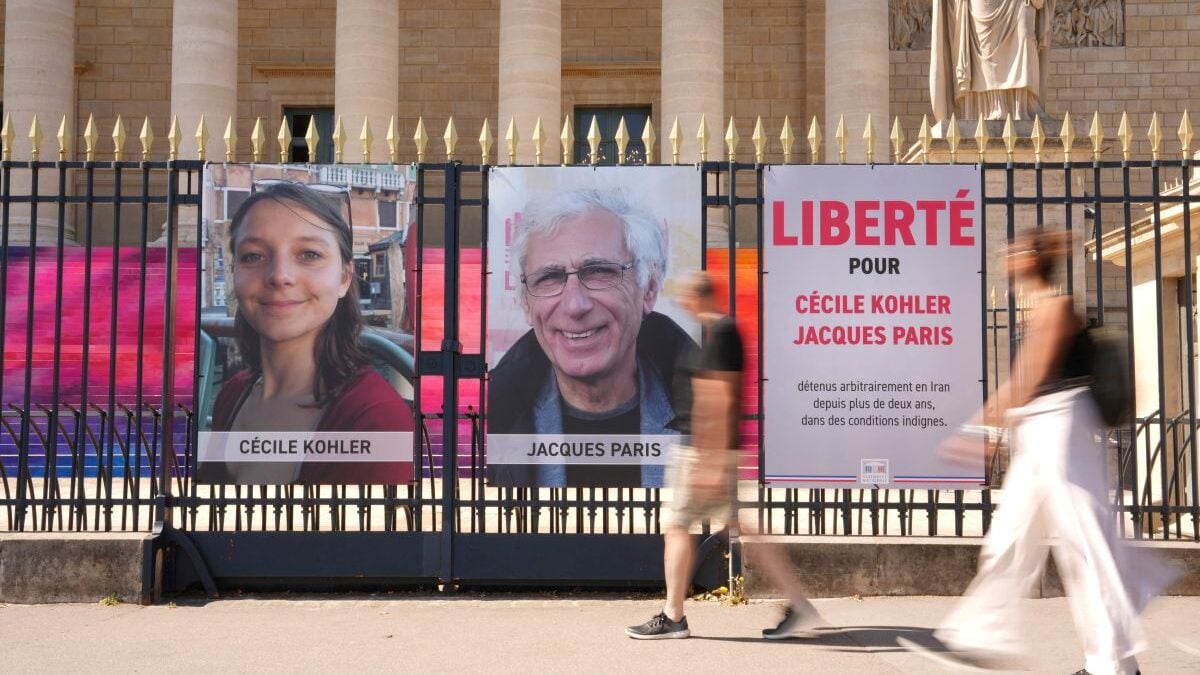
The end of a long diplomatic ordeal. Cécile Kohler, 41, and Jacques Paris, 72, landed at Paris-Charles-de-Gaulle airport shortly before 9:00 a.m., after a stopover in Baku. Arrested in May 2022 during a tourist trip, they were sentenced in 2025 to heavy sentences for espionage, before the mediation of the Omani authorities allowed their definitive release.
“We experienced daily horror“, testified Cécile Kohler after her interview with Emmanuel Macron. “We kept hope until the end“. For his part, Jacques Paris expressed his joy at finding life again, despite an ordeal aimed at “breaking” them.
The body, that great forgotten part of sensory deprivation
If the two hostages are now back home, it is important that psychological reconstruction takes place. Indeed, during their captivity, the absence of physical contact could have represented a formidable psychological ordeal. For Amélie Boukhobza, clinical psychologist, the return to touch is an upheaval that cannot be improvised.
“We must remember that the body has been deprived, constrained, frozen for months. So contact can be very expected… and at the same time confusing. Touching, being touched, hugging those close to you, it can seem almost too much. As if the body does not move as quickly as the desire for reunion. Some may feel invaded, others, on the contrary, need to hold on very tightly. There is no good way to find the other.”
Released since last November, but remaining in Iran, the two hostages were able to communicate via video with their family. But the expert specifies that technology does not replace real contact. “Even if we talk to each other for hours via screen, we don’t know in advance how the body will react. What can help is to respect each other’s rhythm. Don’t force the gestures.”
The distortion of time: when everyday life becomes a test
For a former hostage, the return to freedom sometimes seems like a trip into the future. The world continued its course while their own clock had stopped between four gray walls. “Coming back doesn’t mean it’s over. We return to a daily life which has not stopped” confirms the psychologist.
“We imagine that everything will return to normal, but normality has been suspended. The benchmarks have changed. The automations too. Even simple things can become stressful: running errands, hearing noise, being surrounded…” explains Amélie Boukhobza.
“Paradoxical loneliness” in the face of loved ones
This gap in perception between those who return and those who waited is one of the greatest challenges of family reintegration. “Loved ones are waiting for reactions, stories, a rapid recovery. As if everything could go back to the way it was before. Except no. It doesn’t work like that. Because the one who returns is no longer exactly the one who left. And those who wait have also been through something. There can be a gap, a paradoxical solitude in the midst of reunions.”
The psychologist therefore insists on the need for patience. “It takes time. Reconstruct landmarks. Accept that not everything can be said right away. Let there be silence, back and forth, moments of closeness and others of withdrawal.”
In short, if joy is the first visible emotion, the reconstruction of Cécile Kohler and Jacques Paris will be a long-term task. Getting out of “hell” actually takes as much courage as surviving it.