
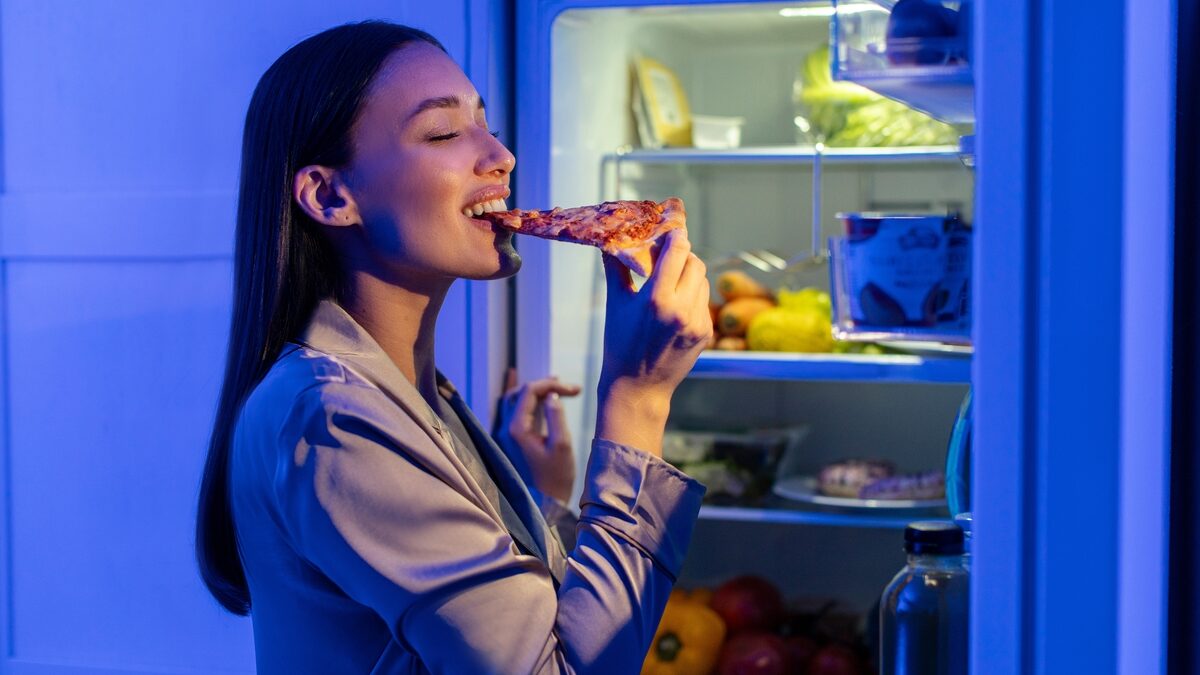
There is something very banal about the package reopened after dinner, in front of a series. But are you really hungry, or has it become an evening reflex? The subject is not to dramatize each cookie, but to also look at the food intake schedule.
On October 9, 2026, the American university OHSU announced an analysis carried out on nearly 200,000 participants from large American cohorts. People reporting eating after dinner or after their usual bedtime reported more metabolic fatty liver disease and cirrhosis.
Does eating after dinner necessarily damage the liver?
This is not what this study shows. The researchers observed a association : in their data, late food intake was more often associated with certain liver diseases. But this does not allow us to confirm that nighttime snacking directly causes steatosis or cirrhosis.
Metabolic fatty liver disease, also called MASLD, corresponds to an accumulation of fat in the liver. It can occur without significant alcohol consumption and remain silent for a long time. It is precisely this discreet nature that makes the subject important: you can have liver abnormalities without obvious symptoms.
The diagnosis is not based on an impression or an isolated eating habit. It involves a medical evaluation, examinations and the search for risk factors.
“Our results add to the numerous research studies establishing a link between late eating habits and harmful consequences on the metabolism and the liver.write the authors.
The essential limitation of this analysis lies in its method: it is an observational study, based on eating habits and liver diseases declared by the participants. Overall diet, physical activity, weight, diabetes, sleep, alcohol or other lifestyle habits can also play a role.
Why does the meal schedule attract attention?
The interest of this work is to ask a simple question:
Does the “when” count in addition to the “what”? Two people can have comparable intakes, but distributed differently throughout the day. Researchers now want to know if advancing food intake can really improve markers of liver health.
For the moment, this path should not become a rigid rule. The study does not set a cut-off time valid for everyone. She does not say that we should ban all food after a specific time, nor that an isolated snack would endanger the liver.
“We are increasingly seeing that the timing of certain behaviors, whether sleeping, eating or exercising, is of utmost importance.”explains Professor Andrew McHill, associate professor and physiologist of sleep and circadian rhythms at OHSU, and co-author of the study. “For example, we have shown that eating at night, when the internal body clock favors sleep, reduces the body’s ability to metabolize food as efficiently and can ultimately lead to obesity, diabetes and, now, poorer liver health.“.
What it does suggest, however, is that late-night snacking is worth questioning when it occurs repeatedly. After dinner, the desire to eat can be linked to a day that is too light in terms of eating, stress, fatigue, boredom or a habit established in front of a screen. In this case, the schedule becomes a useful clue, not a condemnation.
What to do if you snack often in the evening?
The first step is not to feel guilty. It’s more about identifying the scenario: is it every evening? After an insufficient dinner? With very sweet, fatty or salty foods? Without real hunger? This observation often allows you to act more effectively than a simple prohibition.
To protect your liver, the benchmarks already established remain the strongest: a balanced diet, regular physical activity, the fight against a sedentary lifestyle and management of risk factors with your doctor, particularly in the event of overweight, diabetes, hypertension or blood test abnormalities.
If you tend to systematically return to the kitchen after dinner, you can also try simple adjustments: better structure the evening meal, plan a snack earlier if necessary, limit automatic reactions in front of screens, or keep very tempting foods out of immediate reach.
The objective is not a food curfew. For Dr Gérald Kierzek, the message remains measured: do not dramatize the evening snack, but do not ignore repeating habits eitherespecially when added to other risk factors.