
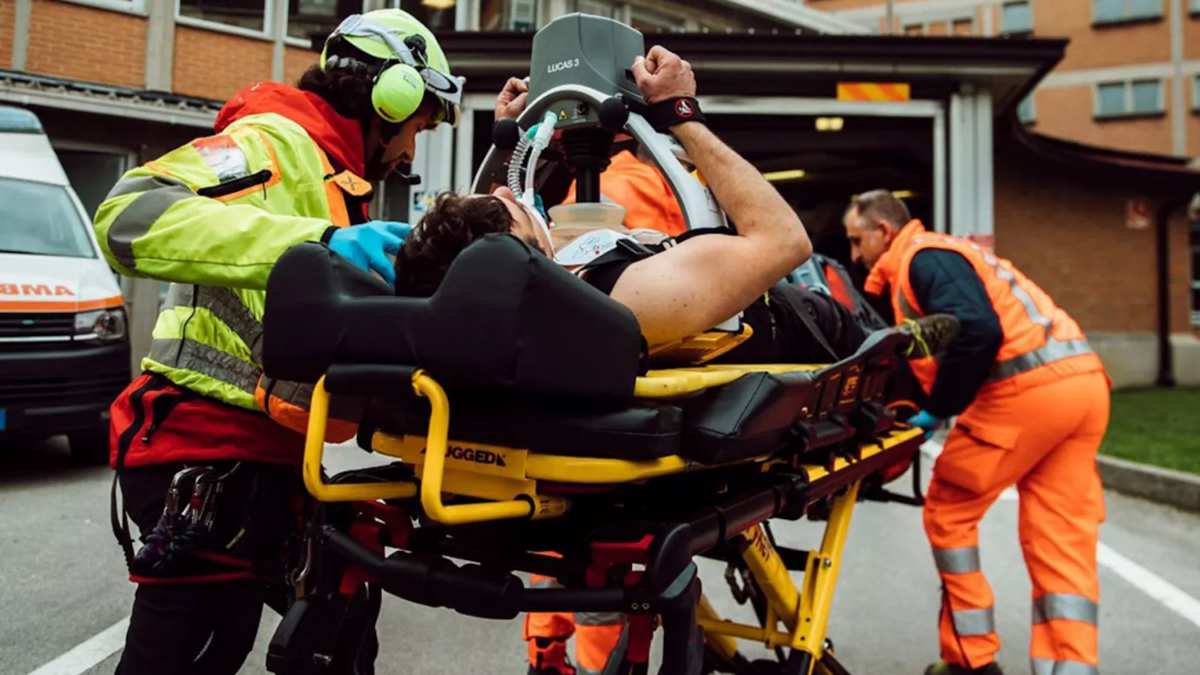
On Instagram, Dr Sermed Mezher, doctor and influencer, highlights the interest of a mechanical heart massage device, quite impressive in images. But in the event of cardiac arrest, the machine is rarely present and the first crucial minutes for the patient’s survival then depend on the witnesses: call, massage, defibrillate if possible.
The first minutes rely mainly on the witnesses
Chest compression devices, like the LUCAS, can provide regular compressions, without fatigue, in certain professional contexts. But they are not available in homes, on the street, or in all emergency vehicles and are more widespread in Anglo-Saxon countries. In practice, the first “tool” available is often your hands.
“This automatic massage board has been around for years, including in France” specifies Dr Gérald Kierzek, emergency physician and medical director of True Medical but important clarification so as not to oversell the device “large trials have not shown a clear improvement in 30-day survival compared to well-performed manual massage; its benefit is therefore mainly operational and quality of compressionsnot proof of better routine survival” he adds.
Faced with a person who does not react, who is unconscious and whose breathing is absent or abnormal, the recommendations for the general public are clear: immediately call 15 or 112start cardiac massage as soon as possible and use an automated external defibrillator, or AED, as soon as it is accessible.
This reflex matters because cardiac arrest is not the same as a heart attack. A heart attack can sometimes be complicated by cardiac arrest, but these are different situations. To differentiate heart attack and cardiac arrest, the essential benchmark to remember here is simple: a person in cardiac arrest does not respond and does not breathe normally.
If you witness such a situation, the action to take can be summarized as follows:
- Call or call emergency services to 15 or 112, putting the phone on loudspeaker if possible;
- Start compressions in the center of the chestwithout waiting for the arrival of a specialized machine;
- Ask for an AED to be brought and follow its spoken instructions when it is available;
- If you do not know how to give mouth-to-mouth resuscitation, continue continuous chest compressions following the emergency services’ instructions.
European recommendations indicate, in adults, a frequency of approximately 100 to 120 compressions per minute, with a depth of 5 to 6 cm, allowing the chest to rise between two compressions. This release counts: it helps the thorax return to its position before the next compression. To better understand this point, True Medical also explains why it is necessary to let the chest rise between two compressions.
Crunch, mannequin, machine: what to remember without panicking
Another striking passage in the video concerns the gap between training on mannequins and reality. The doctor explains that training dummies often give a signal when the pressure is sufficient, then return to shape. On a real person, the sensation may be different, and this may be surprising at the first massage.
In fact, cracking ribs can scare witnesses into thinking they are hurting and need to stop. The nuance is important: a crunch can occur during a correctly performed cardiac massage
and should not, on its own, cause the cuts to be stopped. On the other hand, it is not an objective to be sought, nor proof that the gesture is perfect.
In other words, if the emergency services guide you by telephone,
follow their instructions rather than your impressions. The risk in cardiac arrest is losing precious seconds through hesitation. Simple cues, like cadence, can help; some practical advice is explained in our article on the good reflexes to adopt in the event of a cardiac arrest.
As for compression machines, they have their place in particular situations, for example when a quality manual massage becomes difficult or dangerous for the teams. But for the general public, the priority does not change: do not wait for a specialized device to act. Training in first aid therefore remains a real lever, as the video reminds us, if only to dare to start and continue until the emergency relay.