
We have blamed the sun for decades when we talk about
melanomathis skin cancer that kills the most. However, a team from the Penn State Cancer Institute has just shed light on another parameter, much less intuitive: agricultural practices and the use of pesticides in some rural areas of the United States.
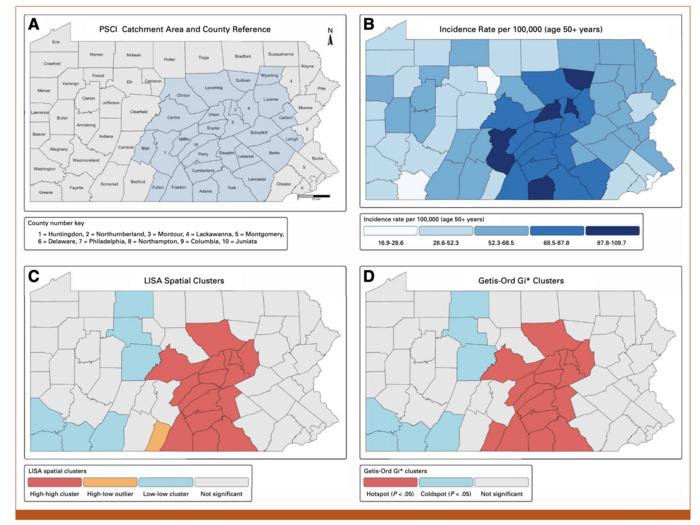
By analyzing skin cancer data for 5 years from the State of Pennsylvania in people over 50, these researchers identified an unusual cluster of cases in fifteen south-central counties, rich in cultivated land. After taking into account sunshine and the social situation, they see the emergence of a clear statistical link between intensive agriculture and malignant skin tumors, to the point of speaking of a “signal” to be monitored closely.
Pesticides, agricultural land and melanoma: what the American study shows
The authors used data from the Pennsylvania Cancer Registry for the years 2017 to 2021, focusing on adults 50 years and older, who account for approximately 85% of cancer cases.
skin cancer melanoma type. They thus revealed a geographic “cluster” of fifteen counties in the south-central part of the state, where the average incidence reached 84.2 cases per 100,000 inhabitants, compared to 53.6 per 100,000 in the rest of Pennsylvania, an incidence 57% higher. “Melanoma is often associated with beaches and sunbathing, but our results suggest that agricultural settings may also play a role.“, explained Charlene Lam, associate professor of dermatology at Penn State Health. “And this doesn’t just concern farmers. Entire communities living near farms, people who never set foot in a field, can be exposed to risk“.
These counties are not just rural: eight out of fifteen are classified as metropolitan, which challenges the idea that agriculture is limited to isolated areas. By comparing the cancer maps to those of land use, the team showed that these counties had on average 19.8% of cultivated land, compared to 6.9% elsewhere, and 16.9% of surfaces treated with
herbicidescompared to 6.5% in other counties. Detailed statistical analyses, published on November 14, 2025 in the journal JCO Clinical Cancer Informaticsindicate that each increase of approximately 10% in the share of cultivated land is accompanied by a 14% increase in the incidence of melanoma, while an increase of approximately 9% in the area treated with herbicides corresponds to an increase of 13% in cases.
How agricultural products could increase the risk of skin cancer
To understand what could link agricultural practices and skin tumors, scientists looked at products spilled on crops. “Pesticides and herbicides are designed to modify biological systems. Some of these mechanisms, such as increased photosensitivity or oxidative stress, could theoretically contribute to the development of melanoma” explained Eugene Lengerich, professor emeritus of public health sciences at Penn State and lead author of the study.
 © Eugene Lengerich
The researchers found that for every 10% increase in cultivated area, the incidence of melanoma increased by 14% across the region. A similar trend was observed for herbicide-treated surfaces: a 9% increase corresponded to a 13% increase in melanoma cases.
Previous work, recalled by the team, has already suggested that various phytosanitary products can increase the skin’s sensitivity to ultraviolet rays, disrupt the immune system or damage DNA in animals and plants. In the new study, the clearest association was for areas treated with herbicides, but the researchers also observed more modest signals for insecticides, fungicides and even manure applications. “Melanoma is often associated with beaches and sunbathing, but our results suggest that agricultural settings may also play a role.,” she said.And this doesn’t just concern farmers. Entire communities living near farms, people who never set foot in a field, can be exposed to risk“.
A signal more than proof, and concrete actions for local residents
For Charlene Lam, another author of the study, one of the crucial points is that exposure to pesticides is not limited to the farmers who handle them. Sprayed substances can disperse in the air, settle in household dust or infiltrate into water supplies. “Our findings suggest that melanoma risk may extend beyond occupational settings to entire communities,” she said.This particularly concerns people living near agricultural land. You don’t have to be a farmer to be exposed to environmental factors“The study highlights a statistical link but does not allow us to state that a specific product directly causes melanoma in a given individual.”Consider this a signal, not a verdict,” said Benjamin Marks, first author of the paper.Data suggests that areas with more cropland and more frequent herbicide use have higher rates of melanoma, but many other factors may come into play, such as genetics, behaviors, or access to health care. Understanding these trends helps us protect not only farmers, but entire communities living near farmland“.
The authors point out that the sun remains the main environmental factor of melanoma. But they believe that these results should encourage a global approach to prevention. “Preventing cancer cannot be done in isolation,” Lengerich said. “This study demonstrates the importance of a holistic approach to health, which is based on the understanding that human health is intimately linked to our environment and our agricultural systems. If herbicides and agricultural practices contribute to melanoma risk, solutions must involve not only doctors, but also farmers, environmental scientists, policymakers and communities, all working together.”. In 2016, more than a quarter of agricultural use of pesticides in the United States already involved molecules banned in the European Union, which illustrates the issue of collective choices regarding authorized substances. Until more is known, researchers advise worried people, especially those who live near agricultural land, to adopt simple risk reduction strategies:
- Limit direct exposure to the sun in the middle of the day and use a broad-spectrum sunscreen, factor 30 or higher;
- Wear covering clothing, a hat and, if possible, sunglasses during outdoor activities;
- Ventilate your home regularly and clean the dust to limit deposits from outside;
- Reduce domestic use of pesticides and strictly follow the safety instructions if applicable;
- Monitor the appearance of suspicious spots or moles and consult a dermatologist if in doubt.
In 2023, 17,922 new cases of cutaneous melanoma were diagnosed in France and this cancer was the cause of 1,922 deaths in 2012. It is one of the cancers whose incidence and mortality have increased significantly over the past 40 years.