
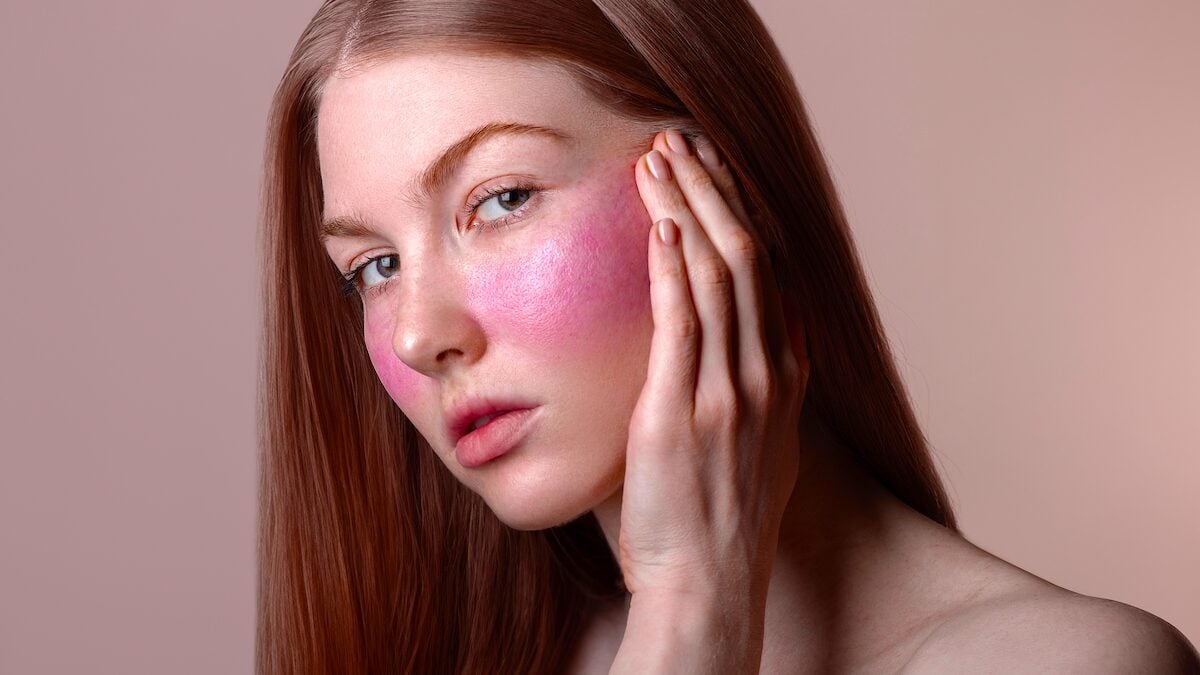
In the ever more extravagant world of beauty trends, some fashions surprise… and others are frankly confusing. The menstrual mask is part of this second category. Popularized on TikTok and Instagram, this practice consists of applying menstrual blood to your face as a “natural” treatment.
A trend between care, spirituality and empowerment
The hashtag #periodfacemask has billions of views, and promises both “skin regeneration” and “reconnection with the feminine”. An intimate practice, often presented as liberating, mystical or ecological.
For those who adopt it, the menstrual mask is not just a treatment: it is a ritual. Some see it as a gesture of emancipation, a way of honoring a fluid that has long been taboo. Others speak of an act of reconnection to the body, or even of a link with ancestral practices.
The promises: stem cells, regeneration, healing…
In the majority of videos, the ritual is simple: you apply the blood, leave it on for a few minutes, then rinse. No strict rules, no precise dose, no validated protocol.
However, defenders of menstrual masks often put forward the same argument: this menstrual blood would be rich, powerful and regenerative.
And it is true that its composition is surprising.
- Proteins;
- Cytokines;
- Bioactive molecules,
- And especially menstrual stem cells (MenSCs), which are now widely studied.
However, under strictly controlled conditions, scientific work has shown that extracts purified menstrual flow could promote healing. In some in vitro experiments, wounds treated with menstrual plasma healed faster than with conventional blood plasma.
Some researchers are even imagining biosynthetic dressings inspired by menstrual flow to treat chronic wounds.
So yes, menstrual blood has fascinating biological potential. But, and this is an essential “but”, this potential has nothing to do with the artisanal application of an untreated fluid to one’s skin.
What the science says about menstrual masks: no evidence of topical effectiveness
In reality, no clinical study demonstrates that menstrual blood applied to the skin has an anti-aging, healing or regenerating effect. And the reason is simple: the potentially interesting molecules are too large to cross the skin barrier.
Gynecologist Dr Odile Bagot, questioned by True Medical, is categorical:
“Stem cells and beneficial substances do not pass through the epidermis. In itself, that is of no interest. We have proven absolutely nothing”.
Furthermore, the menstrual blood used in medical research has nothing to do with that collected at home, in the bathroom.
“Menstrual blood must be cleaned, purified, sterilized. We are absolutely not talking about the same product.”
Clearly for the doctor, the scientific promises circulating on TikTok are an abusive extrapolation of work carried out… in the laboratory, on burns or wounds, with samples processed, secured and analyzed. Not with a cotton swab, a reusable jar and a viral tutorial.
An opinion shared by other experts…

Infections, germs, STIs… Risks that stick to your skin
If the benefits are not possible, on the other hand, the disadvantages are much more real. Unlike sterile medical care (like PRP injections, sometimes nicknamed “vampire treatment”), self-collected menstrual blood is anything but sanitized.
It passes through the vagina, a complex environment naturally populated by microorganisms.
“Menstrual blood can contain staphylococcus, fungi, or even herpes. On irritated or damaged skin, the risk of infection is very real. This is not recommended at all” lists Dr. Bagot.
Conversely, PRP and associated medical techniques are carried out under strict sterile conditions, with suitable equipment, by professionals.
Science doesn’t say that menstrual blood is “dirty” or “toxic.” In this way, the fact that menstrual blood is no longer taboo is a good thing. But she simply says that its therapeutic use requires a medical framework, complex treatments, and hygiene that home practices cannot offer.