
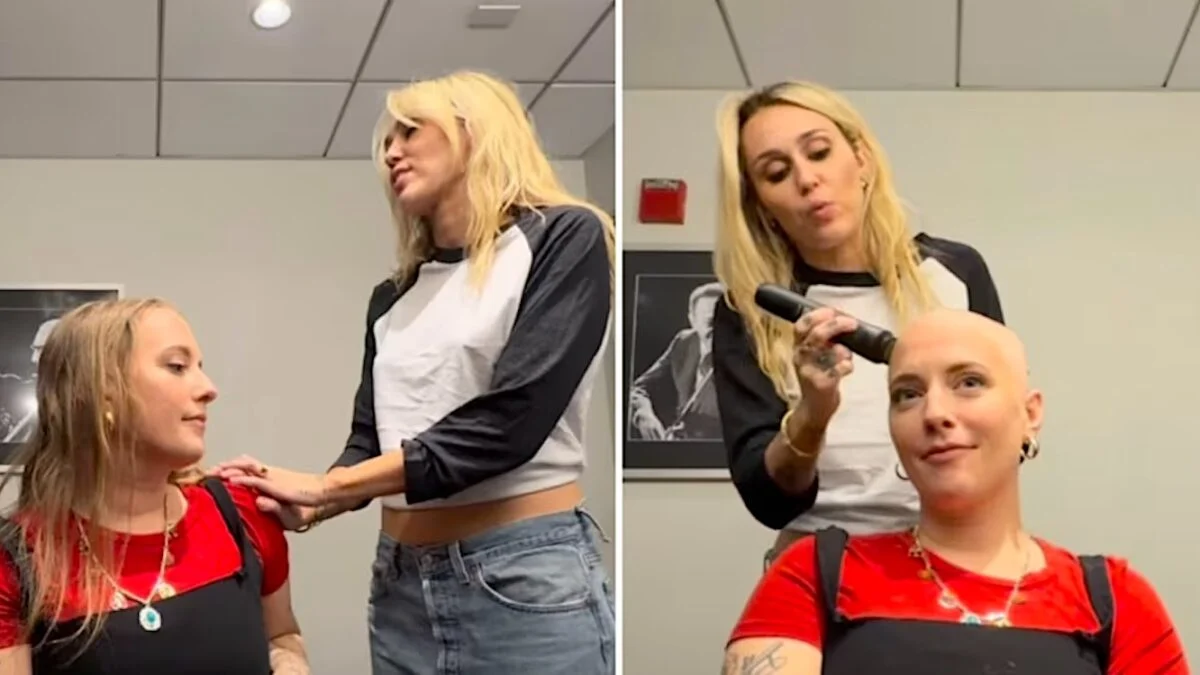
In the video, the sound of the lawnmower comes after a slightly nervous smile. Miley Cyrus stands near Cash Jacobs, American musician and fan of the singer, then begins to shave his head. The scene, filmed in Los Angeles after a concert at the Hollywood Bowl and shared on October 21, was relayed by NBC News and by Vice.
Cash Jacobs is presented by these media as having stage 3 breast cancer and preparing for the announced start of her chemotherapy. This gesture is not medical advice : it above all reminds that, when hair loss is expected, shaving before can be a personal choice, never an obligation.
How did this meeting with Miley Cyrus take place?
According to NBC News, Cash Jacobs had recounted his journey on social networks and expressed a very specific wish: that Miley Cyrus would be the person who shaved his head. Internet users relayed her request by identifying the singer, until her team responded. The meeting was organized around a Miley Cyrus show at the Hollywood Bowl in Los Angeles.
In a post cited by NBC News, Cash Jacobs thanks the singer for making him feel safe and comfortable in what she describes as one of the scariest and most intimate moments of his life. In the video, Miley Cyrus simply says
Let’s go girl before using the mower. The article also reports a lighter moment, where the singer reassures Cash Jacobs about his appearance.
The story resonated because it mixed celebrity, vulnerability and support.
Shaving before hair loss: a must?
No. Certain chemotherapies can cause alopecia, that is to say a loss of hair and sometimes body hair, but this is not systematic. The National Cancer Institute points out that alopecia can be partial or total, that it depends in particular on the molecules and doses, and that treatments such as taxanes or anthracyclines may be affected.
When it occurs, the fall generally appears two to three weeks after the start of chemotherapy, sometimes from the first session. It is most often temporary and reversible, with regrowth after stopping treatment, even if the appearance of the hair may change initially. To understand this link between chemotherapy and hair loss, the safest way is to question the team following the planned treatment.
It is up to the sick person to cut, shorten or shave their hair. A short haircut can help some people get ready. Others prefer to wait, keep their hair as long as possible, wear a scarf, choose a wig or not cover anything. The National Cancer Institute advises, if seeing your hair fall out becomes too painful, to seek help, for example from a hairdresser, rather than experiencing this moment alone if this is not desired.
Available work on chemotherapy-related alopecia describes a significant impact on body image, quality of life and psychological well-being. However, they do not prove that shaving your head in advance systematically improves the experience.. What may help one person may be too brutal for another.
How can you help without making the decision for them?
When faced with a person starting chemotherapy, those around them often look for the right words. The most useful thing can be very simple: ask how she wants to be supported. Some people will want a symbolic moment with loved ones. Others will prefer a discreet meeting, or no special presence. Comments about appearance, even well-intentioned, can be experienced as minimization.
A few guidelines can help let the person keep control:
- Ask if she wants to talk about her hair or something else;
- Avoid sentences like it’s just hair
; - Offer concrete help, without imposing it: support, finding a hairdresser, choosing a scarf;
- Leave the possibility of changing your mind, including at the last moment.
In France, practical questions can also be discussed with the healthcare team. Wigs and certain hair accessories may be subject to a prescription and covered by Health Insuranceaccording to regulated conditions. This point is worth asking early, as it can alleviate some of the cost and allow you to choose before the drop becomes too visible.
For patients, the challenge is not to reproduce a viral moment, but to preserve a space for decision-making in a care pathway where many things are already beyond their control.