
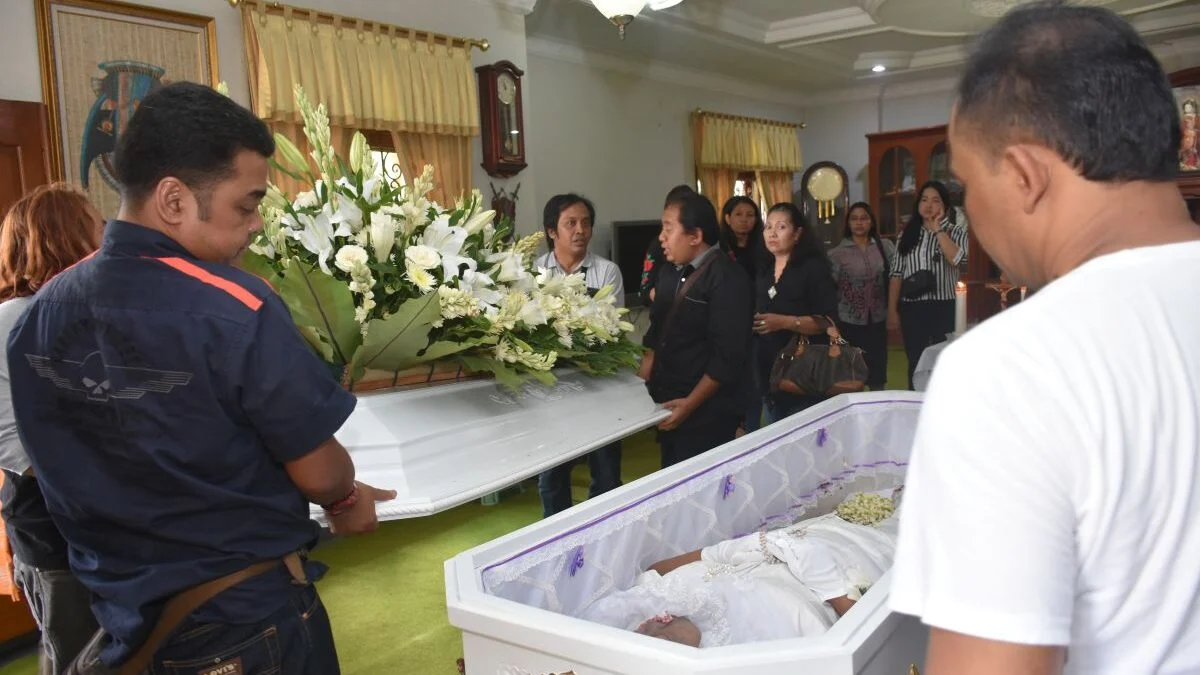
In Guatemala, in the small village of El Jocote (commune of Sacapulas), a 15-year-old girl, Yuleidy Ixcotoyac, whom her family believed to be dead, suddenly regained consciousness in the middle of her own funeral wake.
A scenario worthy of a horror film
The facts, which occurred on Saturday October 10, were reported by the local television channel TV Sac then relayed by the news site Infobae. It all started the night before, when the young girl felt violent discomfort accompanied by severe chest pain. “My heart started to hurt a lot, I felt it heavy and I lost consciousness“, said the survivor.
Panicked, her father, Abraham Ixcotoyac Tojin, quickly put her in the car to take her to the emergency room. But on the journey, no longer seeing the slightest sign of breathing and not feeling any pulse in the wrist, the father convinced himself of the worst: his daughter had just taken her last breath.
Without going to the hospital and without any doctor being able to examine him, he turned around, bought a coffin from a local funeral home and arranged the farewell ceremony for that afternoon.
“She stood up suddenly”: the family’s astonishment at the coffin
At 2:30 p.m., while relatives, neighbors and members of the religious congregation were gathered around open beer in the family yard, the unthinkable happened. It was Lesvia Rios, Yuleidy’s mother, who noticed the first movements. Near the coffin, she saw her daughter’s body moving gently before opening her eyes wide.
There followed cries of astonishment and distress from the assembly: the teenager had just suddenly stood up. Videos that have gone viral on social networks show stunned relatives handing him a glass of water before helping him get out of his wooden box. For the very pious family, there is no doubt: it is a divine intervention. “It was a miracle, I have no words to thank God.” confided the young girl, awakened from this waking nightmare.
False death and Lazarus syndrome: what really happened?
As spectacular and extremely rare as this event is, medicine has already documented similar stories. We sometimes speak of “Lazarus syndrome”, in reference to the biblical character brought back to life, to designate this spontaneous return to normal blood circulation after an apparent cardiac arrest.
Recent cases in India, the United Kingdom and France have reminded us that the line between life and apparent death can sometimes lead to confusion in the absence of medical expertise.
In the case of the young Guatemalan woman, the explanation most likely lies in a dramatic error of judgment committed by loved ones under the influence of emotion and stress, combined with vital constants that have become imperceptible to the naked eye.
Why noting a death cannot be improvised
Questioning death requires a strict clinical protocol that an individual cannot improvise. As Dr Gérald Kierzek, emergency physician and medical director of True Medical, recalls:
“The diagnosis of death is clinical, almost empirical. In fact, there is no additional examination, such as an X-ray or a blood test, to make this diagnosis. The latter is based, in practice, on a “cluster of arguments” such as the absence of pulse, respiration or electrical activity of the heart (flat electrocardiogram).”
The lack of examination by a health professional therefore largely explains this terrible misunderstanding. The pulse of a person in shock or suffering from a severe heart problem can become almost impossible to find for a layman. Dr Gérald Kierzek also specifies the traps into which one can fall when making such an observation. “We are very wary of profound bradycardia, which is characterized by a heart rate so low that the pulse may appear absent, drug poisoning or even hypothermia, which can lead to the wrong conclusion of death even though the person is not dead.
In short, this story, although it ends with immense relief for the Ixcotoyac family, highlights a fundamental health imperative: the declaration of death remains a critical and irreplaceable medical act. Without the obligatory presence of a doctor to certify clinical death, the risk of a tragic diagnostic error – although extremely rare – remains very real.