
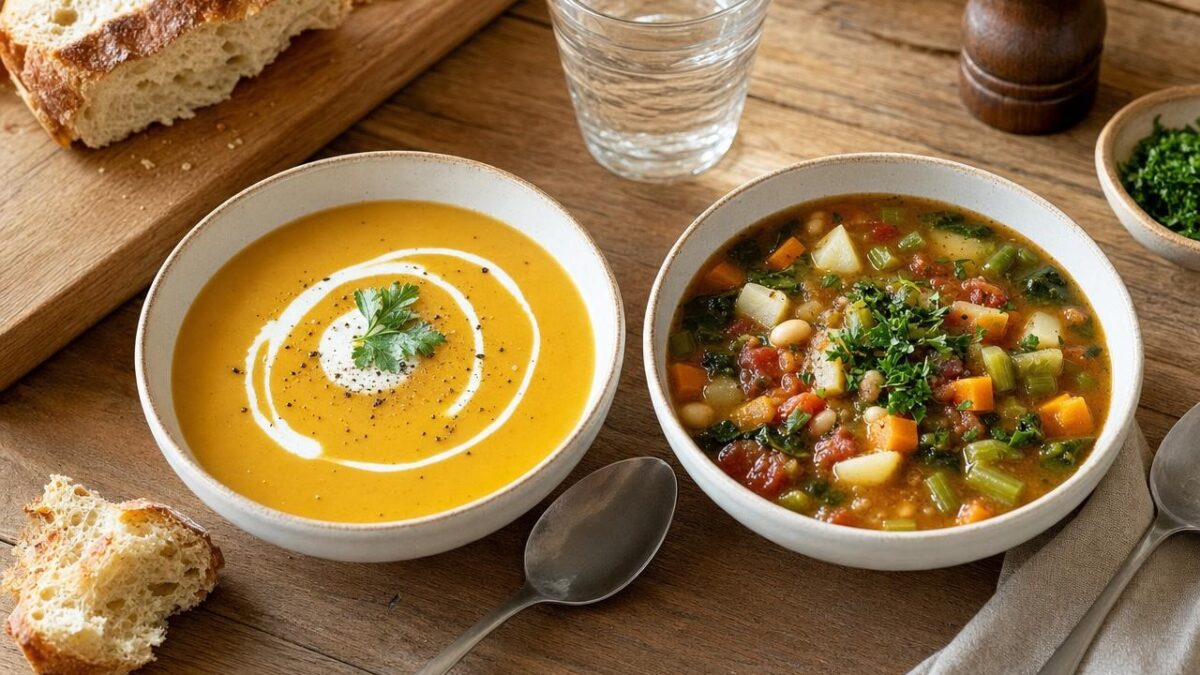
Between the slimming advice circulating and the promises of soup-making robots, one idea keeps coming back: a very thick soup, full of pieces, necessarily “sticks” more than a smooth soup. However, when researchers tested this intuition in the laboratory, with equal calories, the result was not so clear-cut.
In a study published in 2007 in the scientific journal
AppetiteJulie E. Flood and Barbara J. Rolls, of Pennsylvania State University, compared four forms of the same vegetable soup: broth + separated vegetables, soup with pieces, half-mixed soup, fully mixed soup. Their goal: to see if the texture changes the satiety and the energy intake of the meal, in a crossover trial on 60 adults. The answer shakes up a lot of preconceived ideas… and refocuses the debate on something other than just texture.
Mixed or chunked soup: what the study really shows
Each participant ate lunch five times: once without soup, and four times with a
soup preload different, always based on the same ingredients, with the same energy density (0.33 kcal/g) and volumes adapted to gender. Fifteen minutes after this compulsory entry, everyone received the same dish of tortellini as desired, and ate “ad libitum”, that is to say according to their real appetite.
Central result: as soon as a soup was served as a starter, the participants ate less tortellini and, in total, around 20% fewer calories at lunch, or 134 ± 25 kcal (around 560 kJ) less than in the “no soup” condition. The researchers write that “when the soup was consumed as a preload, subjects reduced total lunch energy intake by 20%.” On the other hand, no form of soup (pieces or mixed) stood out: the differences in intake between textures were not significant, and the feelings of hunger after the meal were comparable.
Why texture matters less than energy density
What changes everything here is the couple volume
+ low energy density. By eating a large quantity of liquid loaded with low-calorie vegetables, the stomach is filled at a limited energy cost. In this study, Flood and Rolls note that subjects swallowed a higher total weight of food with soup, but for lower total calories, thanks to an average density of 1.0 kcal/g compared to 2.2 kcal/g without soup.
The authors mention several mechanisms: stomach distension, slower gastric emptying, hormonal responses. Other works cited, such as those of Marina Santangelo or Mauro Peracchi in the British Journal of Nutritionshowed that a mixed vegetable soup could slow down gastric emptying and increase meal-related expenses compared to the same vegetables accompanied by a simple glass of water. But in Julie E. Flood’s trial, increasing the viscosity (more blending) was not enough, on its own, to make people eat less than the thinner versions.
At home: choosing the soup that’s really delicious
For everyday life, this literature says one thing above all: between mixed soup And soup with piecesthe best choice for
satietywith an identical recipe, is one that you find enjoyable and that you will take the time to eat. What weighs the most are the vegetables in quantity, the water included in the dish, and moderation on cream, cheese or butter which quickly increase the calories per spoon.
If you tend to “drink” your velouté too quickly, adjusting the temperature, the size of the bowl, a smaller spoon or small toppings (herbs, a few diced vegetables) can slow down ingestion without changing the recipe. And if you want a soup to be more body-friendly as a single dish, the issue is no longer the texture but the measured addition of proteins (legumes, egg, cheese) and starchy foods, keeping in mind that each addition also increases the calorie addition.