
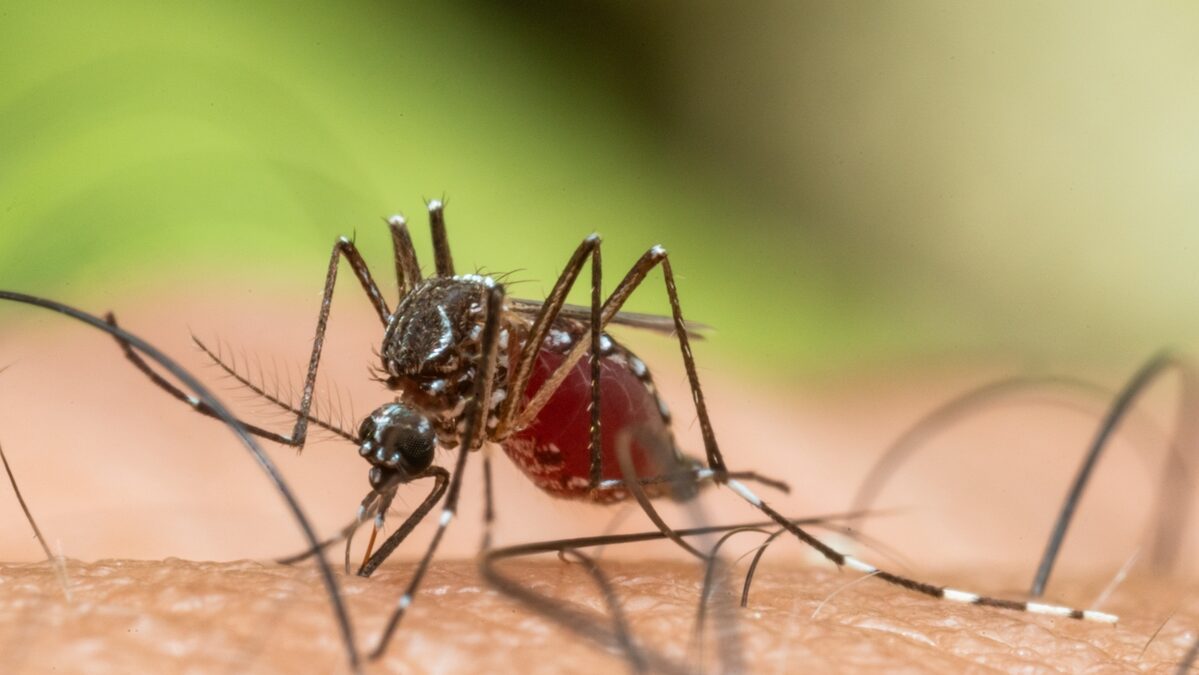
While health authorities are closely monitoring the development of these diseases in France, specialists are calling for vigilance without giving in to alarmism. Explanations on the reasons for this proliferation and the most effective means to limit bites.
Why mosquitoes seem to have gotten a head start this year
For many French people, the observation is the same: mosquito bites started well before the holidays. An impression that is not only subjective. The particularly mild temperatures of spring provided ideal conditions for mosquitoes to develop. Their life cycle depends closely on heat: eggs hatch more quickly, larvae grow faster and adults become active earlier.
Result: several generations can succeed one another during the same season.
Climate change is further accentuating the phenomenon. Less harsh winters allow more eggs to survive until spring, while warm spells encourage their reproduction.
Among the species most affected is the tiger mosquito, which has become an almost permanent inhabitant of the French landscape in just a few years. Long confined to the south of the country, it is now established in almost all of France.
“Its progression is further accentuated by the effect of global warming and its adaptation to urban environments.underlines Dr Gérald Kierzek, emergency doctor and medical director of True Medical.
Experts are also observing an unusual precocity this year. In the columns of Parisianmedical entomologist Guillaume Lacour explains: “There are no more tiger mosquitoes than in previous springs, but the season started earlier than usual, so this risks influencing their numbers to increase in the middle and end of the year..
Added to this is a very concrete factor: human activity. A simple dish under a flower pot, a blocked gutter or a poorly covered water collector can be enough to accommodate hundreds of eggs. In urban areas, these micro-reservoirs constitute a particularly favorable breeding ground.
However, this proliferation is not just a summer nuisance. Because certain mosquitoes carry viruses, the progression of which health authorities are carefully monitoring.
Dengue, chikungunya, Zika: behind the bite, diseases under surveillance
Every year, specialists fear the same scenario: that a tiger mosquito present in France bites an infected person returning from a trip and then transmits the virus to other inhabitants. This is what we call an indigenous case. The figures show an increasing circulation of these diseases. According to Public Health France, more than 500 imported cases of dengue and more than 50 imported cases of chikungunya had already been reported in France since the start of 2026.
Last year, mainland France experienced an unprecedented situation with more than 800 indigenous cases of chikungunya, a historic record.
Dengue also remains a major concern. This viral disease generally causes high fever, significant muscle and joint pain, headaches and sometimes bleeding complications.
Chikungunya is characterized by joint pain that is sometimes very disabling, which can persist for several months after infection.
But another virus is particularly attracting the attention of researchers: Zika. “It is more worrying because it is much less known”warns virologist Yannick Simonin in The Parisian. The specialist also recalls that “was almost unknown until 2016, when the World Health Organization implemented massive funding programs..
If the number of cases remains low in France, scientists are closely monitoring certain signals from Asia where an increase in infections has recently been observed. The Zika virus presents several worrying characteristics. It can be transmitted by mosquitoes, but also during sexual relations. Above all, it represents a major risk for pregnant women.
The consequences of an infection during pregnancy can be dramatic with reduced head circumference (microcephaly), neurological complications or even abortion…
Beyond the tiger mosquito, another insect is the subject of increasing surveillance: the common mosquito of the genus
Culex. This can transmit the West Nile virus, which is responsible for sometimes severe neurological forms. In 2025, 62 indigenous cases were recorded in France, including three deaths.
Faced with these emerging threats, research is intensifying. In the laboratories of the Pasteur Institute, scientists are trying to better understand the mechanisms of transmission. In particular, they are studying the time it takes for a mosquito to become infectious after absorbing a virus.
“This process takes more or less time depending on the disease: one week for dengue, fourteen days for Zika.explains Rachel Bellone, mosquito specialist at the Pasteur Institute in The Parisian.
Researchers are also exploring new strategies to limit the proliferation of these insects, in particular the use of bacteria capable of blocking the transmission of viruses or the release of sterile male mosquitoes. Promising avenues, but still under evaluation.
Simple actions that can really make a difference
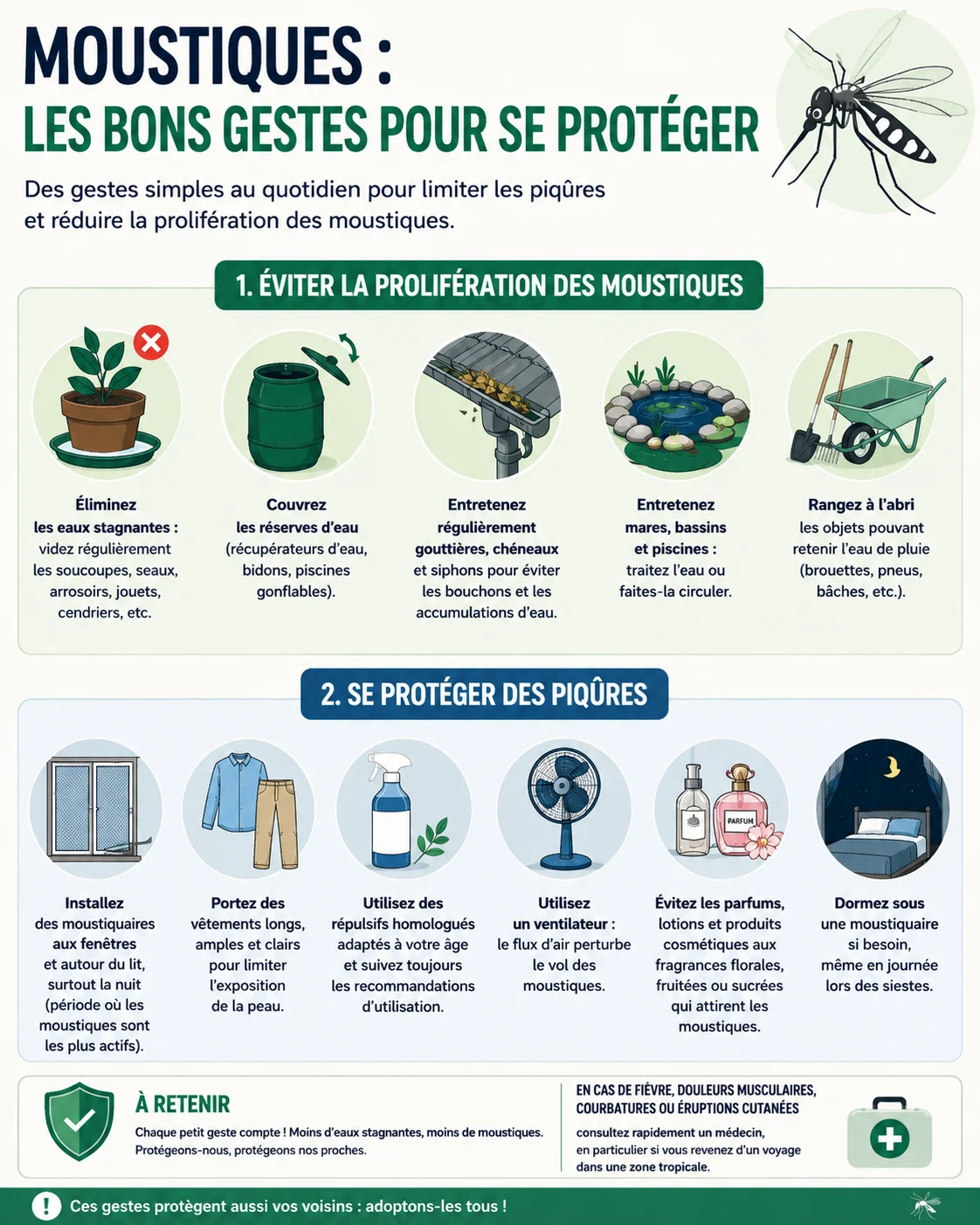
When it comes to mosquitoes, there is unfortunately no infallible protection. However, specialists agree on one point: it is the combination of several measures that offers the best effectiveness.
Dr Gérald Kierzek recommends in particular:
- Install mosquito nets on windows and around beds;
- Eliminate all stagnant water around the home;
- Cover the water collectors and regularly maintain the gutters;
- Wear long, loose, light-colored clothing;
- Use approved repellents adapted to your age and situation;
- Avoid perfumes or cosmetics with very sweet or floral fragrances;
- Use a fan in living rooms, the air flow disrupts the flight of mosquitoes.
The researchers also point out that a simple cap filled with water can be enough to become an egg-laying site. The fight against mosquitoes therefore often begins a few meters from home.
 © True Medical
As heat episodes become more frequent and the tiger mosquito continues to advance across the territory, this collective vigilance takes on new importance. Because behind an insect that many still consider to be a simple summer nuisance, there is now a real public health issue at play. Between scientific research, health surveillance and everyday actions, the battle against mosquitoes has become one of the new realities of French summers.