
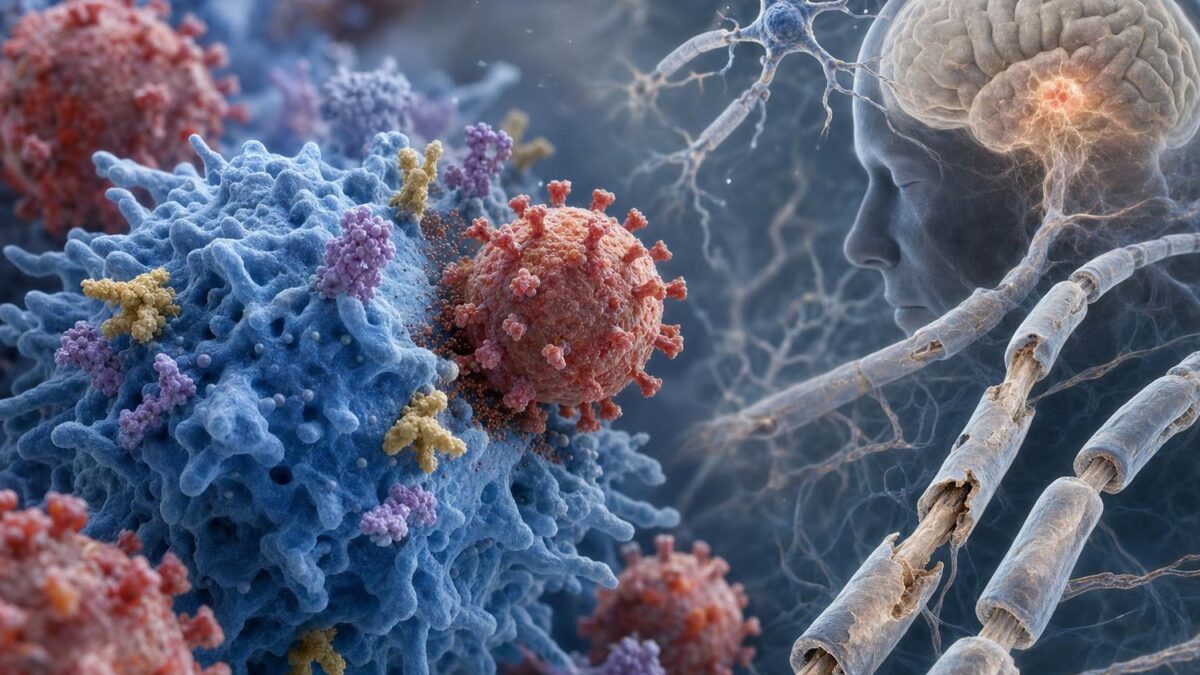
A team from the Institute for Experimental Immunology at the University of Zurich describes how in addition to infection with the Epstein-Barr virus, genetic risk factors play a special role in the development of multiple sclerosis.
Why the Epstein-Barr virus will it cause MS in some people?
A common virus infects about 95% of adults, but only a minority develop chronic illness. This virus is the
Epstein-Barr virus (EBV), linked to multiple sclerosis, especially when it causes mononucleosis in adolescence. However, most infected people will never develop multiple sclerosis, which suggests a decisive role for genetic predispositions. This is what led a team from the Institute of Experimental Immunology at the University of Zurich to focus on B lymphocytes infected by the Epstein-Barr virus (EBV). B cells are part of our immune system and help us fight infections. But in the case of multiple sclerosis, they help to mistakenly identify myelin as a target to attack.
B cells contain a substance called human leukocyte antigen (HLA). This particular protein allows our immune system to distinguish body cells from foreign ones. It accomplishes this by displaying fragments of viruses and bacteria, signaling to the immune system that these are potential dangers. The HLA system presents a great diversity of variants, influenced by the genetic heritage of each person. Previous studies have found that individuals with a particular HLA type, known as HLA-DR15, have a higher risk of developing multiple sclerosis.
How Epstein-Barr and HLA-DR15 attack myelin together
Responsible for eliminating infected cells, T lymphocytes identify elements of the Epstein-Barr virus. This virus also infects B lymphocytes, another type of immune cell, where it remains present throughout the patient’s life. “Normally, T cells and antibodies produced by B cells control infection very effectively and prevent reactivation of the virus.”specifies Professor Roland Martin, from the Institute of Experimental Immunology at the University of Zurich.
The researchers infected B lymphocytes, which the Epstein-Barr virus colonizes for life, then analyzed the protein fragments they present via HLA-DR15. In these people carrying the HLA-DR15 variant, the Epstein-Barr virus (EBV) modifies the expression profile of activated genes in infected B lymphocytes, causing them to produce myelin protein (including the peptides MBP(78-90) and MBP(83-90)), a key target structure in multiple sclerosis.
These false signals sent to the immune system cause it to view myelin as a threat and attack it. This phenomenon was not observed in EBV-uninfected B cells. The same phenomenon was observed in brain tissue from patients with multiple sclerosis, a sign that the same language connects the blood and the brain. Responsible for guiding the immune response, memory CD4+ T lymphocytes, taken from the blood and cerebrospinal fluid of these patients, react to the identified myelin proteins, whereas the response is rare in healthy controls.
When the tolerance of the thymus lets dangerous T cells pass
The mechanism seems updated. Once activated with this bad signal, these T lymphocytes will attack the myelin sheath that surrounds the nerve fibers, causing paralysis, visual disturbances or intense fatigue. Furthermore, researchers have shown that this phenomenon escapes the control of the thymus, where the body normally eliminates lymphocytes that recognize its own proteins too strongly. Result: this autoimmune reaction can persist.
This mechanism helps explain why near-universal infection leads to multiple sclerosis only once in 1,000.”Our study shows how the most important environmental and genetic risk factors can contribute to multiple sclerosis and trigger an autoimmune response that targets myelin components in the brain“, says Roland Martin, from the University of Zurich.
What avenues for Epstein-Barr vaccines and therapies
This virus plays a major role not only in multiple sclerosis, but also in other autoimmune diseases such as rheumatoid arthritis and systemic lupus erythematosus, and can cause certain cancers. “Our results reveal mechanisms that could be targeted by new therapies“, underlines Professor Martin.
Teams, biotechs and laboratories are developing vaccines against EBV to try to reduce the risk of multiple sclerosis. This work reinforces the interest in treatments targeting B cells and opens avenues for other autoimmune diseases linked to EBV.