
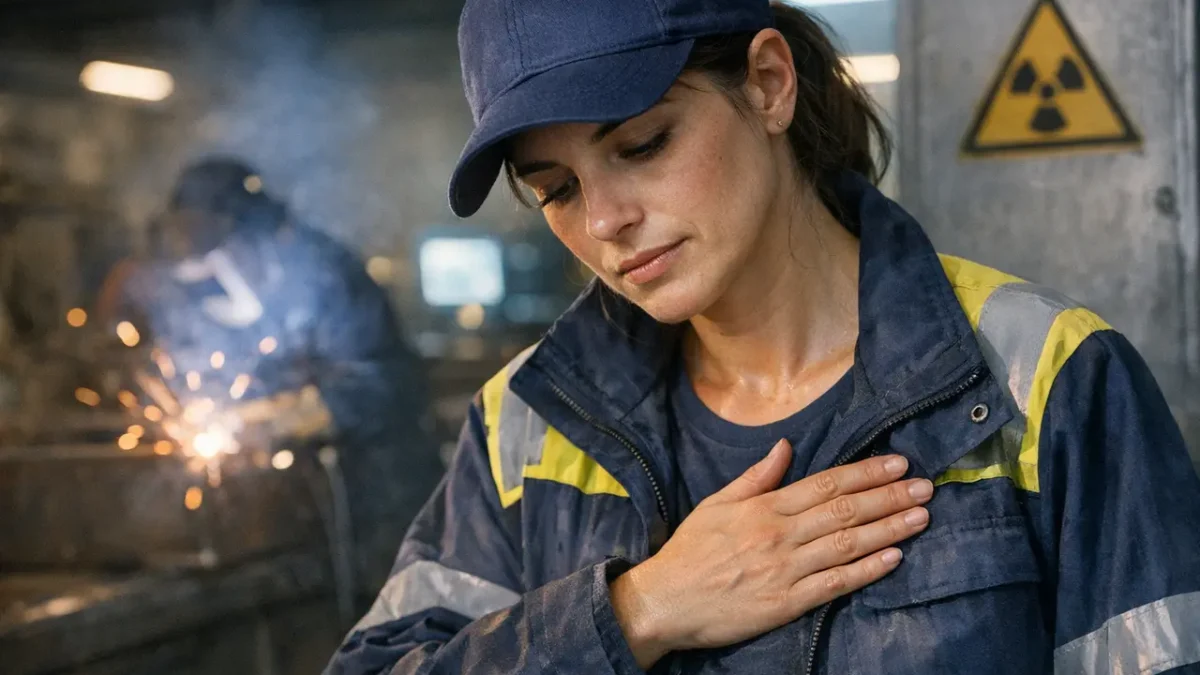
On Instagram, Dr Olivier Marpeau aka @mon.gyneco warns about professions that could expose you to factors linked to breast cancer. The nuance is important: it is not the job itself that is at fault, but certain exposures, especially ionizing radiation and prolonged night work.
Which professions are most affected?
The gynecologist first cites already known factors for breast cancer, such as age, alcohol, being overweight or family history. Work can be added to this context, but it does not, on its own, predict individual risk. The level of risk depends in particular on the type of exposure, its duration, its intensity and other risk factors for breast cancer.
The best established exhibitions concern
ionizing radiation. Dr Marpeau mentions women working in radiology or nuclear power, as well as aircrew exposed to cosmic radiation. X-rays and gamma rays are proven carcinogens for humans and are particularly associated with female breast cancer. An Air France stewardess recently had her breast cancer recognized as an occupational disease. This does not mean that everyone working in these sectors will develop cancer, but that exposure should be assessed and limited as much as possible.
The second major subject is extended night worksuch as caregivers in hospitals, clinics or nursing homes, workers in 3/8 shifts, the police, the gendarmerie or even security agents. The International Agency for Research on Cancer classifies night work as probably carcinogenic to humans. Here again, caution: the evidence in humans remains limited, particularly for breast cancer, and statistical association and certain causality must be distinguished. To find out more, True Medical has devoted an article to the link between night work and breast cancer.
Finally, the expert mentions multiple chemical exposures : endocrine disruptors in certain industries, organic solvents in textiles or dry cleaners, pesticides in agriculture, dyes and hair products in hairdressing salons. This is a point to be presented with greater reserve: for these substances, the link with breast cancer has not been formally demonstrated in each profession, even if signals justify the prevention and monitoring of exposures. Exposure to endocrine disruptors remains an important environmental health issue.
Good reflexes to reduce your exposure
The essential message consists of two pieces of advice: check the protections put in place at work and inform the professional who provides gynecological follow-up. These reflexes are relevant, provided we do not infer that enhanced screening would automatically be necessary for all the women concerned.
Concretely, if you work in a sector exposed to radiation, night work or certain chemical substances, several steps can help clarify the situation:
- Identify exposures precisely : radiation, repeated night shifts, products handled, duration and frequency of exposure;
- Ask the employer or the prevention service what measures are planned: organization of work, limitation of exposure, protective equipment when applicable;
- Contact occupational healthwho is the central contact for assessing professional risks and proposing adaptations if necessary;
- Report these exposures to the attending physician, midwife or gynecologist during usual follow-up, so that the overall risk can be assessed with all personal and family history;
- Do not change your medical follow-up alone: reinforced surveillance is not automatic and is discussed on a case-by-case basis.
For radiation, Dr Marpeau recalls the benefit of radiation protection equipment, such as leaded aprons, when indicated. But prevention does not rely solely on individual equipment: it begins with job evaluation, reduction of exposure and work organization. In aviation, for example, exposure to cosmic radiation depends mainly on the flights carried out and is not managed in the same way as in radiology.
For night work, the subject is more complex: it is not a question of asserting that a night shift directly causes breast cancer in a given person. The research rather points to a possible excess risk in the long termlinked to the disruption of biological rhythms. This is why the main issue is to talk about it during occupational health monitoring, especially in the event of prolonged exposure or cumulative exposure with other factors.