
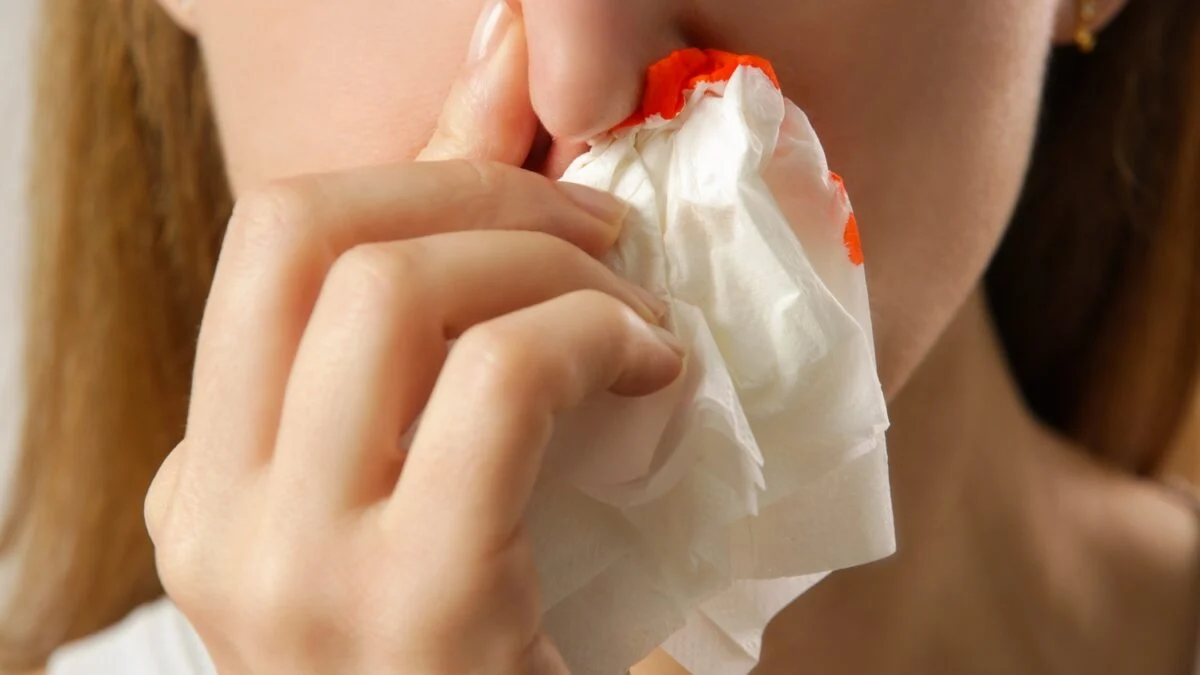
Blood arrives without warning, above the sink, in the playground or when you wake up. A nosebleed quickly impresses, even when it is a limited episode. And in an emergency, the first action that many still try is to raise their head to “stop” the flow.
The useful reflex is quite different: sit, lean slightly forward and compress the nostrils for ten minutes without releasing. For a small bleed, this behavior is often enough to regain control, provided you do not check every thirty seconds.
Why should you avoid raising your head?
Throwing your head back is a common bad reflex. It gives the impression that the blood is flowing less, since it no longer comes out through the nose as much. But it may just flow backwards, into the throat.
Result: the person may swallow blood, which promotes nausea and can confuse the assessment of bleeding. So the right goal is not to hide the discharge, but to allow the nose to bleed forward while still applying effective pressure.
Another trap: releasing too soon. The compression must be continuous to give the bleeding time to stop.
Setting a timer is often more effective than looking at your watch and wondering if “it should be over already”.
What to do with a small nosebleed?
When the bleeding seems limited and the person is well, Health Insurance recommends simple actions, to be carried out in order and without haste.
- Sit downthen tilt your head slightly forward. Breathe through your mouth;
- Blow your nose gently once, if necessary, to remove large clots. Avoid blowing hard or repeating the gesture;
- Pinch both nostrils between the thumb and index finger, just under the hard part of the nose;
- Keep the pressure on for ten minutes without releasing.
If bleeding continues after ten minutes, the compression can be repeated for another ten minutes. On the other hand, if the bleeding persists despite these actions, you should seek medical advice.
The detail counts: pinching too high, on the hard part of the nose, does not have the same effect. The pressure should be on the soft part of the nostrils, where it can really help stop the flow.
When should you call the emergency services?
Some signs change the situation. If the blood is flowing profusely, if the person feels unwell or if the bleeding occurs after a serious or significant trauma, particularly after an accidentyou must call 15 or 112.
Vigilance is also increased in people who take anticoagulant or antiplatelet treatment. You should not stop this treatment alone, but it is important to report it to your caregivers. Heavy bleeding in this context also warrants an urgent call.
After the bleeding stops, the nose remains fragile. Health Insurance advises avoiding blowing your nose for at least twelve hours and not scratching or rubbing the inside of your nose. Also avoid putting anything in there; If you have to sneeze, do it with your mouth open.
Dr. Gérald Kierzek, emergency physician and Medical Director of True Medical adds an important point: “It is also recommended to measure blood pressure during epistaxis, then to medically control persistent hypertension after the episode, particularly in the event of severe or recurrent bleeding.“
The point to remember often takes a few minutes: stay seated, head forward, and hold the compression until the end. This is generally the moment when we want to check who is worth waiting for.