
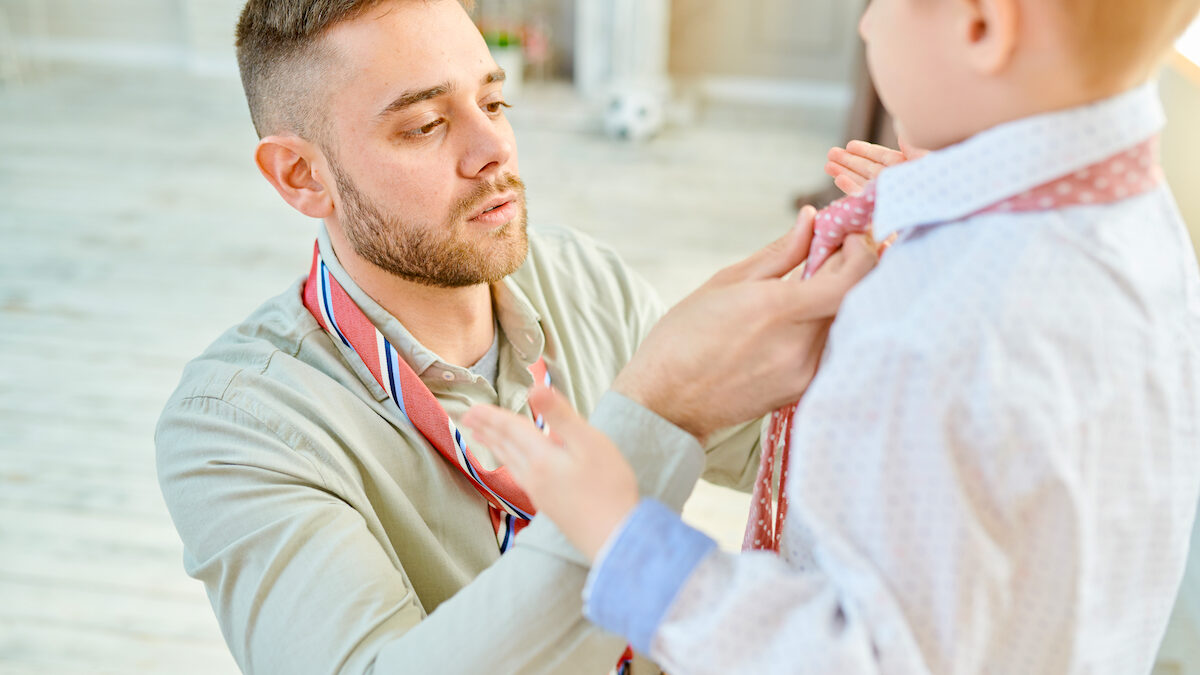
Using your first razor, tying a tie, repairing a bicycle tire… In a typical family life, it’s easy to imagine these tasks being explained by a listening dad. Except that reality is sometimes different, and it happens that we grow up without our father. And without his valuable advice, therefore. It is to counter this injustice that a man created a YouTube channel that has gone viral: “Dad, how do I?”. A channel that simply answers all these practical questions that we would have liked to ask one day.
A childhood marked by absence… and resourcefulness
Rob Kenney, the 57-year-old YouTuber, knows what he’s talking about. At 14, his father left the family home, never to return. A brutal breakup that leaves a void… and many unanswered questions.
“There were lots of things I didn’t know how to do. So I had to fend for myself“, he confides. An experience that he shares today with millions of Internet users. Because behind his very concrete tutorials, there is above all a desire: to transmit what he has not received.
Having become a father in turn, he raised a boy and a girl, and discovered the fundamental role of transmission. Then, in the middle of a pandemic, a simple but powerful idea emerged: becoming that surrogate father for all those who lacked one.
His first videos—how to tie a tie, how to shave—immediately resonated. And very quickly, the channel expanded: cooking, sewing, DIY… Here, no clichés, just everyday gestures explained with kindness.
Today, nearly 600 videos and more than 5.7 million subscribers demonstrate a real need. In the comments, messages are pouring in: “No one ever taught me that, “Thank you for taking the time to explain calmly.”
Growing up without a father: an absence… but not necessarily a void
But ultimately, what does “not having a father” really mean? Is it a physical, concrete, daily absence? Or something more diffuse, more difficult to name: the absence of these moments of transmission, of these simple gestures which mark childhood and gradually build an adult?
Psychologist Amélie Boukhobza rightly invites us to broaden our thinking. According to her, the father figure is not limited to one person.
“The paternal function can be housed elsewhere. At school. In an institution in general. With a coach, a teacher, a grandfather, an uncle, a father-in-law… Sometimes even in a meeting.”
These are all supporting figures, benchmarks, which nevertheless allow us to grow and build ourselves.
And then there is everything that was not experienced, but was imagined. When a father is missing, we think about it, we dream about it, we fantasize about it. We invent models, we ask ourselves questions: how does a father speak? How does he reassure? How does he hold his place? This internal representation then becomes a form of compass, sometimes vague, but very real.
When lack makes you more attentive… but not necessarily more solid
In some cases, having grown up without a father can actually make you more attentive to others. More concerned too. Because what was not transmitted did not disappear: we had to look for it elsewhere, or build it ourselves. This requires effort, reflection, a form of personal invention.
“This experience can give rise to a very strong will: to do differently, to do better. To not reproduce what was lacking. To fill, for others, this void that we have experienced. There is something profoundly human, almost restorative”.
But for all that, the psychologist warns against an overly idealized vision. Lack does not automatically turn someone into an exemplary parent. It also leaves traces, sometimes discreet, sometimes deeper. Areas of uncertainty, hesitation in how to position oneself, or even difficulty expressing one’s emotions may persist. And it happens that some people doubt their legitimacy, simply because they have not had a model to refer to.
Make your story something other than a repetition
What is particularly striking about Rob Kenney’s journey is that he was not content to endure this absence. He did something with it. Where there could have been a silent lack, today there is a word, gestures, a transmission.
For Amélie Boukhobza, this is a real process of transformation. A way of taking a personal experience, sometimes painful, and putting it at the service of others. Almost a form of sublimation.
And this is undoubtedly where the strongest message lies: we are not condemned to repeat indefinitely what we have experienced. Family history is not inevitable. It can be questioned, transformed, reinvented.
Rob Kenney didn’t just learn to fend for himself. He chose, years later, to reach out to those who find themselves in the same situation. And through his videos, he proves that it is possible to transform an absence… into presence for others.