
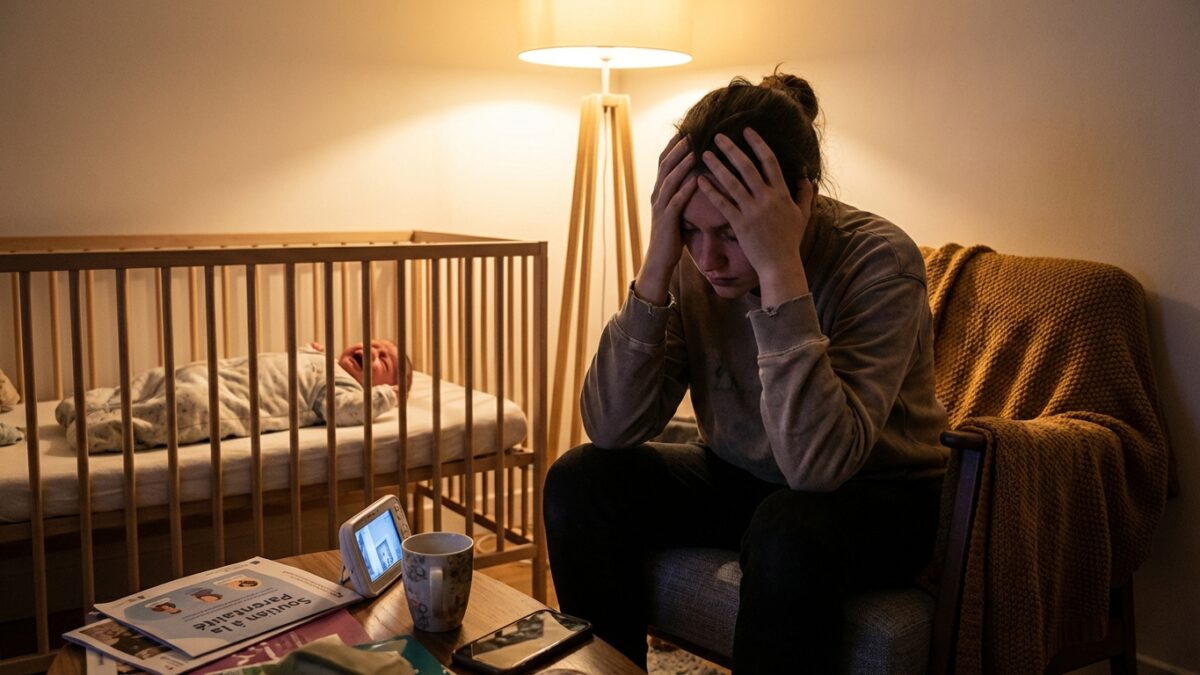
Toddlers don’t talk, don’t walk, and depend on their parents’ every move. A new international study, however, reminds us that this period, which is supposed to be the most protected, is also one of the most exposed to attacks.
Published in the journal eClinicalMedicinethis meta-analysis conducted by the University of British Columbia (UBC) and Memorial University of Newfoundland (MUN) estimates that approximately 1 in 20 babies in the world suffers at least one act of physical abuse during its first two years. Researchers compiled 20 studies, involving more than 220,000 babies and caregivers. In total,
4.8% parents report an aggressive gesture; even removing forms deemed “more tolerated” such as spanking, the prevalence remains 3.9%. A largely hidden reality.
A global meta-analysis on infant physical abuse
The World Health Organization describes physical abuse as “intentional use of force against a child” likely to harm their health, development or dignity. This ranges from a slap on the wrist or spanking to violent hitting or shaking of the infant. At the same time, global estimates suggest that up to 1 billion children aged 2 to 17 are victims of abuse or neglect each year, and infants are the age group who die most often from this violence.
The authors focused on 0–24 months, a first on this scale. When parents respond to anonymous questionnaires, 4.8% admit to at least one physical act towards their baby, with shaking appearing in 2 to 3% of responses. “About four to five percent of parents engage in physically aggressive behavior toward their babies,” said Dr. Nichole Fairbrother, clinical associate professor in the Department of Family Medicine at the University of British Columbia and director of the Perinatal Anxiety Research Laboratory.This should give us all pause and get us thinking about interventions that could change these behaviors.“.
Violence often taken for discipline
Official figures for child protection services remain much lower, often below 1–2%. Many files only concern the most serious cases, identified by a doctor, a school or the police. “Anonymous surveys allow caregivers to reveal behaviors that never reach a clinic, police department or social worker,” explained Dr. Jon Fawcett, assistant professor at Memorial University of Newfoundland and co-lead of the research, “By pooling these studies, we can estimate what is actually happening at the population level, not just what is detected.e”.
The line is even more blurred as some parents still see spanking or slapping as simple corporal punishment. However, the researchers point out that these gestures are part of a continuum of violence : the more frequent they are, the greater the risk of escalation towards severe forms. The cited work links spanking and smacking to behavioral problems, learning difficulties and more mental health problems. In France, the law now prohibits corporal punishment, but the practice persists in many homes.
Babies at high risk: prevent before slipping
An infant’s brain is built at high speed, which makes it particularly vulnerable. Shaking or hitting can cause brain damage, cognitive or emotional impairment, or even death. The authors also point out the context: broken nights, intense crying, financial difficulties, postpartum depression or domestic violence. “Early childhood is the most vulnerable stage of life, and many cases of physical abuse never appear in official statistics,” Dr. Fairbrother recalled, “Knowing the true extent of the problem is the first step to stopping it“.
Researchers call for upstream prevention. Caring for a baby causes a lot of stress, including lack of sleep, constant crying and financial concerns. This stress can cause even the most calm parents to lose their composure and act in unexpected ways. Providing practical and timely advice to new parents, such as strategies for managing crying, as well as access to crisis lines and home visiting programs, could be beneficial.
Countries that explicitly prohibit corporal punishment are sending a clear signal in their view. The study also notes a lack of data in large regions of Africa, South America and South Asia, which suggests that the figure of 1 in 20 babies probably remains below reality. In line with the UN Sustainable Development Goals, the authors call for integrating the protection of infants at the heart of policies to combat violence against children.