
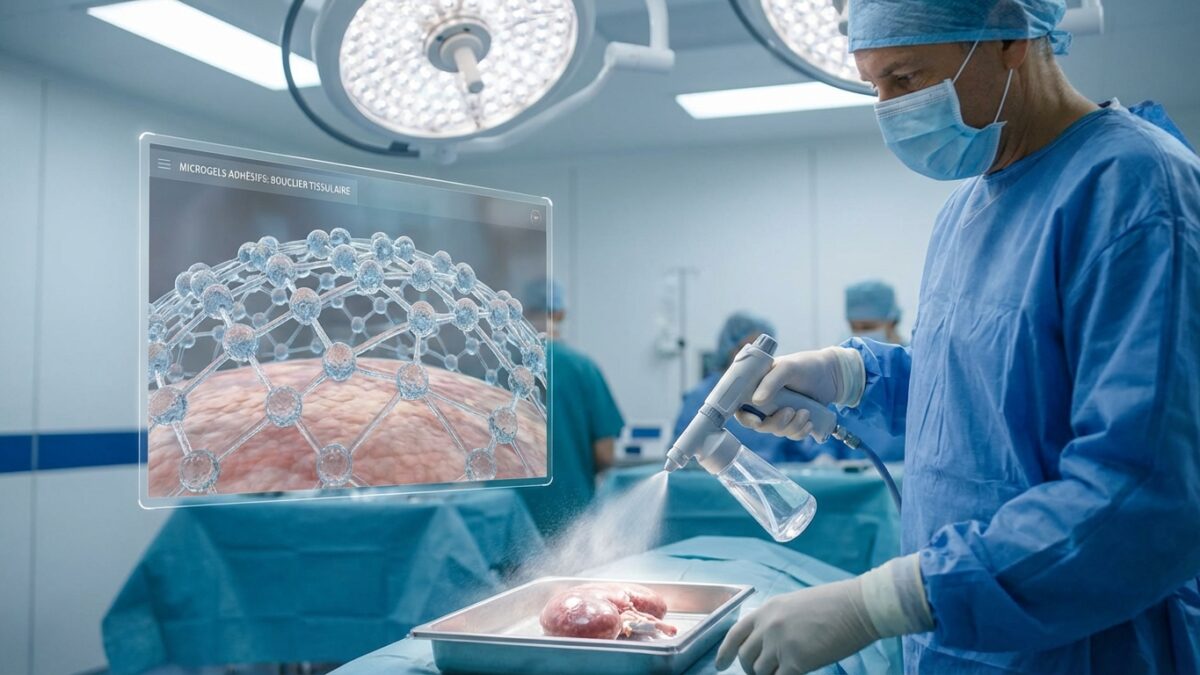
A kidney or heart transplant does not stop in the operating room. For many patients, it then means taking anti-rejection tablets swallowed morning and evening, often for the rest of their lives. A Korean team offers another path: a spray coating
deposited directly on the transplanted organ, described in the
Journal of Controlled Release.
An Immune-Shield spray applied like a film to the organ
Organ transplantation remains the best treatment to replace a destroyed liver or heart, but the graft rejection lies in wait: the immune system sees the organ as an intruder. To prevent this problem, patients are forced to consume immunosuppressants continuously. However, whether taken orally or by injection, these medications travel throughout the body, potentially causing serious side effects such as kidney toxicity and an increased risk of infections. This paradox persists: treatments designed to protect organs end up weakening the patient’s immune system.
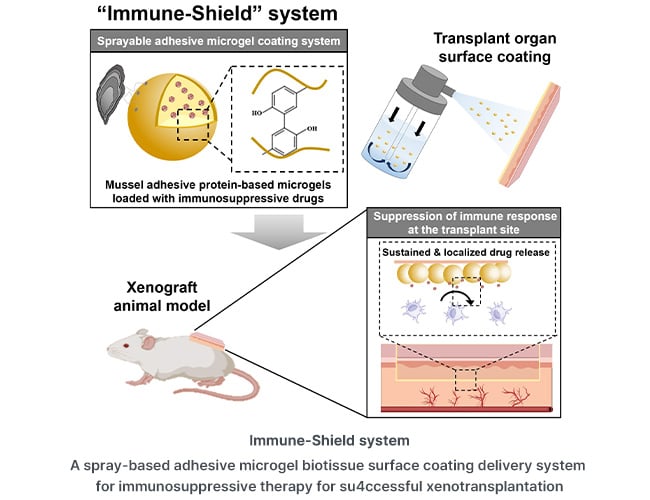
Technology Immune-Shield developed by POSTECH and Ewha Womans University is based on protein microgels inspired by the strong adhesion of mussels, even underwater. Sprayed on the moist surface of the graft, these grains of a few micrometers cling to the tissue, form an invisible layer and gradually release an immunosuppressant, cyclosporin A, exactly where the immune attack begins.
In the tests, more than half of the microgels remained fixed after several days of rinsing on pig skin, and a comparable proportion persisted for twelve days in mice. The drug was released over approximately seventeen days, with almost 90 percent of the dose delivered during this critical post-operative period, without the need for repeated injections.
 © Postech
A mussel glue for a local immune shield
The researchers were inspired by marine mussels, which are capable of remaining attached to a rock beaten by waves. The adhesive protein that they bioengineered, called “mussel adhesive protein”, adheres strongly in a humid environment and has a very flexible structure, little recognized by the body’s defenses, which makes it a discreet support for carrying the drug.
In a model of xenograft cutaneous, where rat skin is grafted onto mice, the team compared absence of treatment, cyclosporine A in solution and cyclosporine A delivered by Immune-Shield. With the spray, tissues survived more than twice as long, with fewer CD8 T cells in the graft and significantly lowered interleukin-2 levels.
What are the prospects for future transplants and xenotransplantation?
For Professor Hyung Joon Cha who led the research, the interest is to relieve the burden of long-term treatments. He summarizes his approach: “We propose a strategy to solve the long-standing challenge of immunosuppressants using mussel adhesive protein, a novel biomaterial developed in Korea“, quoted by POSTECH.
This approach mainly aims at
xenotransplantationwhere animal organs would be transplanted into humans, an area where rejection remains formidable. “As the spray method allows easy application to complex organ surfaces, it is expected to be a key technology to improve the success rate of xenograft transplantations in the future.”
adds Professor Hyung Joon Cha.
The authors point out that their data comes only from an animal skin model. Studies on whole organs and safety analyzes obviously remain necessary before any clinical application.