
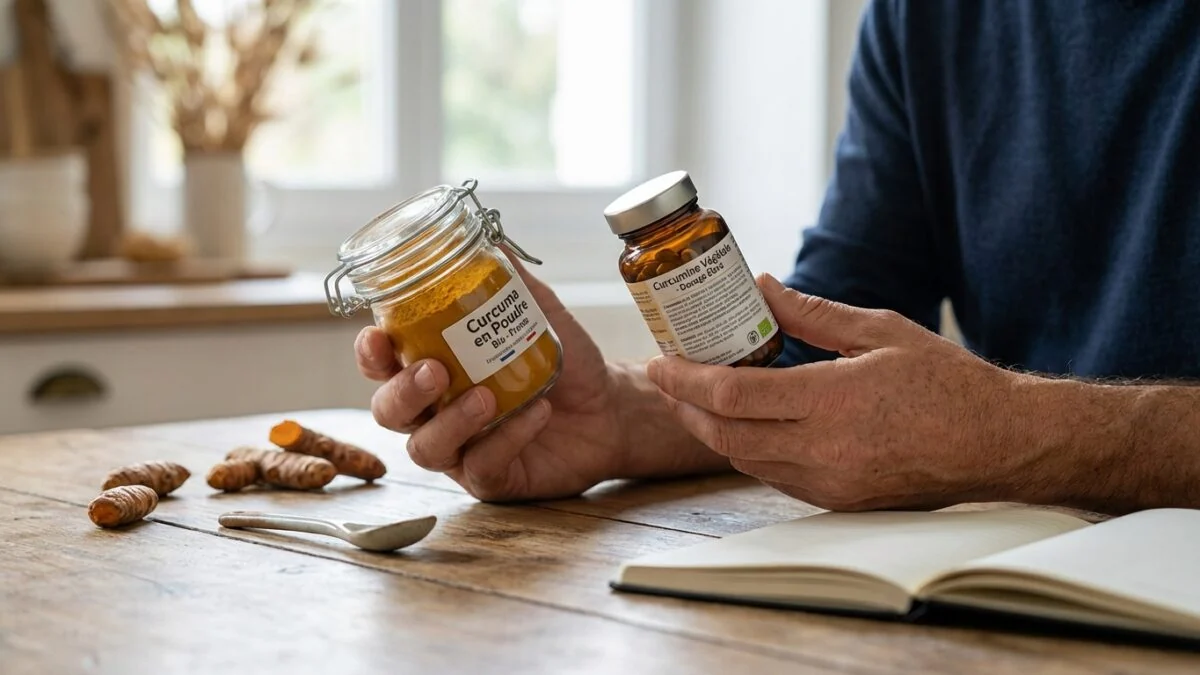
In the kitchen cupboard, turmeric remains a spice. In the bathroom, in the form of capsules, it often becomes a promise against painful knees. It is precisely this use that is being shaken up by a Cochrane review published on November 18, 2026.
Its results concern people with knee osteoarthritis: turmeric or curcumin supplements should not be considered a validated treatment for pain. The data suggest little or no clinically important improvement at best.
What have we really tested in these capsules?
The review does not focus on turmeric added to a dish, in usual culinary doses. She evaluates supplements taken orally : extracts from Curcuma longaproducts based on curcuminoids, including curcumin, with variable compositions and doses. These substances are studied for anti-inflammatory biological effects, but this is not enough to demonstrate a pain-relieving effect in patients.
The authors analyzed 9 clinical trials involving 1,245 peopleall suffering from knee osteoarthritis. The trials compared these supplements to a placebo, non-steroidal anti-inflammatory drugs or paracetamol. The studies were short, from four weeks to three months, and the products tested were very different from each other: this is an important limit for interpreting the results.
Why does this analysis dampen enthusiasm?
Compared to the placebo, the improvement in pain observed with turmeric appears weak: the Cochrane synthesis suggests a difference of approximately 0.72 points on a scale of 0 to 10, probably too modest to be felt as a real change by many patients. The effects on function and quality of life are also judged to be weak or non-existent, with a low level of confidence.
This is not to say that no person will ever feel better. But the review calls into question the idea of a solid, predictable and sufficient effect to replace osteoarthritis treatment. Comparisons with anti-inflammatories or paracetamol exist, but they remain limited and heterogeneous: they do not allow turmeric to be presented as a validated alternative to these treatments.
This conclusion is more cautious than that of some previous work, which suggested a possible benefit on pain or function. The difference is notably due to a stricter selection of tests and the attention paid to their reliability. For the reader, the message is less spectacular, but more useful:
a “natural” promise is not enough to provide effective treatment.
If you are already taking it, what should you check?
In France, the management of knee osteoarthritis is based primarily on better established measures: adapted physical activity, weight loss if necessary, rehabilitation depending on the situation, then analgesic or anti-inflammatory treatments when indicated and tolerated. The High Authority for Health recalls that
physical activity is a first-line treatment in osteoarthritis of a limb.
Turmeric as a supplement is not a trivial product either. ANSES has reported more than 100 reports of adverse effects likely to be linked to turmeric food supplements, including 15 hepatitis cases. The agency calls for particular vigilance with formulations intended to increase absorption, for example with piperine.
- Seek medical advice in case of bile duct disease;
- Always report these supplements if you are taking anticoagulants, anticancer drugs or immunosuppressants;
- For classic forms, ANSES indicates that intake via supplement should remain less than 153 mg per day of curcumin for an adult weighing 60 kg.
If your knee pain increases, if walking becomes more difficult or if you take more supplements to keep up, the right reflex is not to add one more capsule. It is to reassess the pain, mobility, treatments already taken and realistic objectives with a health professional.