
Behind this enigma dating back hundreds of millions of years lies a very concrete issue: better understanding serious diseases such as spinal muscular atrophy and amyotrophic lateral sclerosis.
Our brain has two stories from the first weeks of development
For decades, biologists have imagined a relatively simple scenario: the same population of embryonic cells would give rise to the entire brain, before gradually differentiating.
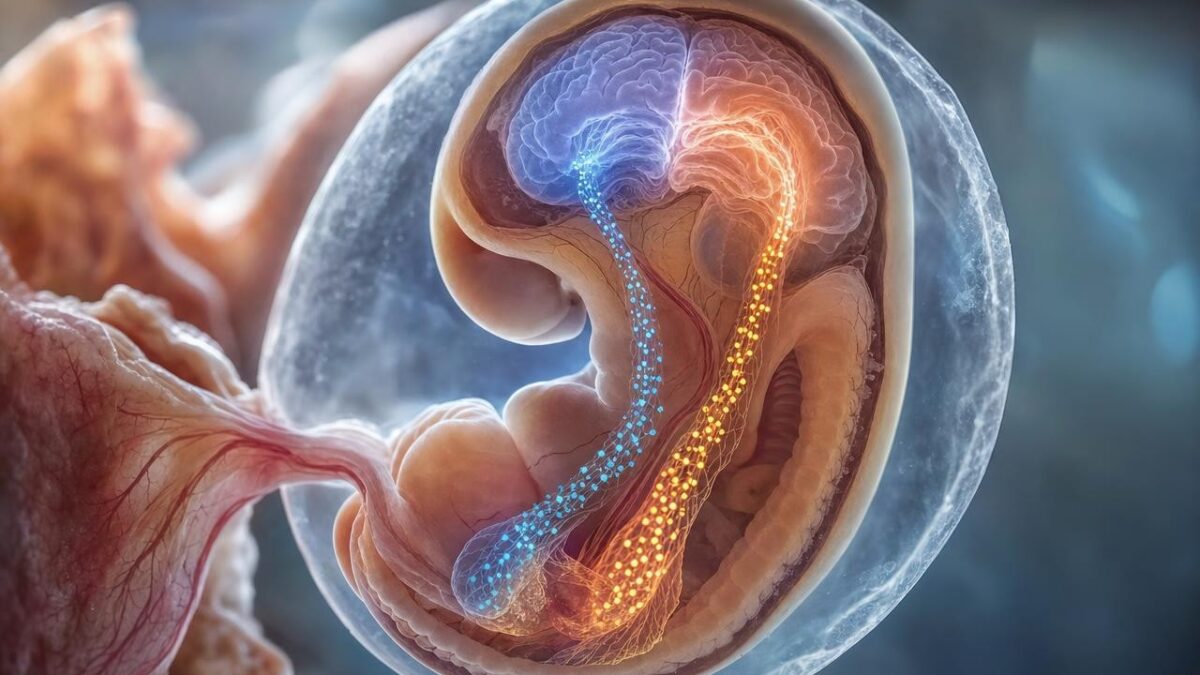
The work led by Kyle Loh, of Stanford Medicine, published on September 18, 2026 in Nature Neuroscienceoffer a completely different story. From gastrulation, a very early stage of embryonic development, two populations of progenitor cells appear in parallel.
- The first, characterized in particular by the expression of the gene
Otx2will give rise to the forebrain and the midbrain; - The second, expressing Gbx2will form the hindbrain, or hindbrain, which largely corresponds to the brainstem.
By studying mouse embryos using cell lineage tracing, researchers found that these two populations
never overlapeven in the early stages of their development.
“We have shown for the first time that the front of the brain comes from a completely different progenitor cell than the one that forms the back of the brain.” says Kyle Loh, Stanford Medicine.
A discovery which leads researchers to speak of two ancestral nervous systems, finally united to function as a single organ.
The brainstem: an essential part that researchers struggled to reproduce
This discovery could above all solve a very concrete problem in medical research. The brainstem controls vital and largely automatic functions: breathing, heart rate, sleep, hungerbut also certain movements of the face, tongue and throat essential for speech and swallowing.
However, this region is involved in several particularly severe neurological diseases, notablyspinal muscular atrophy (SMA) and the
amyotrophic lateral sclerosis (ALS). In these pathologies, certain motor neurons gradually degenerate, which can lead to difficulty swallowing and then breathing.
Until now, researchers had great difficulty producing human brainstem neurons in the laboratory. The study provides an explanation for this difficulty: the cells destined for the forebrain and those which will form the hindbrain have different organizations of their chromatinthat is to say the way in which their DNA is organized and made accessible.
By trying to transform cells destined for the forebrain into neurons of the brainstem, scientists were therefore, in a way, asking a cell to change trajectory when its identity was already largely defined.
“Previous attempts to make brainstem neurons likely attempted to push forebrain and midbrain progenitors to become brainstem cells, which our study shows is impossible.
Rayyan Jokhai, study co-first author, Stanford Medicine.
For the first time, functional human brainstem neurons
With this new understanding, the researchers restarted the process from a much earlier stage. From
human pluripotent stem cellsthey managed to obtain motor neurons corresponding to the brainstem.
These cells not only resemble neurons morphologically: they also exhibit expected functional characteristics. In particular, they produce
action potentialsthe electrical signals by which neurons communicate, and produce proteins characteristic of regions of the brainstem involved in the control of facial muscles and swallowing.
Much is at stake for research into SMA and ALS. Scientists now have a model allowing them to observe these neurons, understand what weakens them and test new therapeutic avenues.
It is not yet a treatment. But this is an important step: finally be able to study in the laboratory the human cells directly affected by these diseases.
Architecture 550 million years old
The researchers then traced the evolutionary thread. They found this organization in two lineages in several species, notably the chicken, the zebrafish and the acorn worm, a small marine animal very distant from humans.
According to their results, this architecture could date back to
about 550 million years.
“Our research suggests that evolution took two existing nervous systems and brought them together spatially” sums up Kyle Loh.
The idea is dizzying: our brain would function today as a unified organ, while its development retains traces of two ancestral nervous systems that have learned to work together.
For researchers, this new reading of brain development does not only tell the story of our brain. It could also provide a more precise method for manufacturing, studying and ultimately better understanding certain nerve cells that have until now been almost inaccessible.