

Ovarian cancer is often diagnosed at an advanced stage because symptoms such as bloating, pain, and pelvic heaviness are nonspecific and may go unnoticed. Treatment often involves surgery to remove as much of the tumor as possible, but there is currently no targeted treatment or effective method to detect recurrence. New therapeutic approaches for ovarian cancer are therefore essential.
Delivering treatments directly into the peritoneal cavity improves results, but current devices, derived from simple catheters, cause so many complications that more than 30% of patients stop even vital chemotherapy, according to the scientific article published in Device. To get around this blockage, an international team opted for a radically different approach.
Biomedical engineers from CÚRAM at the University of Galway, together with the University of Minnesota, MIT and the Wyss Institute, have designed a new rechargeable peritoneal implant against ovarian cancerdescribed in March 2026 in
Device. Placed in the peritoneal cavity and connected to a transcutaneous port, it can be recharged in treatment as many times as necessary, while allowing fluid samples to monitor the disease in real time. A concept designed to attack the tumor from the inside, but also the historical limits of catheters.
A rechargeable peritoneal implant that treats and monitors ovarian cancer
The implant is made of flexible biomaterial, with a porous membrane that allows drugs to gently diffuse into neighboring tissues. The researchers plan for the implant to be placed during the initial surgery to remove as much tumor tissue as possible, allowing any residual disease to be treated over the following weeks and months. The ultimate goal would be to leave the implant in place long term, to allow local monitoring for recurrence and early retreatment if necessary.
“One of the most frustrating aspects of treating ovarian cancer is that we know that localized delivery of treatment is more effective, but the tools we have had until now have not been adequate. We designed this implant with ovarian cancer patients in mind. We wanted an implant capable of delivering live cell therapies repeatedly, reliably and with high precision to the tumor level.“, explains Dr Aoibhín Sheedy, lead author at the University of Galway.
The same connection is also used to monitor the tumor microenvironment. Light suction is enough to bring back peritoneal fluid, containing cancer cells and immune cells, without additional invasive procedures. For Dr Eimear Dolan, co-leader of the study, “What excites us most is the bidirectional nature of this approach. It not only delivers live cell therapies, it allows us to visualize what is happening inside the peritoneal space. Clinicians could use it to monitor the activity of immune cells, the response of the tumor and adapt treatment accordingly. This type of real-time information is unprecedented in this context“.
What the first tests of the implant against ovarian cancer show
In a mouse model of ovarian cancerresearchers used the implant to deliver expanded natural killer (eNK) cells every week and three times a week interleukin-15, a key cytokine for their survival. The amount of tumor decreased more strongly than with the standard intraperitoneal injection, even though the total dose was the same. The implant remained fully functional for up to 70 days, with zero device-related complications, and provided better long-term tumor control, with a significant survival gain in mice treated via the implant compared to those receiving the same protocol by simple injection.
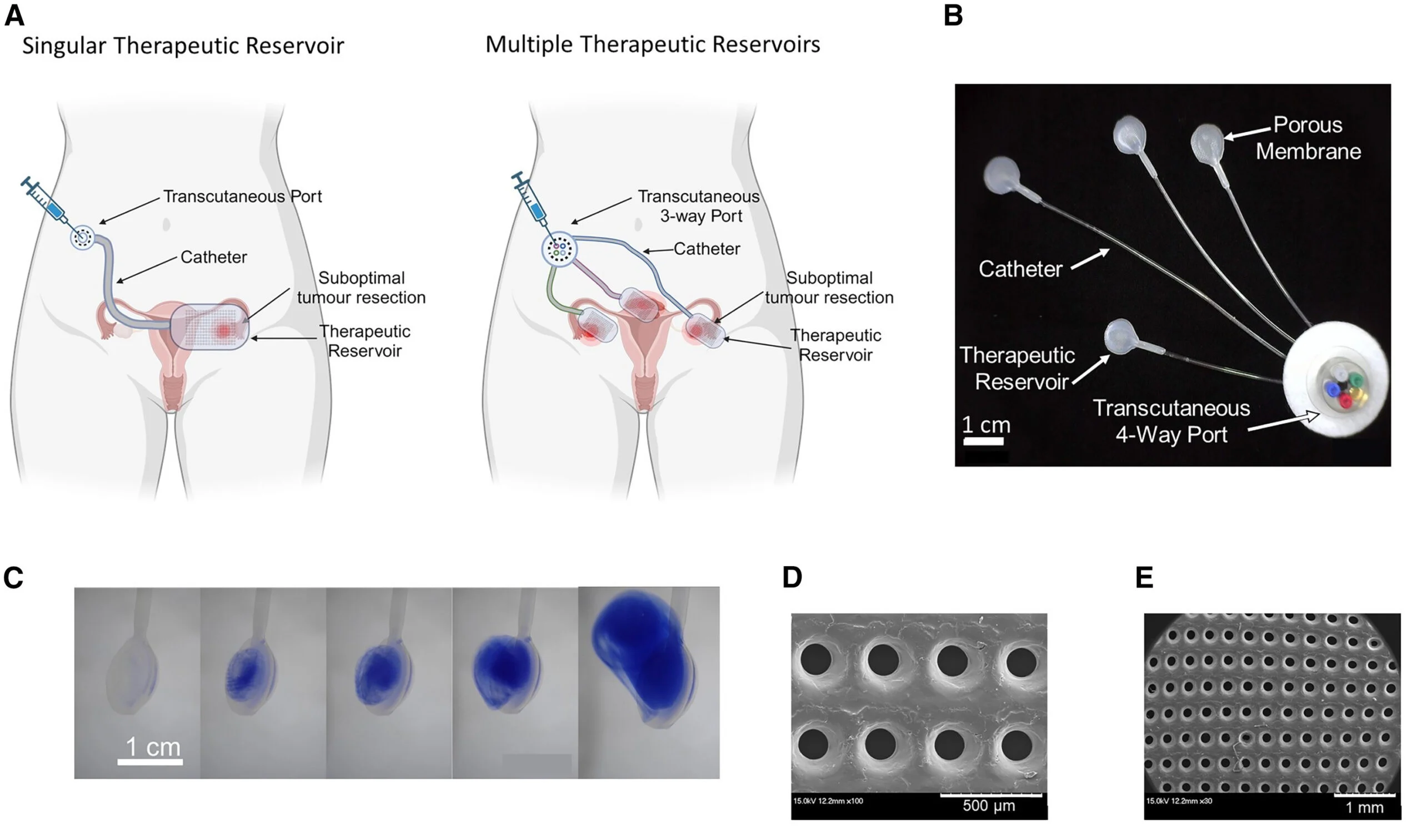 © Device (2026). DOI: 10.1016/j.device.2026.101050
The samples taken by the implant made it possible to detect both tumor cells and therapeutic eNK cells, and even to measure a marker of their maturity (CD16). In practice, this amounts to having a “window” continuously open to the peritoneal cavity to adjust the treatment: intensify the doses if the tumor returns, change the combination if the immune cells become exhausted.
A change in strategy still limited to animal models
These results come after two decades of debate on intraperitoneal chemotherapy: trials have shown up to 16 months more median survival compared to intravenous infusion, but less than half of eligible patients have access to it, in part because of catheter problems. In advanced forms, five-year survival falls to 46% in stage III and 26% in stage IV, recall the authors in Device. “This work represents a shift in how we think about ovarian cancer treatment, bringing therapy directly to the disease level while learning in real time from the tumor microenvironment, providing important insights to guide precision management“, underlines Professor Melissa Gellar, gynecologic oncologist at the University of Minnesota.
The implant remains at the preclinical stage for now, and the University of Galway insists that “additional studies are needed before this approach reaches clinical trials“. However, the team imagines that this same principle of a local and rechargeable platform could, ultimately, be applied to other cancers of the peritoneal cavity, such as gastric, colorectal or pancreatic cancers, where the disease remains confined in the abdomen but lacks targeted treatment tools and detailed monitoring as close as possible to the tumors.