

On an imaging report, one formula can change hope: no more detectable lesion. It is this detail that attracted attention around daraxonrasib, a tablet studied against metastatic pancreatic cancer, after a BBC article and an EORTC press release published in November 2026.
Combined with chemotherapy, the drug shows an encouraging signal, but in a small trial without a comparator group. This is neither a proven cure nor a new standard. And its European authorization concerns, to date, another use.
Tumors invisible to CT: what do we know?
The RMC-GI-102 trial evaluated thedaraxonrasib + gemcitabine/nab-paclitaxel combination in 61 people recently diagnosed with advanced and metastatic pancreatic cancer. According to the data presented by the EORTC-NCI-AACR, a radiological complete response was observed in 8.2% of patients : the lesions were no longer detectable on CT scan. The objective response reached 60.7%, and disease control 90.2%. The median time to recurrence or resumption of tumor growth was 12.8 months (median progression-free survival). Median follow-up was 18.3 months.
“This represents a potentially transformative advance in the first-line treatment of patients with metastatic pancreatic cancer, already surpassing the historical upper limit of overall survival of 8.5 to 11.1 months with conventional chemotherapy.”said Dr. Wungki Park, a medical oncologist specializing in gastroenterology at Memorial Sloan Kettering Cancer Center in New York.
These results are important in a disease where options remain limited, but their scope must remain precise: the study is phase I/II, non-randomized, without arms comparing the combination to chemotherapy alone, and sponsored by Revolution Medicines. In other words, it gives a signal, not definitive proof of superiority.
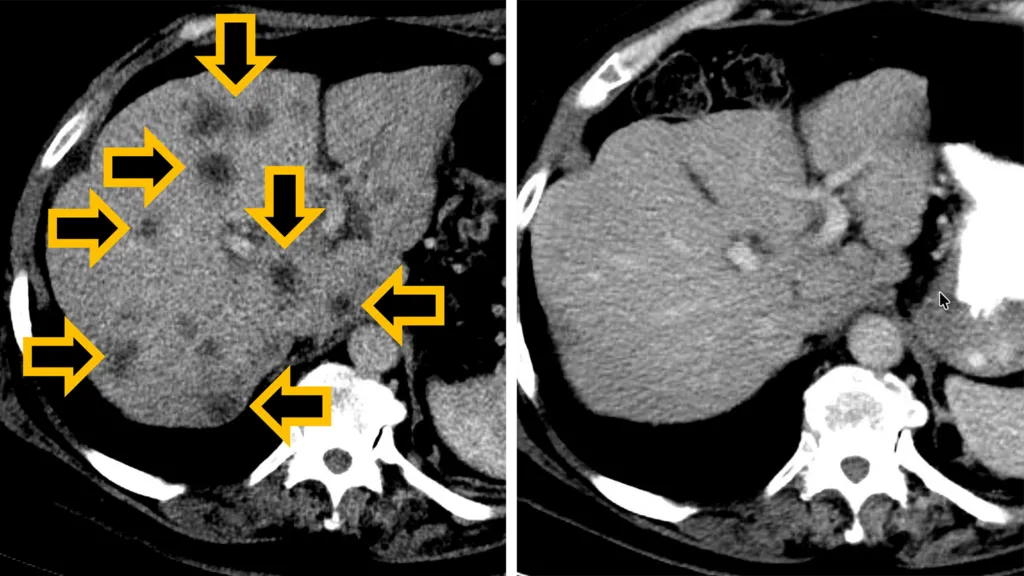 © Dr. Michael May/Dr. Wungki Park/Memorial Sloan Kettering Cancer Center/Press Association
Scans before (left) and after treatment with daraxonrasib combined with chemotherapy showing the disappearance of multiple tumors on CT.
Another essential nuance: a negative scan does not mean eradication of cancer. Tumor cells may persist at a level invisible on imaging, and the disease may return. This is why specialists are calling for larger, comparative trials capable of saying whether these responses translate into longer survival.
Why is this tablet of so much interest to oncologists?
Daraxonrasib targets abnormalities of the RAS family, including KRAS, involved in the growth of the majority of pancreatic cancers. These alterations have long been difficult to achieve with drugs. Seeing a tablet act on this pathway, in combination with chemotherapy used in the first line, explains the very strong attention surrounding these results.
But the status of the drug deserves to be distinguished from that of the combination tested here. Daraxonrasib has obtained European authorization under the name Rasonque, as monotherapy, in adults with metastatic pancreatic adenocarcinoma after at least one line of systemic treatment. True Medical had already detailed this context when Rasonque received the European green light.
What the current trial does not yet validate is the use of daraxonrasib straight away, with gemcitabine/nab-paclitaxel, in newly diagnosed metastatic patients. The actual availability and reimbursement in France must be verified in the French circuit of access to medicines.
What can a patient in France learn from it?
Pancreatic cancer is often discovered late. In mainland France, Public Health France reported an estimated 14,184 new cases and 11,456 deaths in 2018; the standardized 5-year net survival was 11% for people diagnosed between 2010 and 2015. It is this difficult prognosis that makes each potential breakthrough closely monitored.
However, this announcement should not lead to changing its support alone: do not interrupt or modify your treatment without the advice of the oncologist. Like any anticancer treatment, the combination also has reported side effects, including skin rash, diarrhea, fatigue and blood abnormalities related to chemotherapy.
Vigilance also remains valid in the face of persistent symptoms: jaundice, itching, dark urine, pale stools, unexplained loss of weight or appetite, marked fatigue, abdominal or back pain, fever or chills. They do not necessarily mean pancreatic cancer, but warrant medical advice. The next determining point will be the phase III trial announced to confirm, or not, this signal in the front line.