
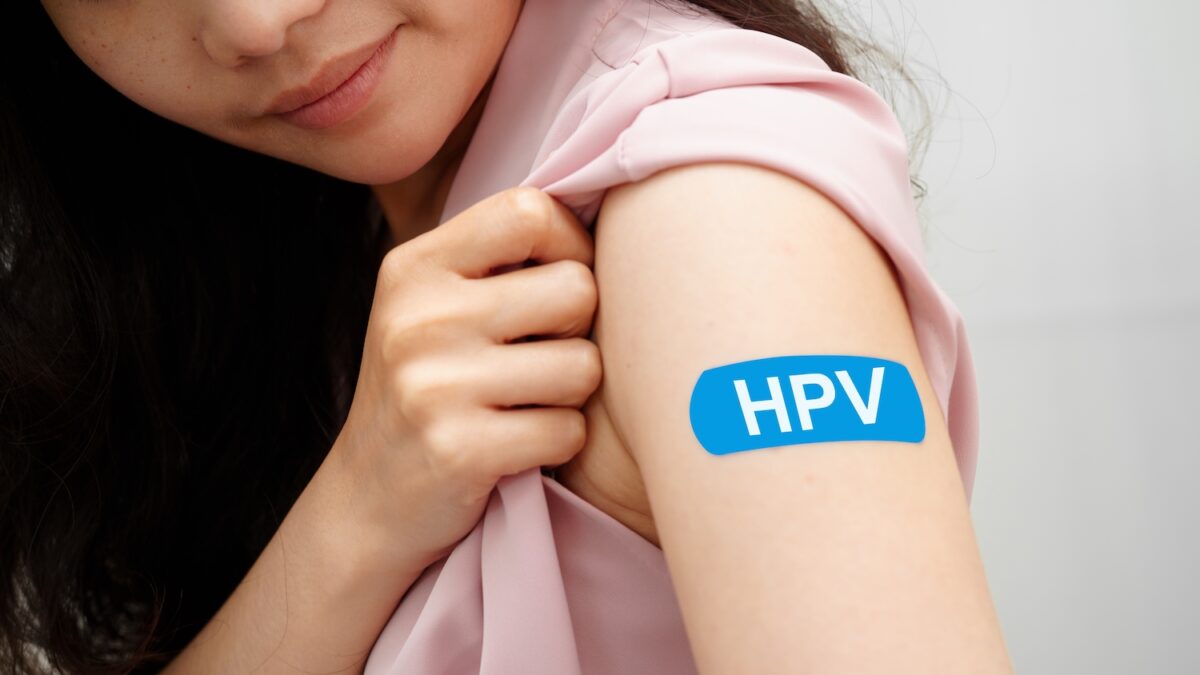
Between everyday scenes and the words of experts, “All protected against HPV” is aimed at everyone: parents, adolescents and young adults. Behind this campaign, a relentless medical reality that is still too little known.
A silent virus, a very real threat
They are invisible, often asymptomatic, and yet fearfully present. Human papillomaviruses, or HPV, are now responsible for more than 7,000 new cases of cancer each year in France. A reality which goes far beyond just cervical cancer – which represents 40% of cases – to also affect the ENT sphere, the anus, the vagina, the vulva and even the penis.
Globally, these viruses are the fifth leading cause of cancer. A considerable health burden, all the more striking as it could, for the most part, be avoided.
And yet, France is lagging behind worryingly. In 2023, only 44.7% of girls over 12 years old had a complete vaccination schedule. Among boys, this figure drops to 15.8%, far behind countries like Spain or the United Kingdom, where coverage exceeds 75%.
Behind these statistics, there are disrupted life trajectories, late diagnoses, heavy treatments. And a nagging question: why does such effective prevention remain so little used?
“This is the moment” : talking to parents, touching everyday life
To respond to this inertia, the Institut Curie chooses an unexpected path: that of the intimate, the everyday, the almost banal.
A first beard in front of the mirror. A wardrobe that has become too small. A mother who discreetly slips sanitary protection into a room. So many familiar scenes which mark the entry into adolescence – and which become, in the “It’s time”, subtle but powerful reminders: to protect your children at the right time.
These short videos, “tender and full of humor”, are aimed directly at parents. They avoid the alarmist tone in favor of a gentle, almost complicit approach. Because vaccination against HPV is recommended – and reimbursed – between the ages of 11 and 26.
The message is simple, but crucial: growing up also means being protected. The transition is natural, almost imperceptible. But it opens the way to another battle, even more complex: that against disinformation.
Fight preconceived ideas, restore confidence
Because if vaccination is slow to take hold, it is also because doubts persist. Too many doubts. Among adolescents and young adults, misconceptions circulate quickly: “It’s too late for me.”“This vaccine only concerns girls”“He’s dangerous.”. Faced with these beliefs, the second part of the campaign, “HPTrue“, gives the floor to the doctors.
In short and direct formats, they respond directly. Dr Enora Laas, Dr Manuel Rodrigues and Dr Diana Bello Roufai deconstruct false information, point by point.
At the heart of this approach, a strong conviction, held by Professor Anne-Vincent Salomon:
“HPV vaccination is one of the most powerful weapons we have to prevent certain cancers. There are still too many misconceptions about this vaccine, and the “All Protected Against HPV” campaign is a unique opportunity to correct them, with simple words and familiar faces. Because vaccinating a teenager against HPV today means preventing them from getting cancer tomorrow.”.
In these words, there is both scientific rigor and a form of contained urgency. That of a medicine which knows how, today, to prevent what it treated yesterday.
A fragile promise, a collective issue
The campaign has been broadcast since April 27, 2026 on social networks. But beyond the screens, it has a broader ambition: to change the outlook, restore confidence, make prevention obvious. Because the fight against HPV-related cancers does not only take place in laboratories or hospitals. It begins much earlier, in family discussions, in medical offices, in these sometimes trivial decisions which nevertheless affect the future.
Prevention rather than cure. A simple, almost obvious idea. And yet, still to be conquered.