

Get up, put your feet on the ground, take a few steps to the kitchen. This banal gesture actually requires a precise orchestration between brain, spinal cord and muscles, which thousands of paralyzed people can no longer trigger.
In them, the lesion of the spinal cord
acts like a cut cable: the brain sends the order, but the message no longer gets through. Australian and Canadian researchers are now testing an unexpected avenue for “reconnecting” this broken wire, thanks to diamond coated electrodes implanted in the heart of the nervous system.
Wires thinner than a hair to speak to one neuron at a time
In current neuroprostheses, such as those used for Parkinson’s disease, the electrodes are relatively large and rigid. They stimulate entire clusters of neurons, sufficient to reduce a tremor, but too coarse to drive the complex coordination of walking or to lodge safely in the spinal cord, a narrow structure. The spinal cord is a complex area: the areas to target are deep and fragile, and the spine is in constant movement.
Teams from the University of Melbourne have developed carbon fiber microelectrodes, five times thinner than a human hair and conduct electricity. Flexible to follow the movements of the body but rigid enough to penetrate the fabric, they remain well tolerated. Their tiny size makes it possible to place many “wires” capable of communicating with individual neurons using the body’s own electrical and chemical languages. A technique that opens the way to very fine control of walking signals, without causing injury.
Why diamond changes the lifespan of implants
But this fineness of the carbon fiber is not enough: over time, conventional micro-electrodes wear out, corrode and become covered in proteins which scramble the signal. The Melbourne physics laboratory, specialist in the growth of diamond (one of the hardest materials in the world), therefore covered these fibers with an ultrathin layer of conductive diamond, obtained by vapor phase deposition. The added thickness is approximately 1 µm, giving the fiber a total diameter of less than 10 µm, still very minimally invasive.
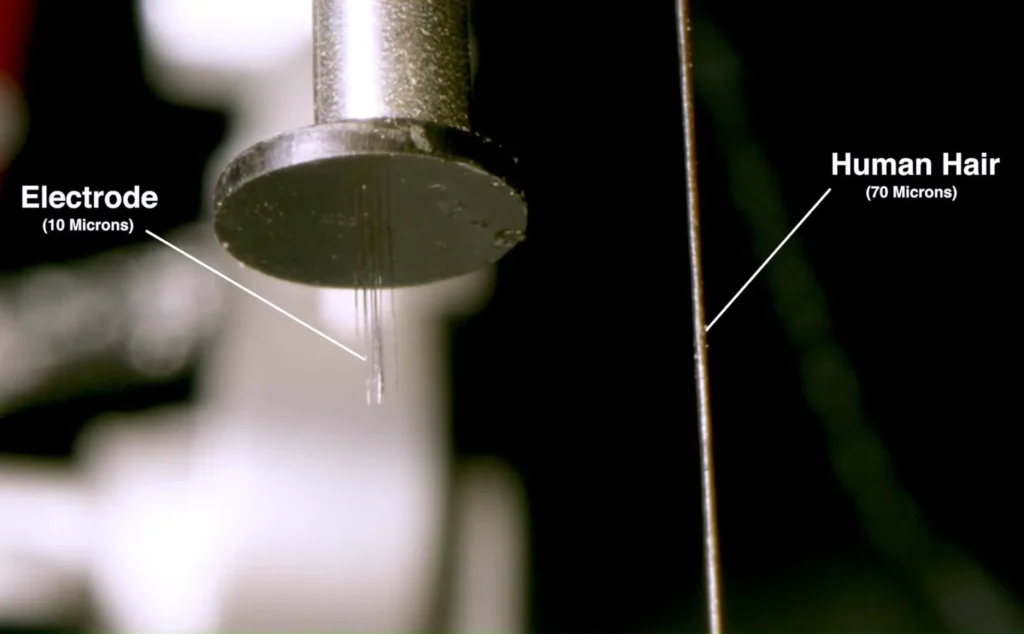 © The University of Melbourne
Carbon fiber electrodes are tiny compared to the thickness of a human hair.
Work carried out with the Mayo Clinic shows that these diamond fibers withstand hours of intensive electrochemical stimulation without degrading, while bare fibers literally end up “eaten away”. They also retain the sensitivity necessary to measure key molecules such as dopamine, a messenger involved in the control of movement. The idea is to obtain an interface capable of communicating with individual neurons and listening to them, without wearing out like traditional carbon fibers.
Towards a brain-marrow bridge to help certain patients walk again
Initial tests show they can be inserted deep enough to communicate with neurons in the spinal cord.
The next step is to show that these implants can actually sense movement intentions in the brain, then coordinately activate the walking circuits in the spinal cord, to bypass the lesion like a bridge. No paralyzed patient yet walks thanks to these diamond electrodes, but the preclinical results lay the building blocks for a future fully implantable and wireless neuro-implant, designed to last a very long time in the human body.