
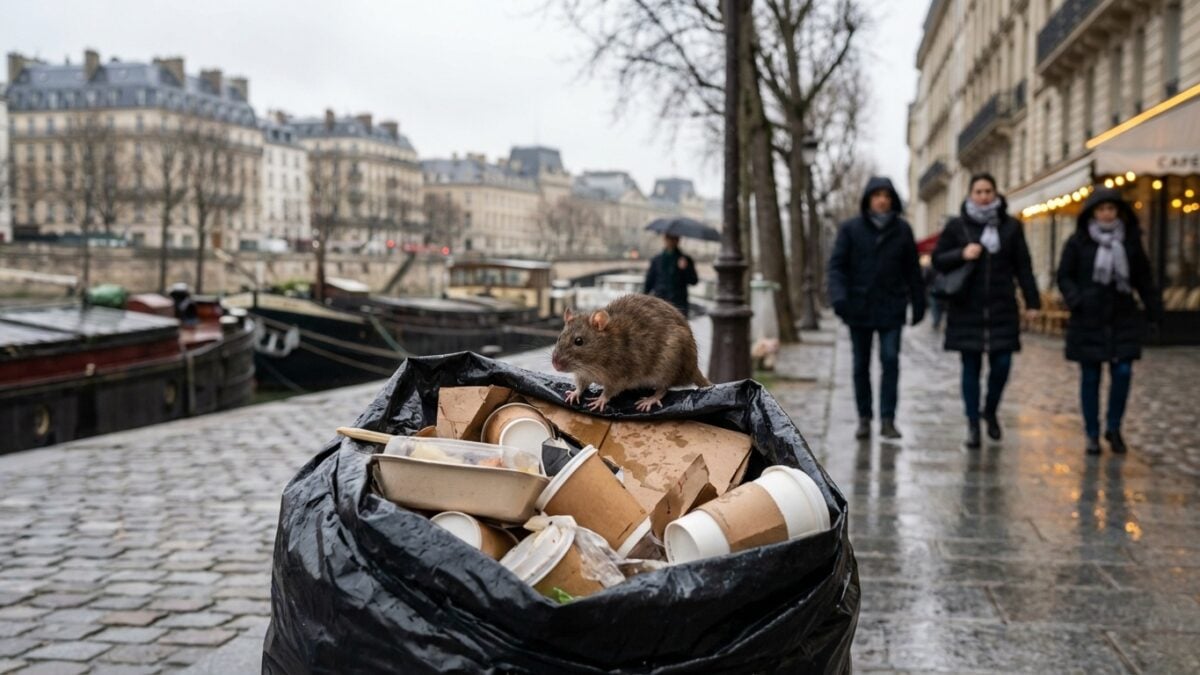
The images of Paris rats as big as cats circulate everywhere, between videos of the banks of the Seine and photos of overflowing trash cans. Repeatedly, the formula gives the impression that the capital is home to giant rodents capable of rivaling an adult feline.
Paris, however, has mostly very ordinary rodents, but extremely numerous. “We know that an adult rat eats around 25 grams per day. With three million rats, that’s 75 tons of waste per day“, explains Grégory Moreau, representative of the Animalist Party, cited by franceinfo. Between estimates of 2.5 million individuals and figures of up to 6 million deemed “fanciful”, according to the Paris town hall, a question arises: does their real size justify this fear?
Paris rats: present species and comparison with cats
In the capital, the vast majority of individuals belong to the
brown rator brown mouse (Rattus norvegicus). Suitable for sewers, cellars and gutters, it generally measures 20 to 25 cm body, with 15 to 20 cm tail, for 200 to 500 g. Specimens exceeding 1 kg exist, but remain rare. THE black rat (Rattus rattus), thinner and smaller, mainly frequents the attics of old buildings and stays away from the busiest areas.
In front of them, a domestic cat displays 40 to 50 cm of body, a tail of 25 to 30 cm and a weight of 3 to 5 kg, with some males reaching 6 kg. Even an exceptionally massive Norway rat therefore remains several times lighter than an adult cat. In the world, the largest “rat” type rodents, such as the Gambian giant rat (Cricetomys gambianus), can approach 90 cm for 2 kg, which is at best the size of a kitten, not a Parisian cat.
Why do some rats appear as big as cats?
When a rat emerges from a trash can or sewer at night, the dim light and surprise cause the brain to exaggerate its size. Seen from below on a sidewalk, an animal perched on a garbage bag suddenly seems enormous. The photos taken in very close-up, sometimes cropped or retouched, further reinforce this impression and fuel the rumor of giant rats in Paris on social networks.
The stories also become distorted each time they are told. A “big rat” becomes “almost a cat,” then “as big as a cat.” In this context, the raw population figures – between approximately 1 rat per capita, or 2.5 million, and much higher estimates – fuel the imagination. The central problem remains density and proximity to humans, not the appearance of a mutant species.
Paris rats: a mainly health danger, more than size
Biologically, even fed by the abundance of waste, housed in safe shelters and helped by mild winters, Parisian rats do not cross the threshold of adult cats. On the other hand, they reproduce very quickly, up to twelve young per litter and several litters per year. Their role as “garbage collectors” does not eliminate the risks: leptospirosis, transmitted through urine, has been described as a “real danger to public health”, warns the Academy of Medicine. “For healthy people, the risk is low,” explains Benoît Pisanu, ecology researcher at the National Museum of Natural History, quoted by Slate.
For residents, the discomfort comes mainly from the frequency of meetings, in parks or near restaurants. Between sometimes poor cleanliness, accessible waste and lack of predators, everything pushes rodents to settle in. Watching them dart under a bench can feel like you’re facing cat-sized monsters; in reality, it is mainly millions of small bodies that sneak into the same city.