
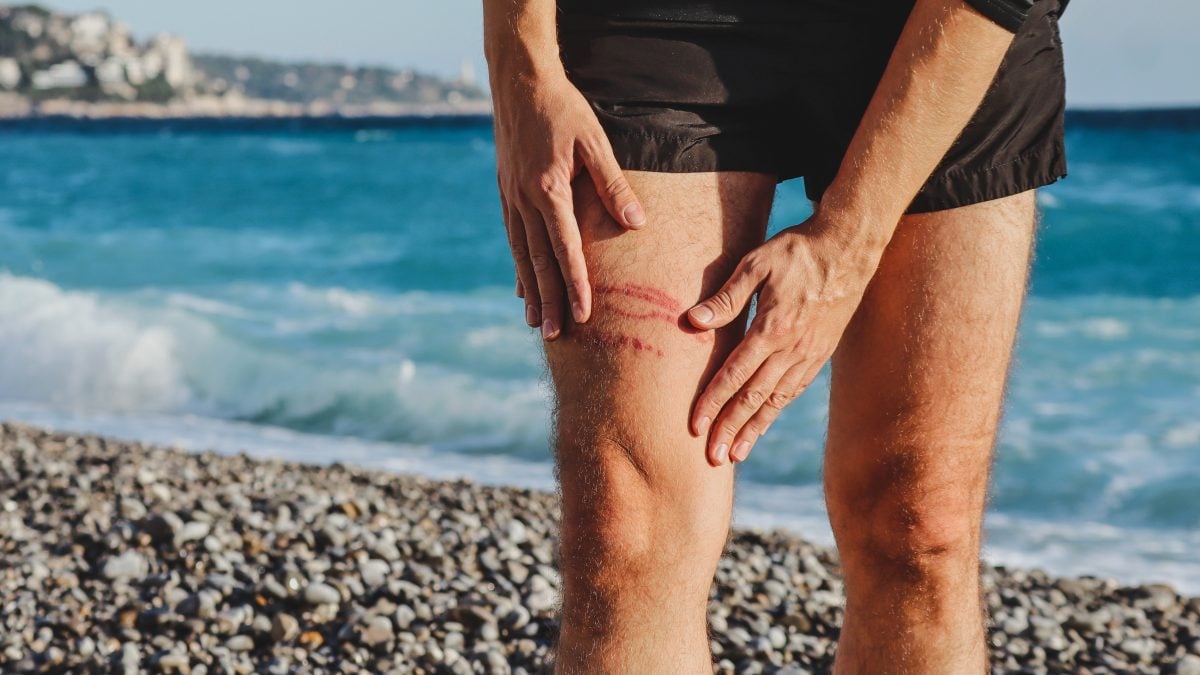
Last week, five beaches in the Basque Country had to “close” because of the presence of physalies. Behind this unfamiliar name, hides a formidable creature which threatens the tranquility (and health) of bathers. The “Portuguese hassle”, “physalie” or “sea bladder” stings … and can even lead to death. Dr. Gérald Kierzek, emergency physician and medical director of True Medical, explains how to spot and avoid their stinging filaments.
Where can we see these famous physalies?
Physalies have been regularly observed on the French coast in the Gulf of Gascogne or in the Mediterranean Sea for several years. But recently, they have taken up residence on the Basque and Landes coast, where the alert was given. Between Bidart and Anglet, five beaches hoisted the red flag. The prefect of the Landes even launched a call for caution on social networks. Because – should we specify it? – Physalies are not very convenient: their bites generate bright and multiple reactions and multiple reactions and skin (hives ..).
“Physalies (Portuguese galleys) look like jellyfish with stinging filaments”, Confirms Dr Gérald Kierzek. “They are found in the open sea, although they can be pushed to the coasts by the winds and currents, on the beaches (even stranded, they remain dangerous) and in frequented areas: Atlantic, Pacific, Indian Ocean, and sometimes in the Mediterranean.”
Be careful too “at periods at risk, when they are numerous, especially after storms or strong winds “, warns the medical director of True Medical.
In the open sea or on the beach, how to spot their filaments?
Since the “sea bladder” remains dangerous even once failed (its filaments retain their stinging power long after the death of the animal) it is essential to know how to identify it.
“The filaments (tentacles) of the physalies are transparent or bluish, which makes them very difficult to spot in the water. They can reach up to several meters long and discreet discreetly under the body of the physalie (which resembles a blue/purple swollen bag),” specifies the emergency doctor.
Therefore, two good reflexes must be adopted:
- “Avoid swimming where physalies have been reported”advocates Dr. Gérald Kierzek.
- “Beware even if you only see the” float “: the rest of the tentacles can be invisible”, The medical expert still warns.
What to do in case of bite?
Whether you are on the sea or by the beach, acting quickly is necessary:
- Immediately rinse the wound with sea water (especially no fresh water, which aggravates the burn);
- Remove the tentacle fragments with a pliers or a glove, without rubbing;
- Apply dry sand, then gently scrape the wound to remove the remaining stinging cells (with a CB type plastic card);
- Rinse the affected area in hot water (30-40 ° C) to relieve pain;
- Consult a doctor if serious symptoms appear (breathing difficulties, discomfort …).
On the side of bad reflexes to ban, there are also many:
“Never rub the skin, at risk if not to burst more stinging cells, forget the vinegar (it turns out to be ineffective on these wounds, unlike those caused by conventional jellyfish), and do not rine on the stung area. Finally, in case of contact with a Portuguese galley while swimming, immediately out of water”, concludes the medical director of True Medical.