
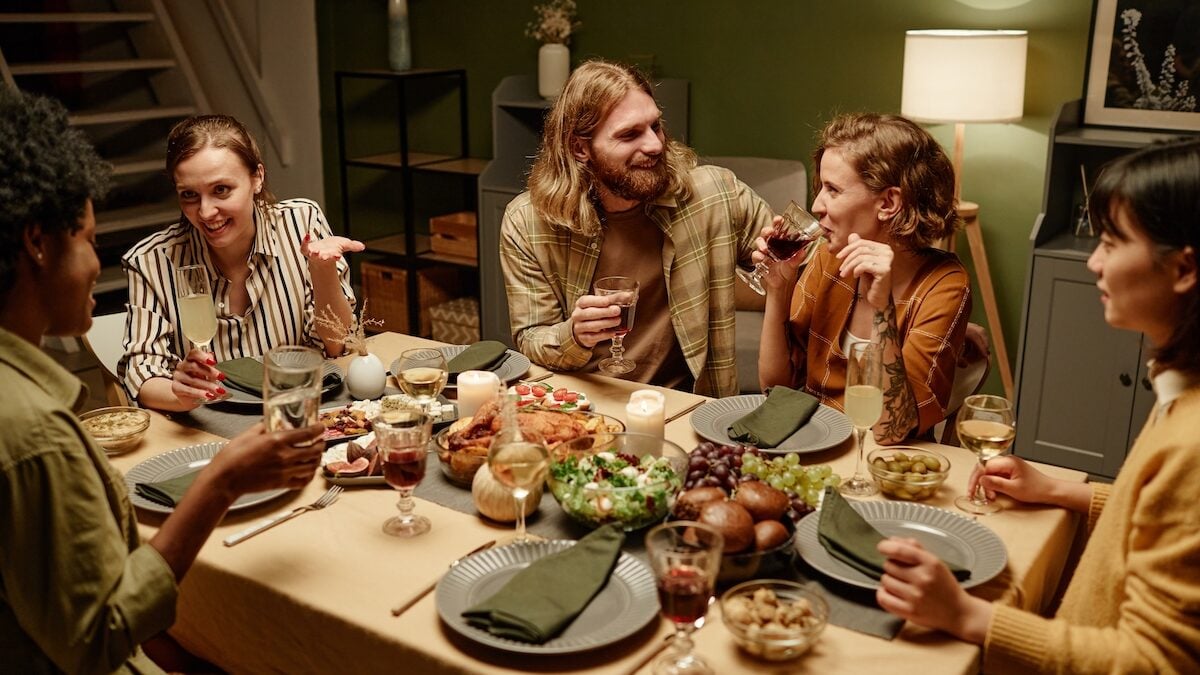
Some people are just waiting for one thing: to arrive at the weekend to go and unwind, go out, mingle with people. Others, on the other hand, avoid these events and favor moments in small groups, 4 around a table, at home if possible. Is it a lack of openness? Not really according to Amélie Boukhobza, who explains to us what this preference underlines.
“Some people love large tables, evenings where there are people, noise, where things move in all directions. And others… not at all,” observes the psychologist. For the latter, social pleasure does not necessarily come through crowds or agitation. They prefer conversations that take their time, confidences that happen naturally over a dinner, exchanges where we have the feeling of really connecting with others.
Another way to be sociable
In the collective imagination, liking small groups is often associated with introversion. However, the reality is much more nuanced. “It can sometimes be a reflection of introversion. Social anxiety too. Difficulty finding one’s place in the world…. But not always”specifies Amélie Boukhobza.
Some people simply like calmer, deeper interactions. Where large evenings can give an impression of dispersion, moments in small groups offer a more reassuring setting and more conducive to sincere exchanges.
For them, the problem is not the others, but the multiplication of requests: several conversations at the same time, loud music, constant noise, the impression of having to be everywhere at once.
“They need more calm to feel that they exist in the exchange”summarizes the psychologist.
When the brain needs less stimulation
This preference can also be linked to a form of mental saturation. Some people absorb a lot of information and emotion when they are in highly stimulating environments. After a few hours in a crowded evening, they can feel real mental fatigue, whereas others, on the contrary, feel energized.
In this case, seeking more intimate moments becomes a way of preserving your balance. And this can change depending on the period of life.
“When we are in high demand at work, as a parent, in an emotionally charged period… we may have less desire for socialization and more need for connections that rest rather than connections that stimulate”underlines Amélie Boukhobza.
In other words, preferring a quiet dinner to an all-night party does not necessarily reflect a fixed personality trait. It may simply reflect a need of the moment.
Prefer quality over quantity
For some people, what matters most is the intensity of the connections. They seek deeper exchanges, discussions that go beyond banalities, encounters that leave a mark. A meal for four can then seem much more emotionally nourishing than an evening spent meeting dozens of people without really interacting.
But watch out for shortcuts. As the psychologist reminds us, preferring small groups does not mean being “deeper”, “more authentic” or “more sensitive” than others. Conversely, liking big parties doesn’t mean that we avoid sincere relationships.
“Sometimes it’s just a taste. A different way to recharge your relationship batteries”, she concludes. Because ultimately, there is no one right way to be sociable, but just as many ways to feel good with others. And if it’s on his couch, that’s great too.