
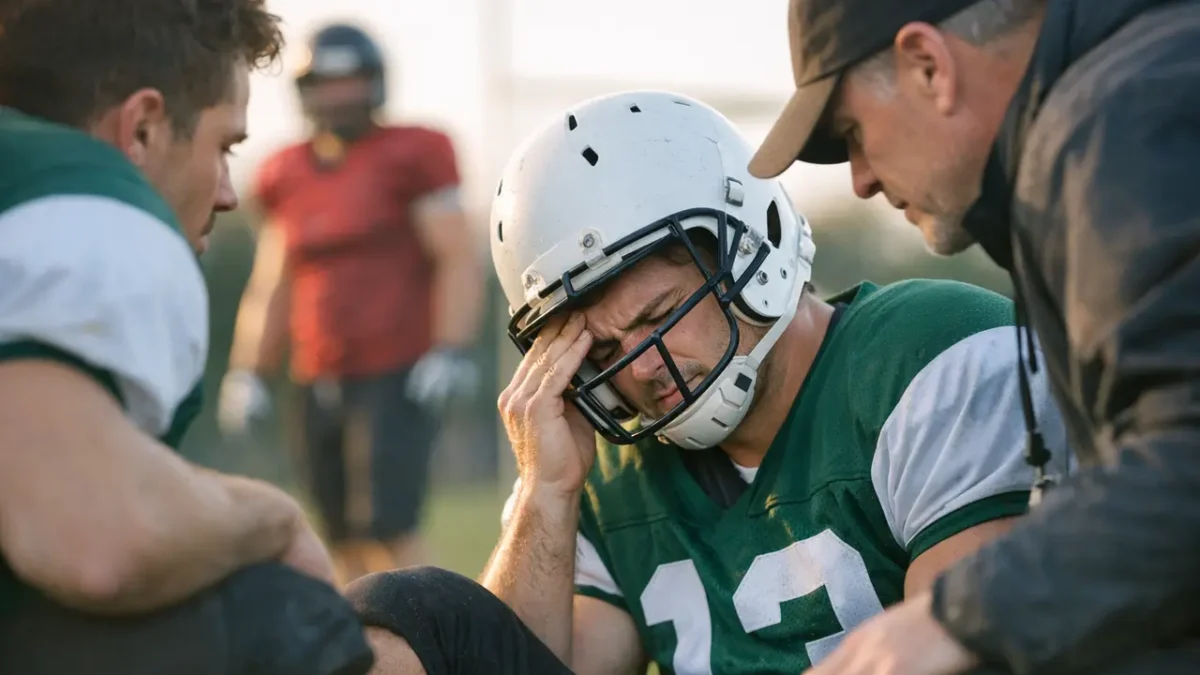
After a head impact in rugby, boxing or football, should you continue playing? The answer is simple: the priority reflex is to leave the field in case of doubt. In the show “The advice of Doctor Kierzek” on ICI, broadcast on November 9, 2026, the emergency doctor reminds us why.
Repeated shocks are especially worrying when they add up
The column is based on a very significant American study published in JAMA Network Open by Julia Gallini et al. It concerns former NFL players who died between 2008 and 2023. Among the 387 brains evaluated from donors, 362 presented chronic traumatic encephalopathy lesions, or 93.5%. After correcting for bias linked to brain donation, the authors estimate a prevalence of around 75% among the 2,362 former players who died over the period.
This figure is impressive, but it must be read correctly: it does not concern amateur athletes, nor all current contact sports players. Brains donated to science do not necessarily represent all former players, particularly because families may be more inclined to donate a brain when there was already a concern.
Dr. Kierzek describes chronic traumatic encephalopathyor ETC, as a degenerative brain disease linked to repeated impacts to the head. He cites memory lapses, difficulty concentrating, irritability or depression. But these signs remain non-specific: they are not sufficient to make a diagnosis of CTE in a living person. The doctor also insists on a major limitation: today, confirmation of certainty relies on examining the brain after death.
The nuance provided in the column is essential. Dr. Kierzek doesn’t say to stop exercising. On the contrary, he reminds us that the benefits of physical activity are immense. For him, the risk depends above all on cumulative exposure: years of repeated blows, particularly at high levels. His formula sums up the idea well: Sunday rugby is not the NFL. To better understand the link between American football, repeated shocks and brain degeneration, caution therefore consists of distinguishing occasional practice, intensive practice and history of shocks.
After a shock, the signs that require you to stop
The practical message of the column can be summed up in a few words: in the moment, we do not try to “hold on” at all costs. Dr. Kierzek cites several situations that should raise suspicion of a concussion after an impact to the head.
- Appearing lost or confused after impact;
- Holding your head or complaining of headaches;
- Show disorientation, balance problems or unusual behavior;
- Not remembering the action or shock clearly.
These signals are consistent with the principle recalled by the international Amsterdam consensus on sports-related concussion: recognize and remove from play. For readers who want to get back to basics, here are also the signs of a concussion after a head impact.
“When in doubt, we stop, we leave the field and we don’t say: it’s nothing.”
This reflex is not a sanction against the player: it aims to prevent a new shock from occurring when the brain may have just been affected. After discharge, Dr Kierzek suggests rest, then a gradual recovery, with medical advice requested. In practice, medical advice and protocols take precedence over the desire to resume immediatelyespecially in sports with contact, collision or risk of falling.
The federations have regulated these situations. In amateur rugby, the medical regulations of the French Rugby Federation provide for a blue card when a referee detects or suspects a concussion; it leads to the definitive exit of the player concerned. This framework aligns with previously documented concerns about the effects of repeated concussions in rugby.
Last point addressed in the column: the equipment. Helmet in amateur boxing, mouth guards, adapted equipment… they have their place, in particular to reduce certain dental or superficial trauma. But they do not make head impacts harmless and never replace leaving the game in the event of a suspected concussion.
The right guideline is therefore not to be afraid of the terrain, but to not trivialize a shock. Continuing sport remains beneficial;
continuing despite a possible concussion is not.
Additional sources
META DESCRIPTION: